

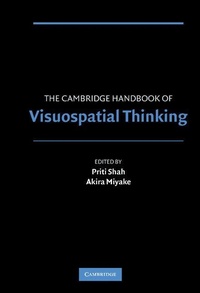
The Cambridge Handbook of Visuospatial Thinking
Published on 25. July 2005
Book
Hardback
580 pages
978-0-521-80710-4 (ISBN)
Description
The ability to navigate across town, comprehend an animated display of the functioning of the human heart, view complex multivariate data on a company's website, or to read an architectural blueprint and form a three-dimensional mental picture of a house are all tasks involving visuospatial thinking. The field of visuospatial thinking is a relatively diverse interdisciplinary research enterprise. An understanding of visuospatial thinking, and in particular, how people represent and process visual and spatial information, is relevant not only to cognitive psychology but also education, geography, architecture, medicine, design computer science/artificial intelligence, semiotics and animal cognition. The goal of this book, first published in 2005, is to present a broad overview of research on visuospatial thinking that can be used by researchers as well as students interested in this topic in both basic research and applied/naturalistic contexts.
Reviews / Votes
' ... a wonderful book for anyone who subscribers to the cognitive psychology paradigm.' American Journal of PsychologyMore details
Series
Language
English
Place of publication
Cambridge
United Kingdom
Target group
Professional and scholarly
College/higher education
Illustrations
8 Tables, unspecified; 4 Halftones, unspecified; 71 Line drawings, unspecified
Dimensions
Height: 235 mm
Width: 157 mm
Thickness: 35 mm
Weight
980 gr
ISBN-13
978-0-521-80710-4 (9780521807104)
Copyright in bibliographic data and cover images is held by Nielsen Book Services Limited or by the publishers or by their respective licensors: all rights reserved.
Schweitzer Classification
Other editions
Additional editions
Priti Shah | Akira Miyake
The Cambridge Handbook of Visuospatial Thinking
E-Book
07/2005
Cambridge University Press
€49.99
Available for download
Priti Shah
Cambridge Handbook of Visuospatial Thinking
E-Book
07/2005
Cambridge University Press
€41.99
Available for download
Persons
Akira Miyake is Associate Professor in the Department of Psychology at the University of Colorado, Boulder and a Faculty Fellow at the Institute of Cognitive Science. He has published in the areas of working memory, executive functions, language comprehension and spatial thinking in such journals as Cognitive Psychology and Journal of Memory and Language. Priti Shah is Assistant Professor in the Department of Psychology at the University of Michigan, Ann Arbor. She has published in the areas of spatial thinking, graphical display comprehension and working memory in such journals as Memory & Cognition, the Journal of Educational Psychology and Science Education.
Content
1. Functional significance of visuospatial representations Barbara Tversky; 2. Visuospatial images Daniel Reisberg and Friderike Heuer; 3. Disorders of visuospatial working memory Robert Logie and Sergio Della Sala; 4. Individual differences in spatial abilities Mary Hegarty and David Waller; 5. Sex differences in visuospatial abilities: more than meets the eye Diane F. Halpern and Marcia L. Collear; 6. Development of spatial competence Nora S. Newcombe and Amy E. Learmonth; 7. Navigation Daniel R. Montello; 8. Mapping the understanding of understanding maps Holly A. Taylor; 9. Spatial situation models Mike Rinck; 10. Design applications of visual spatial thinking: the importance of frame of reference Christopher D. Wickens, Michele Vincow and Michele Yeh; 11. The presentation and comprehension of graphically-presented data Priti Shah, Eric G. Freedman and Ioanna Vekiri; 12. Multimedia learning: guiding visuospatial thinking with instructional animation Richard E. Mayer.