

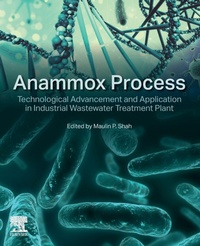
Anammox Process
Technological Advancement and Application in Industrial Wastewater Treatment Plant
Published on 16. August 2024
Book
Paperback/Softback
268 pages
978-0-443-19209-8 (ISBN)
Description
Anammox Process: Technological Advancement and Application in Industrial Wastewater Treatment Plant systematically summarizes studies on the effect of various operational factors on nitrogen removal performance, along with reactor type, mode of operation (batch or continuous), and cultured anammox bacterial species. The book lists the effect of potential anammox inhibition factors, such as high nitrite concentration, high salinity, sulfides, toxic metal elements, and toxic organic compounds and provides a thorough interpretation of the synergistic and antagonistic toxicity of these inhibitors. In addition, this updated resource suggests a strategy for the optimization of anammox processes for wastewater treatment, also stressing the importance of future studies.
More details
Language
English
Place of publication
Philadelphia
United States
Target group
Professional and scholarly
Product notice
Paperback (trade)
Unsewn / adhesive bound
Dimensions
Height: 228 mm
Width: 191 mm
Thickness: 24 mm
Weight
1124 gr
ISBN-13
978-0-443-19209-8 (9780443192098)
Copyright in bibliographic data and cover images is held by Nielsen Book Services Limited or by the publishers or by their respective licensors: all rights reserved.
Schweitzer Classification
Other editions
Additional editions
Maulin P. Shah
Anammox Process
Technological Advancement and Application in Industrial Wastewater Treatment Plant
E-Book
08/2024
Elsevier
€205.00
Available for download
Person
Dr. Maulin P. Shah is a distinguished environmental scientist, academician, and globally recognized expert in the fields of environmental biotechnology and sustainable
wastewater treatment. He has made significant contributions to advancing eco-friendly
technologies for pollution control, particularly through innovative biological treatment processes. Dr. Shah holds extensive academic and research experience, with a strong focus on
industrial wastewater treatment, bioremediation, and microalgae-based technologies. His work emphasizes the integration of sustainability principles with practical engineering solutions, helping industries reduce their environmental footprint.
Remarkably, Dr. Shah has edited over 300+ books covering a wide spectrum of cutting-edge domains, including industrial wastewater microbiology, bioremediation, biodegradation, algal biotechnology, biofuel, bioenergy, circular economy, metagenomics related to wastewater treatment, and enzyme engineering. This exceptional editorial contribution reflects his deep expertise and unparalleled commitment to advancing global knowledge in environmental science.
Over the years, he has also authored and contributed to numerous high-impact
research papers and scholarly books published by reputed international publishers. His
publications are widely cited and serve as essential references for researchers, academicians, and industry professionals worldwide.
He is actively associated as an Editorial Board Member in more than 30 high-reputed
international journals affiliated with leading organizations and publishers such as
International Water Association, American Chemical Society, Royal Society of Chemistry,
Elsevier, Springer, Taylor & Francis, Wiley, IOP Publishing, Apple Academic Press,
Scrivener Publishing, and Bentham Science Publishers. His extensive editorial involvement
highlights his leadership and recognition in the global scientific community.
Dr. Shah is widely recognized for his collaborative research with leading scientists
across the globe, promoting interdisciplinary solutions to complex environmental challenges.
His work effectively bridges the gap between fundamental research and real-world industrial
applications. In addition to his research excellence, he has been invited as a keynote speaker at numerous national and international conferences, where he shares valuable insights on sustainable development, wastewater management, and environmental innovation. He is also deeply committed to mentoring students and young researchers, fostering academic growth and inspiring future leaders in environmental science and engineering.
Beyond academia, Dr. Shah contributes to industry-oriented solutions and policy-
relevant research aimed at environmental protection, resource recovery, and sustainable
development. Through his relentless dedication and visionary approach, Dr. Maulin P. Shah
has established himself as a leading authority in environmental sustainability, committed to
building a cleaner, greener, and more sustainable future.
wastewater treatment. He has made significant contributions to advancing eco-friendly
technologies for pollution control, particularly through innovative biological treatment processes. Dr. Shah holds extensive academic and research experience, with a strong focus on
industrial wastewater treatment, bioremediation, and microalgae-based technologies. His work emphasizes the integration of sustainability principles with practical engineering solutions, helping industries reduce their environmental footprint.
Remarkably, Dr. Shah has edited over 300+ books covering a wide spectrum of cutting-edge domains, including industrial wastewater microbiology, bioremediation, biodegradation, algal biotechnology, biofuel, bioenergy, circular economy, metagenomics related to wastewater treatment, and enzyme engineering. This exceptional editorial contribution reflects his deep expertise and unparalleled commitment to advancing global knowledge in environmental science.
Over the years, he has also authored and contributed to numerous high-impact
research papers and scholarly books published by reputed international publishers. His
publications are widely cited and serve as essential references for researchers, academicians, and industry professionals worldwide.
He is actively associated as an Editorial Board Member in more than 30 high-reputed
international journals affiliated with leading organizations and publishers such as
International Water Association, American Chemical Society, Royal Society of Chemistry,
Elsevier, Springer, Taylor & Francis, Wiley, IOP Publishing, Apple Academic Press,
Scrivener Publishing, and Bentham Science Publishers. His extensive editorial involvement
highlights his leadership and recognition in the global scientific community.
Dr. Shah is widely recognized for his collaborative research with leading scientists
across the globe, promoting interdisciplinary solutions to complex environmental challenges.
His work effectively bridges the gap between fundamental research and real-world industrial
applications. In addition to his research excellence, he has been invited as a keynote speaker at numerous national and international conferences, where he shares valuable insights on sustainable development, wastewater management, and environmental innovation. He is also deeply committed to mentoring students and young researchers, fostering academic growth and inspiring future leaders in environmental science and engineering.
Beyond academia, Dr. Shah contributes to industry-oriented solutions and policy-
relevant research aimed at environmental protection, resource recovery, and sustainable
development. Through his relentless dedication and visionary approach, Dr. Maulin P. Shah
has established himself as a leading authority in environmental sustainability, committed to
building a cleaner, greener, and more sustainable future.
Content
1. Characterization of the start-up of single and two-stage Anammox processes with real low-strength wastewater treatment
2. Performance of Anammox Processes for Wastewater Treatment
3. Biological nitrogen removal by the anaerobic ammonium oxidation (anammox) process
4. Recent Advances in Anammox Bioreactors for Industrial Wastewater Reuse
5. Applications of anammox process
6. Mainstream application of anammox process
7. Immobilization of anammox biomass
8. Preservations of anammox biomass
9. Strategies for controlling denitritation
10. Effect of operational conditions on anammox bacterial community
11. Autotrophic nitrogen removal technologies
12. Microbiology and application of the anammox process
13. Influence of effluent recirculation on the performance of Anammox process
14. Anammox performance, granulation, and microbial response under COD disturbance
15. Physiological and kinetic characterization of a suspended cell anammox culture
16. Development of long-term stable partial nitrification and subsequent anammox process
17. Future prospects of anammox process
2. Performance of Anammox Processes for Wastewater Treatment
3. Biological nitrogen removal by the anaerobic ammonium oxidation (anammox) process
4. Recent Advances in Anammox Bioreactors for Industrial Wastewater Reuse
5. Applications of anammox process
6. Mainstream application of anammox process
7. Immobilization of anammox biomass
8. Preservations of anammox biomass
9. Strategies for controlling denitritation
10. Effect of operational conditions on anammox bacterial community
11. Autotrophic nitrogen removal technologies
12. Microbiology and application of the anammox process
13. Influence of effluent recirculation on the performance of Anammox process
14. Anammox performance, granulation, and microbial response under COD disturbance
15. Physiological and kinetic characterization of a suspended cell anammox culture
16. Development of long-term stable partial nitrification and subsequent anammox process
17. Future prospects of anammox process