

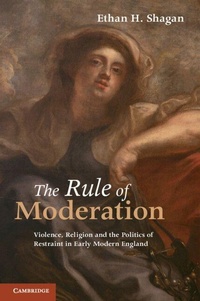
The Rule of Moderation
Violence, Religion and the Politics of Restraint in Early Modern England
Published on 29. September 2011
Book
Paperback/Softback
396 pages
978-0-521-13556-6 (ISBN)
Description
Why was it that whenever the Tudor-Stuart regime most loudly trumpeted its moderation, that regime was at its most vicious? This groundbreaking book argues that the ideal of moderation, so central to English history and identity, functioned as a tool of social, religious and political power. Thus The Rule of Moderation rewrites the history of early modern England, showing that many of its key developments - the via media of Anglicanism, political liberty, the development of empire and even religious toleration - were defined and defended as instances of coercive moderation, producing the 'middle way' through the forcible restraint of apparently dangerous excesses in Church, state and society. By showing that the quintessentially English quality of moderation was at heart an ideology of control, Ethan Shagan illuminates the subtle violence of English history and explains how, paradoxically, England came to represent reason, civility and moderation to a world it slowly conquered.
Reviews / Votes
'This is a lively and provocative, but also deeply illuminating and richly suggestive work from one of the most original and stimulating historians currently working in the early modern period. Professor Shagan scores many a palpable hit in this wonderfully sustained critique of early modern historians' sloppy tendency to essentialize 'moderation' and 'moderate', and to misread these terms' relative, polemical function in the sources of the period. It should be required reading for all those working on early modern British history.' Anthony Milton, University of Sheffield 'Discussion of England's religious moderation has over the centuries been attended by much woolly thinking and some downright intellectual and historical dishonesty. There can be few people better able than Ethan Shagan to take a scalpel to this body of material, given the sophistication and detachment of his historical analysis and his ability to look at old problems in new ways.' Diarmaid MacCulloch, University of Oxford 'A profound and important book, which deserves to be widely discussed and debated. Shagan issues a provocative challenge to complacent acceptance of claims about the intrinsic or relative 'moderation' of England's church, system of government, and empire, from pre-modern into modern times.' Peter Marshall, University of WarwickMore details
Language
English
Place of publication
Cambridge
United Kingdom
Target group
Professional and scholarly
Product notice
Paperback (trade)
Illustrations
9 Halftones, unspecified
Dimensions
Height: 229 mm
Width: 152 mm
Thickness: 21 mm
Weight
572 gr
ISBN-13
978-0-521-13556-6 (9780521135566)
Copyright in bibliographic data and cover images is held by Nielsen Book Services Limited or by the publishers or by their respective licensors: all rights reserved.
Schweitzer Classification
Other editions
Additional editions
Ethan H. Shagan
The Rule of Moderation
Violence, Religion and the Politics of Restraint in Early Modern England
Book
09/2011
Cambridge University Press
€116.60
Shipment within 15-20 days
Person
Ethan H. Shagan is Associate Professor of History and Director for the Center for British Studies at the University of California, Berkeley. He is the author of Popular Politics and the English Reformation (Cambridge University Press, 2002) which won numerous prizes including the Royal Historical Society's Whitfield Prize and the American Historical Association's Morris Forkosch Prize, and is editor of Catholics and the 'Protestant Nation': Religious Politics and Identity in Early Modern England (2005).
Content
Part I. Moderate Foundations: Introduction; 1. The bridle of moderation; Part II. Moderate Churches: 2. Violence and the via media in the reign of Henry VIII; 3. Conformist moderation; 4. Puritan moderation; Part III. Moderate Rule: 5. English expansion and the empire of moderation; 6. Social moderation and the governance of the middle sort; 7. Moderate freedom in the English Revolution; 8. Toleration became moderate in seventeenth-century England; Conclusion.