

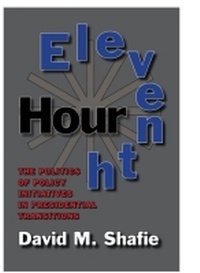
Eleventh Hour
The Politics of Policy Initiatives in Presidential Transitions
Will be published approx. on 31. August 2013
Book
Hardback
248 pages
978-1-60344-954-0 (ISBN)
Description
President Jimmy Carter issued last-minute rules immediately before leaving the White House, creating frustration for the incoming Reagan Administration. As George W. Bush prepared to cede the Oval Office to Barack Obama almost three decades later, he ordered more than thirty last-minute policy changes, quickly finalizing the rules before the Obama Administration could overturn them.
Presidents are able to bypass Congress and quietly initiate significant policy changes by using the executive branch's authority to alter existing statutes. In Eleventh Hour: The Politics of Policy Initiatives in Presidential Transitions, David M. Shafie analyses how and why five successive presidents have done so at the end of their administrations, offering important new insights for the growing study of the administrative presidency.
After assessing transcripts of speeches and staff communications, such as memos from the White House Domestic Policy offices, memos from selected regulatory agencies and the Office of Management and Budget, as well as records in the Clinton, Reagan, George (H. W.) Bush, and Carter Presidential Libraries, Shafie also conducted in-depth interviews with administration personnel charged with formulating and implementing the executive rule changes. Based on his research, Shafie explains end-of-term rulemaking as an instrument of presidential prerogative power by mapping its evolution through five recent presidential transitions and exploring its effectiveness, consequences, and implications.
Giving consideration to recent efforts to limit interregnum rulemaking and to overturn specific late-term rules, as well as evaluating the prospects for future presidents to favour this instrument to advance their unfinished domestic policy priorities, Eleventh Hour offers groundbreaking research into the uses of executive power.
Presidents are able to bypass Congress and quietly initiate significant policy changes by using the executive branch's authority to alter existing statutes. In Eleventh Hour: The Politics of Policy Initiatives in Presidential Transitions, David M. Shafie analyses how and why five successive presidents have done so at the end of their administrations, offering important new insights for the growing study of the administrative presidency.
After assessing transcripts of speeches and staff communications, such as memos from the White House Domestic Policy offices, memos from selected regulatory agencies and the Office of Management and Budget, as well as records in the Clinton, Reagan, George (H. W.) Bush, and Carter Presidential Libraries, Shafie also conducted in-depth interviews with administration personnel charged with formulating and implementing the executive rule changes. Based on his research, Shafie explains end-of-term rulemaking as an instrument of presidential prerogative power by mapping its evolution through five recent presidential transitions and exploring its effectiveness, consequences, and implications.
Giving consideration to recent efforts to limit interregnum rulemaking and to overturn specific late-term rules, as well as evaluating the prospects for future presidents to favour this instrument to advance their unfinished domestic policy priorities, Eleventh Hour offers groundbreaking research into the uses of executive power.
More details
Series
Language
English
Place of publication
College Station
United States
Illustrations
Table. 9 figures. Appendix. Bib. Index.
Dimensions
Height: 229 mm
Width: 152 mm
Thickness: 20 mm
Weight
456 gr
ISBN-13
978-1-60344-954-0 (9781603449540)
Copyright in bibliographic data and cover images is held by Nielsen Book Services Limited or by the publishers or by their respective licensors: all rights reserved.
Schweitzer Classification
Person
David M. Shafie, an assistant professor of political science at Chapman University in Orange, California, is coauthor of Rethinking California: Politics and Policy in the Golden State. He also writes extensively on environmental politics and policy. He holds a doctorate from the University of Southern California.