

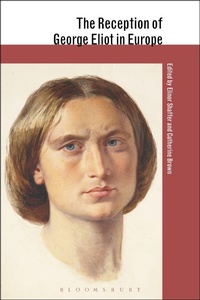
The Reception of George Eliot in Europe
Published on 11. February 2016
Book
Hardback
512 pages
978-1-4411-9022-2 (ISBN)
Description
George Eliot (born Mary Ann Evans, 1819-1880) was one of the most important writers of the European nineteenth century, as well as a pioneering translator of challenging and controversial Continental thinkers, and an influential editor and essayist. Although such novels of provincial life as Adam Bede, The Mill on the Floss and Middlemarch have seen her characterised as a thoroughly English writer, her reception and immersion in the literary, intellectual and political life of Europe was remarkable. Written by a team of leading international scholars, The Reception of George Eliot in Europe is the first comprehensive and systematic survey of Eliot's place in European culture. Exploring Eliot's deep knowledge of German literature and thought, her galvanizing influence on women novelists and translators in countries as diverse as Sweden and Spain, her travels in Holland, Germany, Switzerland, Austria, the Czech Lands, Italy, and Spain and her friendship with leading figures such as Mazzini, Turgenev, and Liszt, this study reveals her full stature as a cosmopolitan writer and thinker. A film of her Italian Renaissance novel Romola was one of the first to circulate in Europe.
Including an historical timeline and a comprehensive bibliography of primary and secondary sources and translations, The Reception of George Eliot in Europe is an essential reference resource for anyone working in the field of Victorian Literature or the European nineteenth century.
Including an historical timeline and a comprehensive bibliography of primary and secondary sources and translations, The Reception of George Eliot in Europe is an essential reference resource for anyone working in the field of Victorian Literature or the European nineteenth century.
Reviews / Votes
Begun in 2002, Bloomsbury's "The Reception of British and Irish Authors in Europe" series offers comprehensive, erudite coverage of geopolitical or translation contexts for individual authors. This volume on how George Eliot was received across hostile, friendly, or historically shifting borders over a tumultuous 150 years addresses numerous questions: Who cared that "he" was a woman? Who didn't? Who published her? Which works? When? In English or translation? How good were the translations? How many copies sold? Read in libraries? How much political, social, or literary favor or hostility appears in the texts-or the margins? The essays vary in length, depth, density, and variety of authorship, method, and style, but readers favoring a particular geography or work will find surprises. Eliot was sensitive to social stratification, so this reviewer found the essays on the shifting geopolitical contexts of Germany and former Soviet bloc countries the liveliest and most layered. Italians of course fixated on Romola-but who knew that Hollywood exploited both romantic Gish sisters, Lillian and Dorothy, to make it into a 1924 blockbuster? The volume includes a vast bibliography. Summing Up: Recommended. Upper-division undergraduates through faculty. * CHOICE * Important sociopolitical connections emerge from the pictures of individual countries, giving the reader a broad view of not only the responses of Eliot's contemporary audience, but the far-reaching ripples of her impact over time. This combination of narrow focus on single countries, the detailed examination of Eliot's works in translation, and the high-level overview that emerges of the nineteenth-century literary landscape will be of most use to more advanced students and scholars who wish to dig deeply into Eliot's legacy and enduring relevance. * American Reference Books Annual * An interesting account of the reception of Eliot's work across Europe ... We find much insight on Eliot's creative progress and intellectual background. * Revista de Filologia Inglesa *More details
Series
Language
English
Place of publication
New York
United States
Publishing group
Bloomsbury Publishing Plc
Dimensions
Height: 240 mm
Width: 161 mm
Thickness: 32 mm
Weight
925 gr
ISBN-13
978-1-4411-9022-2 (9781441190222)
DOI
CBID162334
Copyright in bibliographic data and cover images is held by Nielsen Book Services Limited or by the publishers or by their respective licensors: all rights reserved.
Schweitzer Classification
Other editions
Additional editions

Elinor Shaffer | Catherine Brown
The Reception of George Eliot in Europe
E-Book
02/2016
1st Edition
Bloomsbury Academic USA
€595.99
Available for download

Elinor Shaffer | Catherine Brown
The Reception of George Eliot in Europe
E-Book
02/2016
1st Edition
Bloomsbury Academic USA
€595.99
Available for download
Persons
Elinor Shaffer is a Fellow of the British Academy, (Hon.) Professor, University College London, UK, and Senior Research Fellow, Institute of Modern Languages Research, School of Advanced Study, University of London. She is the Director of Research and Series Editor of the Reception of British and Irish Authors in Europe, of which The Reception of George Eliot in Europe is the twenty-first volume. She is also author of 'Kubla Khan' and The Fall of Jerusalem: the Mythological School in Biblical Criticism and Secular Literature (1980), which begins with Coleridge and concludes with a study of Daniel Deronda; author of the Introduction to the Everyman Middlemarch; and "The Sound of Grass Growing": Eliot in Weimar', a lecture to the Goethe Society. She is a founder-member of the British Comparative Literature Association and founder-editor of Comparative Criticism.
Catherine Brown is Head of the English Faculty and Senior Lecturer in English at the New College of the Humanities, London, UK. She is the author of The Art of Comparison: How Novels and Critics Compare (2011), which considers the nature of comparison per se using the case studies of George Eliot's Daniel Deronda, Lev Tolstoy's Anna Karenina, and D.H. Lawrence's
Catherine Brown is Head of the English Faculty and Senior Lecturer in English at the New College of the Humanities, London, UK. She is the author of The Art of Comparison: How Novels and Critics Compare (2011), which considers the nature of comparison per se using the case studies of George Eliot's Daniel Deronda, Lev Tolstoy's Anna Karenina, and D.H. Lawrence's
Content
Series Editor's Preface
Elinor Shaffer
Acknowledgements
List of Contributors
Abbreviations
Timeline
Catherine Brown and Elinor Shaffer
Introduction
Elinor Shaffer and Catherine Brown
Northern Europe
Germany
1. The Reception of George Eliot in Germany during her Lifetime
Gerlinde Roeder-Bolton
2. George Eliot in East, West and Reunified Germany, 1949-2013
Annika Bautz
Netherlands
3. George Eliot in the Netherlands Diederik van Werven
Scandinavia
4. "Spirit of the Age(s)": The Reception of George Eliot in Sweden
Git Claesson Pipping and Catherine Sandbach Dahlstroem
5. George Eliot's Reception in Denmark
Ebbe Klitgard
6. George Eliot in Norway: The Enthusiasm that Petered Out
Marie Nedregotten Sorbo
Southern Europe
France
7. The Reception of George Eliot in France
Alain Jumeau
Italy
8. The Reception of George Eliot in Italy: 1868 to the Present
Maria-Luisa Bignami
9. The Early Italian Reception of Romola
Franco Marucci
10. Romola in England and Italy. With Timeline of Romola
Francesca Bugliani
Spain
11. George Eliot in Spain
Maria Jesus Lorenzo-Modia
Catalunia
12. George Eliot in Catalonia: The Long and the Short of It
Jacqueline Hurtley and Marta Ortega Saez
Eastern Europe
Russia
13. The Reception of George Eliot in Russia: The Start that Determined the Paradigm
Boris Proskurnin
14. George Eliot in the Soviet Union and Post-Soviet Russia (1917-2014)
Natalya V. Gorbunova
Bulgaria
15. George Eliot in Bulgaria
Vesela Katsarova
Czech Lands
16. An Unspeakable Journey: Czech and Slovak Reception of George Eliot
Zdenek Beran
Poland
17. The Reception of George Eliot in Poland
Ilona Dobosiewicz
Hungary
18. The Hungarian Reception of George Eliot
Mihaly Szegedy-Maszak
Romania
19. George Eliot in Romania
Adina Ciugureanu
Greece
20. The Reception of George Eliot in Greece
Georgia Farinou-Malamatari
Bibliography
Index
Elinor Shaffer
Acknowledgements
List of Contributors
Abbreviations
Timeline
Catherine Brown and Elinor Shaffer
Introduction
Elinor Shaffer and Catherine Brown
Northern Europe
Germany
1. The Reception of George Eliot in Germany during her Lifetime
Gerlinde Roeder-Bolton
2. George Eliot in East, West and Reunified Germany, 1949-2013
Annika Bautz
Netherlands
3. George Eliot in the Netherlands Diederik van Werven
Scandinavia
4. "Spirit of the Age(s)": The Reception of George Eliot in Sweden
Git Claesson Pipping and Catherine Sandbach Dahlstroem
5. George Eliot's Reception in Denmark
Ebbe Klitgard
6. George Eliot in Norway: The Enthusiasm that Petered Out
Marie Nedregotten Sorbo
Southern Europe
France
7. The Reception of George Eliot in France
Alain Jumeau
Italy
8. The Reception of George Eliot in Italy: 1868 to the Present
Maria-Luisa Bignami
9. The Early Italian Reception of Romola
Franco Marucci
10. Romola in England and Italy. With Timeline of Romola
Francesca Bugliani
Spain
11. George Eliot in Spain
Maria Jesus Lorenzo-Modia
Catalunia
12. George Eliot in Catalonia: The Long and the Short of It
Jacqueline Hurtley and Marta Ortega Saez
Eastern Europe
Russia
13. The Reception of George Eliot in Russia: The Start that Determined the Paradigm
Boris Proskurnin
14. George Eliot in the Soviet Union and Post-Soviet Russia (1917-2014)
Natalya V. Gorbunova
Bulgaria
15. George Eliot in Bulgaria
Vesela Katsarova
Czech Lands
16. An Unspeakable Journey: Czech and Slovak Reception of George Eliot
Zdenek Beran
Poland
17. The Reception of George Eliot in Poland
Ilona Dobosiewicz
Hungary
18. The Hungarian Reception of George Eliot
Mihaly Szegedy-Maszak
Romania
19. George Eliot in Romania
Adina Ciugureanu
Greece
20. The Reception of George Eliot in Greece
Georgia Farinou-Malamatari
Bibliography
Index