

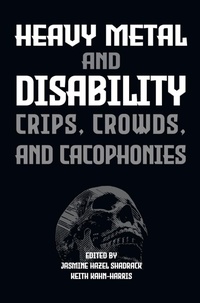
Heavy Metal and Disability
Crips, Crowds, and Cacophonies
Published on 29. April 2024
Book
Hardback
196 pages
978-1-78938-945-6 (ISBN)
Description
The relationship between metal and disability is distinctive. Persisting across metal's sub-genres is a preoccupation with exploring and questioning the boundary that divides the body that has agency from the body that has none. This boundary is one that is familiar to those for whom the agency of the body is an everyday matter of survival.
Metal's preoccupation with unleashing and controlling sensorial overload acts both as an analogue of neurodiversity and as a space in which those who are neurodivergent find ways to understand and leverage their sensory capacities. Metal offers potent resources for the self-understanding of people with disabilities. It does not necessarily mean that this potential is always explored or that metal scenes are hospitable to those with disabilities. This collection is disability-positive, validating people with disabilities as different but not damaged.
While metal scholars who contribute to this collection see metal as a space of possibility, in which dis/ability and other intersectional identities can be validated and understood, the collection does not imply that the possibilities that metal affords are always actualised. This collection situates itself in a wider struggle to open up metal, challenging its power structures; a struggle in which metal studies has played a significant part.
Metal's preoccupation with unleashing and controlling sensorial overload acts both as an analogue of neurodiversity and as a space in which those who are neurodivergent find ways to understand and leverage their sensory capacities. Metal offers potent resources for the self-understanding of people with disabilities. It does not necessarily mean that this potential is always explored or that metal scenes are hospitable to those with disabilities. This collection is disability-positive, validating people with disabilities as different but not damaged.
While metal scholars who contribute to this collection see metal as a space of possibility, in which dis/ability and other intersectional identities can be validated and understood, the collection does not imply that the possibilities that metal affords are always actualised. This collection situates itself in a wider struggle to open up metal, challenging its power structures; a struggle in which metal studies has played a significant part.
More details
Series
Language
English
Place of publication
United Kingdom
Publishing group
Intellect
Target group
College/higher education
Illustrations
15 Halftones, black and white
Dimensions
Height: 250 mm
Width: 175 mm
Thickness: 15 mm
Weight
530 gr
ISBN-13
978-1-78938-945-6 (9781789389456)
Copyright in bibliographic data and cover images is held by Nielsen Book Services Limited or by the publishers or by their respective licensors: all rights reserved.
Schweitzer Classification
Other editions
Additional editions
E-Book
03/2024
Intellect Books
€102.99
Available for download
Persons
Jasmine Hazel Shadrack is an adjunct professor at the Don Wright School of Music Composition and Research, at Western University, Canada. She is also a musician, composer, disability advocate and an extreme metal performer.
Keith Kahn-Harris is a sociologist and writer, based in London. He has been writing about metal since the 1990s, is the author of 'Extreme Metal: Music and Culture on the Edge' and co-editor of a number of collections.
Keith Kahn-Harris is a sociologist and writer, based in London. He has been writing about metal since the 1990s, is the author of 'Extreme Metal: Music and Culture on the Edge' and co-editor of a number of collections.
Content
Introduction
'United We Never Shall Fall': Metal and Disability
Esther Clinton and Jeremy Wallach
Resonant Forms: Autistic Hearing and Heavy Metal Aesthetics
Jon W. Fessenden
Fools Gather 'Round to Watch Me Bleed: Disability, Isolation, and Participation in Metal's Communities of Aesthetic Practice
Rebecca Jiggens and Jasmine Hazel Shadrack
Disabled Drone: Trans-Feminist Noisecraft
Steff Juniper
The Psychology of Metal Music, Culture, and Dis/Ability
Kyle J. Messick
Neurodiversity and Heavy Metal Music
Kate Quinn and Samantha Barton
Dis-ruptions: Heavy Metal Appropriations of Disability in Media
Eric Smialek and Samantha Bassler
Stimming in the Pit: How Autistic Heavy Metal Fans Have Remained Unseen
Vik J. Squires
The Bone Ballet: An Examination in the Intersectionality of Metal, Ballet, and Disability
Dawn States
Dis/Abling Narratives of Indigenous Bodies through Decolonial Metal Music in Latin America
Nelson Varas Diaz and Daniel Nevarez Araujo
Goth Subculture, Neurodivergence, and the Dark Power of Changeling Narratives
Kayley Whalen
Notes on Contributors
'United We Never Shall Fall': Metal and Disability
Esther Clinton and Jeremy Wallach
Resonant Forms: Autistic Hearing and Heavy Metal Aesthetics
Jon W. Fessenden
Fools Gather 'Round to Watch Me Bleed: Disability, Isolation, and Participation in Metal's Communities of Aesthetic Practice
Rebecca Jiggens and Jasmine Hazel Shadrack
Disabled Drone: Trans-Feminist Noisecraft
Steff Juniper
The Psychology of Metal Music, Culture, and Dis/Ability
Kyle J. Messick
Neurodiversity and Heavy Metal Music
Kate Quinn and Samantha Barton
Dis-ruptions: Heavy Metal Appropriations of Disability in Media
Eric Smialek and Samantha Bassler
Stimming in the Pit: How Autistic Heavy Metal Fans Have Remained Unseen
Vik J. Squires
The Bone Ballet: An Examination in the Intersectionality of Metal, Ballet, and Disability
Dawn States
Dis/Abling Narratives of Indigenous Bodies through Decolonial Metal Music in Latin America
Nelson Varas Diaz and Daniel Nevarez Araujo
Goth Subculture, Neurodivergence, and the Dark Power of Changeling Narratives
Kayley Whalen
Notes on Contributors