

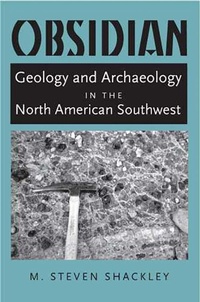
Obsidian
Geology and Archaeology in the North American Southwest
Will be published approx. on 1. September 2005
Book
Hardback
264 pages
978-0-8165-2396-2 (ISBN)
Description
Obsidian was long valued by ancient peoples as a raw material for producing stone tools, and archaeologists have increasingly come to view obsidian studies as a crucial aid in understanding the past. Steven Shackley now shows how the geochemical and contextual analyses of archaeological obsidian can be applied to the interpretation of social and economic organization in the ancient Southwest. This book, the capstone of decades of investigation, integrates a wealth of obsidian research in one volume. It covers advances in analytical chemistry and field petrology that have enhanced our understanding of obsidian source heterogeneity, presents the most recent data on and interpretations of archaeological obsidian sources in the Southwest, and explores the ethnohistorical and contemporary background for obsidian use in indigenous societies. Shackley provides a thorough examination of the geological origin of obsidian in the region and the methods used to collect raw material and determine its chemical composition, and descriptions of obsidian sources throughout the Southwest.
He then describes the occurrence of obsidian artifacts and shows how their geochemical fingerprints allow archaeologists to make conclusions regarding the procurement of obsidian. The book presents three groundbreaking applications of obsidian source studies. It first discusses an application to early Preceramic groups, showing how obsidian sources can reflect the range they inhabited over time as well as their social relationships during the Archaic period. It then offers an examination of the Late Classic Salado in Arizona's Tonto Basin, where obsidian data, along with ceramic and architectural evidence, suggest that Mogollon migrants lived in economic and social harmony with the Hohokam, all the while maintaining relationships with their homeland. Finally, it provides an intensive look at social identity and gender differences in the Preclassic Hohokam of central Arizona, where obsidian source provenance and projectile point styles suggest that male Hohokam sought to create a stylistically defined identity in at least three areas of the Hohokam core area. These male 'sodalities were organized quite differently from female ceramic production groups.
Today, obsidian research in the American Southwest enjoys an equal standing with ceramic, faunal, and floral studies as a method of revealing social process and change in prehistory. Shackley's book discusses the ways in which archaeologists should approach obsidian research, no matter what the region, offering a thorough survey of archaeological obsidian studies that will have methodological and theoretical applications worldwide. The volume includes an extensive glossary created specifically for archaeologists.
He then describes the occurrence of obsidian artifacts and shows how their geochemical fingerprints allow archaeologists to make conclusions regarding the procurement of obsidian. The book presents three groundbreaking applications of obsidian source studies. It first discusses an application to early Preceramic groups, showing how obsidian sources can reflect the range they inhabited over time as well as their social relationships during the Archaic period. It then offers an examination of the Late Classic Salado in Arizona's Tonto Basin, where obsidian data, along with ceramic and architectural evidence, suggest that Mogollon migrants lived in economic and social harmony with the Hohokam, all the while maintaining relationships with their homeland. Finally, it provides an intensive look at social identity and gender differences in the Preclassic Hohokam of central Arizona, where obsidian source provenance and projectile point styles suggest that male Hohokam sought to create a stylistically defined identity in at least three areas of the Hohokam core area. These male 'sodalities were organized quite differently from female ceramic production groups.
Today, obsidian research in the American Southwest enjoys an equal standing with ceramic, faunal, and floral studies as a method of revealing social process and change in prehistory. Shackley's book discusses the ways in which archaeologists should approach obsidian research, no matter what the region, offering a thorough survey of archaeological obsidian studies that will have methodological and theoretical applications worldwide. The volume includes an extensive glossary created specifically for archaeologists.
More details
Language
English
Place of publication
Tucson
United States
Target group
College/higher education
Product notice
sewn/stitched
Cloth over boards
With dust jacket
Illustrations
illustrations
Dimensions
Height: 244 mm
Width: 161 mm
Thickness: 21 mm
Weight
558 gr
ISBN-13
978-0-8165-2396-2 (9780816523962)
Copyright in bibliographic data and cover images is held by Nielsen Book Services Limited or by the publishers or by their respective licensors: all rights reserved.
Schweitzer Classification
Other editions
Additional editions
E-Book
07/2022
1st Edition
University of Arizona Press
€94.99
Available for download
Person
M. Steven Shackley is Professor of Anthropology and Director of the Berkeley Archaeological XRF Laboratory at the University of California, Berkeley.