

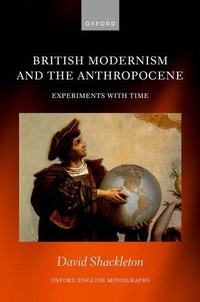
British Modernism and the Anthropocene
Experiments with Time
Published on 11. August 2023
Book
Hardback
226 pages
978-0-19-285774-3 (ISBN)
Description
British Modernism and the Anthropocene: Experiments with Time assesses the environmental politics of modernism in relation to the idea of the Anthropocene-a proposed geological epoch in which humans have fundamentally changed the Earth System. The early twentieth century was marked by environmental transformations that were so complex and happened on such great scales that they defied representation. Modernist novelists responded with a range of innovative narrative forms that started to make environmental crisis on a planetary scale visible. Paradoxically, however, it is their failures to represent such a crisis that achieve the greatest success.
David Shackleton explores how British modernists employed types of narrative breakdown-including fragmentation and faltering passages devoid of events-to expose the limitations of human schemes of meaning, negotiate the relationship between different scales and types of time, produce knowledge of ecological risk, and register various forms of non-human agency. Situating modernism in the context of fossil fuel energy systems, plantation monocultures, climate change, and species extinctions, Shackleton traces how H.G. Wells, D.H. Lawrence, Olive Moore, Virginia Woolf, and Jean Rhys undertook experiments with time in their novels that refigure history and the historical situations into which they were thrown. Ultimately, British Modernism and the Anthropocene shows how modernist novels provide rich resources for rethinking the current environmental crisis, and cultivating new structures of environmental care and concern.
David Shackleton explores how British modernists employed types of narrative breakdown-including fragmentation and faltering passages devoid of events-to expose the limitations of human schemes of meaning, negotiate the relationship between different scales and types of time, produce knowledge of ecological risk, and register various forms of non-human agency. Situating modernism in the context of fossil fuel energy systems, plantation monocultures, climate change, and species extinctions, Shackleton traces how H.G. Wells, D.H. Lawrence, Olive Moore, Virginia Woolf, and Jean Rhys undertook experiments with time in their novels that refigure history and the historical situations into which they were thrown. Ultimately, British Modernism and the Anthropocene shows how modernist novels provide rich resources for rethinking the current environmental crisis, and cultivating new structures of environmental care and concern.
Reviews / Votes
The monograph argues that different aspects of modernist experiments with time and history evince their environmental concerns and politics, which, once recognized, can 'provide rich resources for rethinking the current environmental crisis'. * Pengfei Zhang, Forum for Modern Language Studies *More details
Series
Language
English
Place of publication
Oxford
United Kingdom
Target group
Professional and scholarly
Product notice
sewn/stitched
Cloth over boards
Illustrations
4 colour and 8 black and white illustrations
Dimensions
Height: 237 mm
Width: 164 mm
Thickness: 20 mm
Weight
581 gr
ISBN-13
978-0-19-285774-3 (9780192857743)
Copyright in bibliographic data and cover images is held by Nielsen Book Services Limited or by the publishers or by their respective licensors: all rights reserved.
Schweitzer Classification
Other editions
Additional editions

E-Book
07/2023
1st Edition
OUP eBook
€64.49
Available for download

E-Book
07/2023
1st Edition
OUP eBook
€64.49
Available for download
Person
David Shackleton is a Senior Lecturer in English Literature at Cardiff University, having previously taught at the University of Exeter and the University of Oxford. His work has appeared in Modernism/modernity, The Review of English Studies, and Victorian Literature and Culture. He is interested in the power of stories to shape our responses to climate change and the current environmental crisis.
Content
Introduction: Modernism and the Anthropocene
1: H. G. Wells, Geology, and Ecological Risk
2: D. H. Lawrence and Nietzsche's Thought of Eternal Recurrence
3: Olive Moore's Queer Ecology
4: Virginia Woolf and the Pageant of History
5: Jean Rhys's Plantation Modernism
Conclusion: Modernist World-Ecology
Bibliography
Index
1: H. G. Wells, Geology, and Ecological Risk
2: D. H. Lawrence and Nietzsche's Thought of Eternal Recurrence
3: Olive Moore's Queer Ecology
4: Virginia Woolf and the Pageant of History
5: Jean Rhys's Plantation Modernism
Conclusion: Modernist World-Ecology
Bibliography
Index