

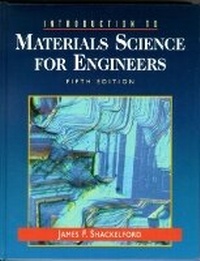
Introduction to Materials Science for Engineers
International Edition
5th Edition
Published on 16. April 2003
Book
Paperback/Softback
800 pages
978-0-13-015296-1 (ISBN)
Description
For a first course in Materials Sciences and Engineering taught in the departments of materials science, mechanical, civil and general engineering.
This text provides balanced, current treatment of the full spectrum of engineering materials, covering all the physical properties, applications and relevant properties associated with engineering materials. It explores all of major categories of materials while also offering detailed examinations of a wide range of new materials with high-tech applications.
This text provides balanced, current treatment of the full spectrum of engineering materials, covering all the physical properties, applications and relevant properties associated with engineering materials. It explores all of major categories of materials while also offering detailed examinations of a wide range of new materials with high-tech applications.
More details
Edition
5th edition
Language
English
Place of publication
United States
Publishing group
Pearson Education (US)
Target group
Professional and scholarly
Dimensions
Height: 255 mm
Width: 205 mm
Thickness: 38 mm
Weight
1618 gr
ISBN-13
978-0-13-015296-1 (9780130152961)
Copyright in bibliographic data and cover images is held by Nielsen Book Services Limited or by the publishers or by their respective licensors: all rights reserved.
Schweitzer Classification
Other editions
New editions
Book
07/2004
6th Edition
Pearson
€65.76
Article exhausted; check for reprint
Previous edition

James F. Shackleford
Introduction to Materials Science for Engineers
Book
01/1996
4th Edition
Pearson Education (US)
€38.37
Article exhausted; check for reprint
Content
1. Materials for Engineering.
I. THE FUNDAMENTALS.
2. Atomic Bonding.
3. Crystalline Structure-Perfection.
4. Crystal Defects and Noncrystalline Structure-Imperfection.
5. Diffusion.
6. Mechanical Behavior.
7. Thermal Behavior.
8. Failure Analysis and Prevention.
9. Phase Diagrams-Equilibrium Microstructural Development.
10. Kinetics-Heat Treatment.
II. THE STRUCTURAL MATERIALS.
11. Metals.
12. Ceramics and Glasses.
13. Polymers.
14. Composites.
III. THE ELECTRONIC, OPTICAL AND MAGNETIC MATERIALS.
15. Electrical Behavior.
16. Optical Behavior.
17. Semiconductor Materials.
18. Magnetic Materials.
IV. MATERIALS IN ENGINEERING DESIGN.
19. Environmental Degradation.
20. Materials Selection.
I. THE FUNDAMENTALS.
2. Atomic Bonding.
3. Crystalline Structure-Perfection.
4. Crystal Defects and Noncrystalline Structure-Imperfection.
5. Diffusion.
6. Mechanical Behavior.
7. Thermal Behavior.
8. Failure Analysis and Prevention.
9. Phase Diagrams-Equilibrium Microstructural Development.
10. Kinetics-Heat Treatment.
II. THE STRUCTURAL MATERIALS.
11. Metals.
12. Ceramics and Glasses.
13. Polymers.
14. Composites.
III. THE ELECTRONIC, OPTICAL AND MAGNETIC MATERIALS.
15. Electrical Behavior.
16. Optical Behavior.
17. Semiconductor Materials.
18. Magnetic Materials.
IV. MATERIALS IN ENGINEERING DESIGN.
19. Environmental Degradation.
20. Materials Selection.