

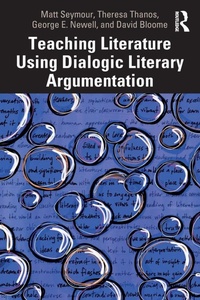
Teaching Literature Using Dialogic Literary Argumentation
1st Edition
Published on 20. May 2020
Book
Paperback/Softback
154 pages
978-0-367-25219-9 (ISBN)
Description
Introducing a new framework for teaching and learning literature in secondary schools, this book presents Dialogic Literary Argumentation as an inquiry-based approach to engage students in communicating and exploring ideas about literature. As a process of discovery, Dialogic Literary Argumentation facilitates conversation-"arguing-to-learn"-as a method to support students' diverse perspectives and engagement with one another in order to develop individual and collective understandings of literature and their place in the world. Covering both the theoretical foundation and application of this method, this book demonstrates how to apply Dialogic Literary Argumentation to teach literature in a way that foregrounds dialogue, learning through inquiry, diverse views, listening to others, and engagement with our communities. Ideal for preservice teachers in literacy methods courses and practicing teachers, it features real-world cases, discussions of the principles presented, resource lists, and conversation starters for professional learning communities, professional development, and teacher education.
More details
Language
English
Place of publication
London
United Kingdom
Publishing group
Taylor & Francis Ltd
Target group
College/higher education
Postgraduate
Illustrations
2 s/w Zeichnungen, 2 s/w Abbildungen, 20 s/w Tabellen
20 Tables, black and white; 2 Line drawings, black and white; 2 Illustrations, black and white
Dimensions
Height: 229 mm
Width: 152 mm
Thickness: 10 mm
Weight
265 gr
ISBN-13
978-0-367-25219-9 (9780367252199)
Copyright in bibliographic data and cover images is held by Nielsen Book Services Limited or by the publishers or by their respective licensors: all rights reserved.
Schweitzer Classification
Other editions
Additional editions
Matt Seymour | Theresa Thanos | George E. Newell
Teaching Literature Using Dialogic Literary Argumentation
Book
05/2020
1st Edition
Routledge
€205.90
Shipment within 15-20 days
Matt Seymour | Theresa Thanos | George E. Newell
Teaching Literature Using Dialogic Literary Argumentation
E-Book
04/2020
1st Edition
Routledge
€55.49
Available for download
Matt Seymour | Theresa Thanos | George E. Newell
Teaching Literature Using Dialogic Literary Argumentation
E-Book
04/2020
1st Edition
Routledge
€55.49
Available for download
Persons
Matt Seymour is a Doctoral Candidate at The Ohio State University, USA. He is a former high school English language arts teacher.
Theresa Thanos is a Doctoral Candidate at The Ohio State University, USA. She is a former middle school and high school English language arts teacher.
George E. Newell is Professor of Teaching and Learning at The Ohio State University, USA, and Principal Investigator of The Ohio State University Argumentative Writing Project.
David Bloome is the EHE Distinguished Professor of Teaching and Learning and Director of the Center for Video Ethnography and Discourse Analysis at The Ohio State University, USA.
Theresa Thanos is a Doctoral Candidate at The Ohio State University, USA. She is a former middle school and high school English language arts teacher.
George E. Newell is Professor of Teaching and Learning at The Ohio State University, USA, and Principal Investigator of The Ohio State University Argumentative Writing Project.
David Bloome is the EHE Distinguished Professor of Teaching and Learning and Director of the Center for Video Ethnography and Discourse Analysis at The Ohio State University, USA.
Content
Chapter 1 - Introduction Section
I. Foundations for Teaching Dialogic Literary Argumentation: Learning to Argue
Chapter 2 - What is Dialogic Literary Argumentation?
Chapter 3 - Reading and Writing Literature are Social and Dialogic
Chapter 4 - Classroom Conversations to Promote the Principles of Dialogic Literary Argumentation and to Establish a Shared Language for Engaging Literature
Chapter 5 - Establishing a Dialogic Rationality
Section II. Embracing Complexity: Arguing to Learn
Chapter 6 - Argumentation as Inquiry and Learning
Chapter 7 - Dialogic Literary Argumentation as Exploration of the Human Condition
Chapter 8 - Creating a Classroom Environment that Encourages Learning to take Risks with Dialogic Literary Argumentation
Chapter 9 - Conceptualizing Dialogic Literary Argumentation across the Academic Year
Section III Assessing Student Work and Engagement with Dialogic Literary Argumentation
Chapter 10 - Assessing Students' Judgement and Insight with Dialogic Literary Argumentation Over Time
Chapter 11 - Providing Feedback on Students' Written Dialogic Literary Arguments
I. Foundations for Teaching Dialogic Literary Argumentation: Learning to Argue
Chapter 2 - What is Dialogic Literary Argumentation?
Chapter 3 - Reading and Writing Literature are Social and Dialogic
Chapter 4 - Classroom Conversations to Promote the Principles of Dialogic Literary Argumentation and to Establish a Shared Language for Engaging Literature
Chapter 5 - Establishing a Dialogic Rationality
Section II. Embracing Complexity: Arguing to Learn
Chapter 6 - Argumentation as Inquiry and Learning
Chapter 7 - Dialogic Literary Argumentation as Exploration of the Human Condition
Chapter 8 - Creating a Classroom Environment that Encourages Learning to take Risks with Dialogic Literary Argumentation
Chapter 9 - Conceptualizing Dialogic Literary Argumentation across the Academic Year
Section III Assessing Student Work and Engagement with Dialogic Literary Argumentation
Chapter 10 - Assessing Students' Judgement and Insight with Dialogic Literary Argumentation Over Time
Chapter 11 - Providing Feedback on Students' Written Dialogic Literary Arguments