

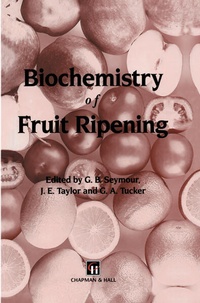
Biochemistry of Fruit Ripening
Published on 23. October 2012
Book
Paperback/Softback
XI, 454 pages
978-94-010-4689-3 (ISBN)
Description
It is over 20 years since the publication of A.c. Hulme's two volume text on The Biochemistry of Fruits and thei.r Products. Whilst the bulk of the information contained in that text is still relevant it is true to say that our understanding of the biochemical and genetic mech
Reviews / Votes
... the Biochemistry of Fruit Ripening is aimed at all those involved in planning, harvesting, transport and storage of fruit.... to emphasise in particular the advances made in the last 20 years. - Comment; ...400 well documented pages...In summary, this book should allow a researcher or teacher unfamiliar with this area to assemble biochemical information concerning a wide range of individual fruits efficiently - Plant ScienceMore details
Edition
Softcover reprint of the original 1st ed. 1993
Language
English
Place of publication
Dordrecht
Netherlands
Target group
Professional and scholarly
Research
Illustrations
XI, 454 p.
Dimensions
Height: 235 mm
Width: 155 mm
Thickness: 26 mm
Weight
709 gr
ISBN-13
978-94-010-4689-3 (9789401046893)
DOI
10.1007/978-94-011-1584-1
Schweitzer Classification
Other editions
Additional editions
G.B. Seymour | J.E. Taylor | Gregory A. Tucker
Biochemistry of Fruit Ripening
E-Book
12/2012
Springer
€341.33
Available for download
G.B. Seymour | J.E. Taylor | Gregory A. Tucker
Biochemistry of Fruit Ripening
Book
04/1993
Chapman and Hall
€320.99
Shipment within 10-20 days
Content
1 Introduction.- 1.1 Respiration and energy.- 1.2 Flavour changes.- 1.3 Colour changes.- 1.4 Texture changes.- 1.5 Control of ripening.- 1.6 Conclusions.- References.- 2 Avocado.- 2.1 Introduction.- 2.2 Physiology.- 2.3 Biochemistry.- 2.4 Gene expression during fruit ripening.- References.- 3 Banana.- 3.1 Introduction.- 3.2 Ethylene production and respiration.- 3.3 Carbohydrate metabolism.- 3.4 Pigment changes.- 3.5 Cell wall changes.- 3.6 Phenolic compounds.- 3.7 Organic acid and amino acid metabolism.- 3.8 Production of volatile compounds.- 3.9 Lipids.- 3.10 Other changes.- 3.11 Concluding remarks.- References.- 4 Citrus fruit.- 4.1 Commercial importance of citrus fruit.- 4.2 Taxonomy and cultivars.- 4.3 Harvest.- 4.4 Postharvest.- 4.5 General physiology.- 4.6 Biochemical changes during development, ripening and storage.- 4.7 Citrus biotechnology.- References.- 5 Exotics.- 5.1 Introduction.- 5.2 Persimmon.- 5.3 Lychee.- 5.4 Guava.- 5.5 Annona species.- 5.6 Carambola.- 5.7 Tamarillo.-5.8 Passion fruit.- 5.9 Mangosteen.- 5.10 Feijoa.- 5.11 Rambutan.- References.- 6 Grape.- 6.1 Origin and distribution.- 6.2 Grape berry morphology.- 6.3 Fruit growth and development.- 6.4 Growth regulation - phytohormones.- 6.5 Postharvest physiology.- 6.6 Handling and storage.- 6.7 Compositional changes.- 6.8 Phenolic compounds.- 6.9 Aroma.- 6.10 Cell wall metabolism.- References.- 7 Kiwifruit.- 7.1 Introduction.- 7.2 Physiology.- 7.3 Biochemistry.- 7.4 Pathways and enzymes.- 7.5 Regulation of ripening.- 7.6 Future prospects.- References.- 8 Mango.- 8.1 Introduction.- 8.2 Fruit development and harvest maturity.- 8.3 Ripening processes.- References.- 9 Melon.- 9.1 Introduction.- 9.2 Botany.- 9.3 Physiological changes during development and ripening.- 9.4 Biochemical changes during development and ripening.- 9.5 Postharvest diseases and disorders.- 9.6 Genetic improvement.- References.- 10 Pineapple and papaya.- 10.1 The pineapple - an introduction.- 10.2 Pineapple - physiology and biochemistry.- 10.3 Papaya - an introduction.- 10.4 Papaya - physiology.- 10.5 Papaya - biochemistry.- References.- 11 Pome fruits.- 11.1 Introduction.- 11.2 Physiology.- 11.3 Biochemistry.- 11.4 Regulation.- References.- 12 Soft fruit.- 12.1 Introduction.- 12.2 Physiology.- 12.3 Biochemistry.- 12.4 Metabolic pathways.- 12.5 Hormonal regulation of development and ripening.- 12.6 Gene expression during development and ripening.- References.- 13 Stone fruit.- 13.1 Introduction.- 13.2 The Prunus species and their origins.- 13.3 Peaches and nectarines (P. persica).- 13.4 Plum (P. domestica).- 13.5 Mume, or Japanese apricot (P. mume).- 13.6 Apricot (P. armeniaca).- 13.7 Almond (P. amygdalus).- 13.8 Tart or sour cherry (P. cerasus).- 13.9 Sweet cherry (P. avium).- 13.10 Olive (Olea europaea L).- References.- 14 Tomato.- 14.1 Introduction.- 14.2 History and classification.- 14.3 Tomato production.- 14.4 Fruit quality.- 14.5 Ethylene synthesis and action.- 14.6 Temperature stresses and their effects on ripening.- 14.7 The mechanism of tomato ripening.- 14.8 Non-ripening mutants.- 14.9 Cloning and characterization ripening-related mRNAs.- 14.10 Polygalacturonase and its role in texture change.- 14.11 Tomato genetic engineering.- 14.12 Control of fruit-specific and ripening-specific gene expression.- References.- Glossary of botanical names.