

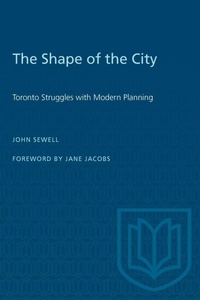
The Shape of the City
Toronto Struggles with Modern Planning
2nd Edition
Published on 8. September 1993
Book
Paperback/Softback
252 pages
978-0-8020-7409-6 (ISBN)
Description
Critics have long voiced concerns about the wisdom of living in cities and the effects of city life on physical and mental health. For a century, planners have tried to meet these issues. John Sewell traces changes in urban planning, from the pre-Depression garden cities to postwar modernism and a revival of interest in the streetscape grid.
In this far-ranging review, Sewell recounts the arrival of modern city planning with its emphasis on lower densities, limited access streets, segregated uses, and considerable green space. He makes Toronto a case history, with its pioneering suburban development in Don Mills and its other planned communities, including Regent Park, St Jamestown, Thorncrest Village, and Bramalea.
The heyday of the modern planning movement was in the 1940s to the 1960s, and the Don Mills concept was repeated in spirit and in style across Canada. Eventually, strong public reaction brought modern planning almost to a halt within the city of Toronto. The battles centred on saving the Old City Hall and stopping the Spadina Expressway. Sewell concludes that although the modernist approach remains ascendant in the suburbs, the City of Toronto has begun to replace it with alternatives that work.
This is a reflective but vigorous statement by a committed urban reformer. Few Canadians are better suited to point the way towards city planning for the future.
In this far-ranging review, Sewell recounts the arrival of modern city planning with its emphasis on lower densities, limited access streets, segregated uses, and considerable green space. He makes Toronto a case history, with its pioneering suburban development in Don Mills and its other planned communities, including Regent Park, St Jamestown, Thorncrest Village, and Bramalea.
The heyday of the modern planning movement was in the 1940s to the 1960s, and the Don Mills concept was repeated in spirit and in style across Canada. Eventually, strong public reaction brought modern planning almost to a halt within the city of Toronto. The battles centred on saving the Old City Hall and stopping the Spadina Expressway. Sewell concludes that although the modernist approach remains ascendant in the suburbs, the City of Toronto has begun to replace it with alternatives that work.
This is a reflective but vigorous statement by a committed urban reformer. Few Canadians are better suited to point the way towards city planning for the future.
More details
Series
Edition
2nd edition
Language
English
Place of publication
Toronto
Canada
Product notice
Paperback (trade)
Dimensions
Height: 235 mm
Width: 159 mm
Thickness: 25 mm
Weight
413 gr
ISBN-13
978-0-8020-7409-6 (9780802074096)
Copyright in bibliographic data and cover images is held by Nielsen Book Services Limited or by the publishers or by their respective licensors: all rights reserved.
Schweitzer Classification