

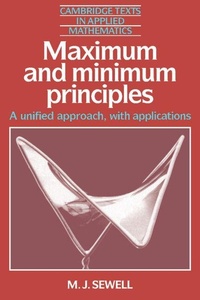
Maximum and Minimum Principles
A Unified Approach with Applications
Published on 17. December 1987
Book
Paperback/Softback
488 pages
978-0-521-34876-8 (ISBN)
Description
In many problems of applied mathematics, science, engineering or economics, an energy expenditure or its analogue can be approximated by upper and lower bounds. This book provides a unified account of the theory required to establish such bounds, by expressing the governing conditions of the problem, and the bounds, in terms of a saddle functional and its gradients. There are several features, including a chapter on the Legendre dual transformation and some of its singularities. Many substantial examples and exercises are included, especially from the mechanics of fluids, elastic and plastic solids and from optimisation theory. The saddle functional viewpoint gives the book a wide scope. The treatment is straightforward, the only prerequisite being a basic knowledge of the calculus of variations. Part of the book is based on final-year undergraduate courses. This is developed into an account which will interest a wide range of students and professionals in applied mathematics, engineering, physics and operations research.
More details
Series
Language
English
Place of publication
Cambridge
United Kingdom
Target group
Professional and scholarly
Product notice
Paperback (trade)
Illustrations
Worked examples or Exercises
Dimensions
Height: 229 mm
Width: 152 mm
Thickness: 29 mm
Weight
785 gr
ISBN-13
978-0-521-34876-8 (9780521348768)
Copyright in bibliographic data and cover images is held by Nielsen Book Services Limited or by the publishers or by their respective licensors: all rights reserved.
Schweitzer Classification
Other editions
Additional editions
Book
12/1987
Cambridge University Press
€68.09
Article exhausted; check for reprint
Previous edition
Book
12/1987
Cambridge University Press
€68.09
Article exhausted; check for reprint
Content
Preface; 1. Saddle function problems; 2. Duality and Legendre transformations; 3. Upper and lower bounds via saddle functionals; 4. Extensions of the general approach; 5. Mechanics of solids and fluids; References; Index.