

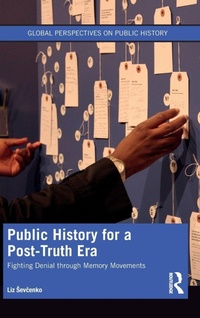
Public History for a Post-Truth Era
Fighting Denial through Memory Movements
1st Edition
Published on 25. July 2022
Book
Hardback
304 pages
978-1-032-02922-1 (ISBN)
Description
Public History for a Post-Truth Era explores how to combat historical denial when faith in facts is at an all-time low. Moving beyond memorial museums or documentaries, the book shares on-the-ground stories of participatory public memory movements that brought people together to grapple with the deep roots and current truths of human rights abuses. It gives an inside look at "Sites of Conscience" around the world, and the memory activists unearthing their hidden histories, from the Soviet Gulag to the slave trade in Senegal. It then follows hundreds of people joining forces across dozens of US cities to fight denial of Guantanamo, mass incarceration, and climate change.
As reparations proposals proliferate in the US, the book is a resource for anyone seeking to confront historical injustices and redress their harms. Written in accessible, non-academic language, it will appeal to students, educators, or supportive citizens interested in public history, museums, or movement organizing.
As reparations proposals proliferate in the US, the book is a resource for anyone seeking to confront historical injustices and redress their harms. Written in accessible, non-academic language, it will appeal to students, educators, or supportive citizens interested in public history, museums, or movement organizing.
Reviews / Votes
The denial of substantiated realities of the past is examined in Liz Sevcenko's incisive contribution, which explores questions of truth, consensus, and power in public histories from several critical perspectives. Written in an accessible and clear style, it is punctuated by personal reflections and offers a lucid treatment of the subject. This breadth and depth make it a valuable addition to literature on this vital topic.Florence Evans, University of Amsterdam, Netherlands, in Museums & Social Issues
"Well written and richly detailed, Public History for a Post-Truth Era is a worthy addition to Routledge's Global Perspectives in Public History series...Public historians and their students will find this book most useful as a behind-the-scenes guide, and historians of all types will appreciate the stimulating questions Sevcenko raises-sometimes intentionally, sometimes not-about facts, truth, historical method, and expertise."
Meredith H. Lair, George Mason University, in The Public Historian, Volume 46, Number 2, May 2024, pp. 172-174
More details
Series
Language
English
Place of publication
London
United Kingdom
Publishing group
Taylor & Francis Ltd
Target group
College/higher education
Postgraduate and Undergraduate
Dimensions
Height: 235 mm
Width: 157 mm
Thickness: 22 mm
Weight
610 gr
ISBN-13
978-1-032-02922-1 (9781032029221)
Copyright in bibliographic data and cover images is held by Nielsen Book Services Limited or by the publishers or by their respective licensors: all rights reserved.
Schweitzer Classification
Other editions
Additional editions
E-Book
07/2022
1st Edition
Routledge
€53.99
Available for download
E-Book
07/2022
1st Edition
Routledge
€53.99
Available for download
Book
07/2022
1st Edition
Routledge
€62.10
Shipment within 10-20 days
Person
Liz Sevcenko is Founding Director of the Humanities Action Lab, currently homed at Rutgers University-Newark, and was the Founding Director of the International Coalition of Sites of Conscience. She organizes coalitions for historical memory and redress, combining the visions and forces of people working in public history, social movements, and transitional justice. She lives in Brooklyn.
Content
Introduction / 1 Snapshots from Memory Movements at the turn of the Millenium, Album 1: Heritage and Human Rights in New York, Nottinghamshire, Buenos Aires, and Cape Town / 2 Snapshots from Memory Movements at the turn of the Millenium, Album 2: Truth without Accountability in Bangladesh, Czech Republic, Russia, U.S., and Senegal / 3 Defining Memory, Dialogue, and Action / 4 Assessing Impact / 5 How GTMO's History has been Shaped by Denial: Public Memory and Public Policy in America's State of Exception / 6 Remembering and Reckoning with GTMO / 7 Mobilizing an International Memory Movement for GTMO / 8 Public Memory and the U.S. Carceral State / 9 Remembering Rikers: Participatory Public Memory for Public Policy / 10 Local Stories, National Genealogy: Memory Movements Against Mass Incarceration / 11 Historical Denial and the Climate Crisis / Conclusion