

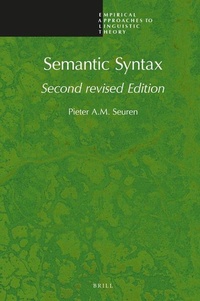
Semantic Syntax
Second Revised Edition
2nd Edition
Published on 9. November 2017
Book
Hardback
456 pages
978-90-04-35352-7 (ISBN)
Description
This book presents a detailed formal machinery for the conversion of the Semantic Analyses (SAs) of sentences into surface structures of English, French, German, Dutch, and to some extent Turkish. The SAs are propositional structures consisting of a predicate and one, two or three argument terms, some of which can themselves be propositional structures. The surface structures are specified up to, but not including, the morphology. The book is thus an implementation of the programme formulated first by Albert Sechehaye (1870-1946) and then, independently, by James McCawley (1938-1999) in the school of Generative Semantics. It is the first, and so far the only formally precise and empirically motivated machinery in existence converting meaning representations into sentences of natural languages.
More details
Series
Edition
approx. xix, 375 pp.
Language
English
Place of publication
Leiden
Netherlands
Target group
Professional and scholarly
Edition type
New edition
Product notice
sewn/stitched
Cloth over boards
Illustrations
368 Line drawings, black and white
Dimensions
Height: 235 mm
Width: 155 mm
Thickness: 31 mm
Weight
842 gr
ISBN-13
978-90-04-35352-7 (9789004353527)
Copyright in bibliographic data and cover images is held by Nielsen Book Services Limited or by the publishers or by their respective licensors: all rights reserved.
Schweitzer Classification
Other editions
Additional editions
Book
11/2017
2nd Edition
Brill
€64.50
Shipment within 10-20 days
Previous edition
Person
Pieter Seuren(PhD Utrecht 1969), was lecturer in linguistics at Cambridge and Oxford between 1967 and 1974, professor of linguistics at the Radboud University Nijmegen between 1974 and 1999, and has been research fellow at the Max Planck Institute for Psycholinguistics, Nijmegen, since 1999. He authored 13 books and +/-170 articles.
Content
Editor's Foreword
Preface to the First Edition
Preface to the Second Edition
1 Introduction 1
?1.1?Some Historical and Methodological Backgrounds
?1.2?Surface Semantics and Compositionality
?1.3?Some General Properties of the Rule System
?1.4?SAs as a Way of Representing Sentence Meaning
?1.5?Prelexical Syntax and Other Aspects of Lexical Meaning
2 Some Formal Properties of Grammars, Trees and Rules
?2.1?Introductory
?2.2?Nodes, Constituents, Expansions and Areas
?2.3?Downgrading of S-nodes
?2.4?Argument Functions
?2.5?Elementary Operations
?2.6?Some Definitions
?2.7?Routines
?2.8?Directionality and Spines
?2.9?The Auxiliary System and the Complementation System
?2.10?Aux
?2.11?The Double (treble) Tense Analysis
?2.12?The Complementation System
3 The English Auxiliary and Complementation System
?3.1?Some Basic Machinery
?3.2?Further Preliminary Remarks
?3.3?The Generation of a Few Simple English Sentences
?3.4?Negation, the Modals and emph
?3.5?Adverbs, Prepositions, and Prepositional Objects
?3.6?Internal and External Datives
?3.7?Passives, Progressives and other be-sentences
?3.8?Some Aspects of Complementation
4 The French Auxiliary and Complementation System
?4.1?Preliminary Comparative Observations
?4.2?Some Basic Machinery
?4.3?Some Example Sentences
?4.4?The Complementation System: sr, sd, pr
?4.5?Negative and Other Adverbs
?4.6?Passive in French
?4.7?Clitic en and the Raising-Control Analogy
5 The Dutch Auxiliary and Complementation System
?5.1?Preliminary Comparative Observations
?5.2?Some Basic Machinery
?5.3?Passive in Dutch
?5.4?The Complementation System
?5.5?Verb-final and End Cluster Arrangement or Creeping
?5.6?Pr on zijn1 and Adjectives
?5.7?The Syntax of Adverbs and Negation; the Queuing Principle
?5.8?Dutch an SOV-language?
6 The German Auxiliary and Complementation System
?6.1?Preliminary Comparative Observations
?6.2?Branching Directionality in V-clusters: The R-condition
?6.3?Some Basic Machinery
?6.4?Fronting and Question Formation in German
?6.5?Clitic Movement and the Position of the Subject
?6.6?Counterfactual and Subjunctive in the Four Languages
7 Any Other Business
?7.1?Quantification
?7.2?Clefting, Deep Accent and wh-questions
?7.3?Conjunction Reduction
?7.4?Subordinate Clauses and Prepositional Participial Clauses
?7.5?Deeper Semantic Analysis (DSA)
?7.6?A Glance at Turkish
List of French Words
List of Dutch Words
List of German Words
Bibliography
Preface to the First Edition
Preface to the Second Edition
1 Introduction 1
?1.1?Some Historical and Methodological Backgrounds
?1.2?Surface Semantics and Compositionality
?1.3?Some General Properties of the Rule System
?1.4?SAs as a Way of Representing Sentence Meaning
?1.5?Prelexical Syntax and Other Aspects of Lexical Meaning
2 Some Formal Properties of Grammars, Trees and Rules
?2.1?Introductory
?2.2?Nodes, Constituents, Expansions and Areas
?2.3?Downgrading of S-nodes
?2.4?Argument Functions
?2.5?Elementary Operations
?2.6?Some Definitions
?2.7?Routines
?2.8?Directionality and Spines
?2.9?The Auxiliary System and the Complementation System
?2.10?Aux
?2.11?The Double (treble) Tense Analysis
?2.12?The Complementation System
3 The English Auxiliary and Complementation System
?3.1?Some Basic Machinery
?3.2?Further Preliminary Remarks
?3.3?The Generation of a Few Simple English Sentences
?3.4?Negation, the Modals and emph
?3.5?Adverbs, Prepositions, and Prepositional Objects
?3.6?Internal and External Datives
?3.7?Passives, Progressives and other be-sentences
?3.8?Some Aspects of Complementation
4 The French Auxiliary and Complementation System
?4.1?Preliminary Comparative Observations
?4.2?Some Basic Machinery
?4.3?Some Example Sentences
?4.4?The Complementation System: sr, sd, pr
?4.5?Negative and Other Adverbs
?4.6?Passive in French
?4.7?Clitic en and the Raising-Control Analogy
5 The Dutch Auxiliary and Complementation System
?5.1?Preliminary Comparative Observations
?5.2?Some Basic Machinery
?5.3?Passive in Dutch
?5.4?The Complementation System
?5.5?Verb-final and End Cluster Arrangement or Creeping
?5.6?Pr on zijn1 and Adjectives
?5.7?The Syntax of Adverbs and Negation; the Queuing Principle
?5.8?Dutch an SOV-language?
6 The German Auxiliary and Complementation System
?6.1?Preliminary Comparative Observations
?6.2?Branching Directionality in V-clusters: The R-condition
?6.3?Some Basic Machinery
?6.4?Fronting and Question Formation in German
?6.5?Clitic Movement and the Position of the Subject
?6.6?Counterfactual and Subjunctive in the Four Languages
7 Any Other Business
?7.1?Quantification
?7.2?Clefting, Deep Accent and wh-questions
?7.3?Conjunction Reduction
?7.4?Subordinate Clauses and Prepositional Participial Clauses
?7.5?Deeper Semantic Analysis (DSA)
?7.6?A Glance at Turkish
List of French Words
List of Dutch Words
List of German Words
Bibliography