

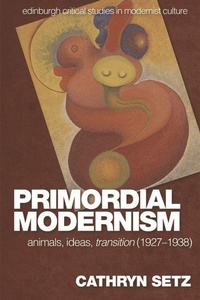
Primordial Modernism
Animals, Ideas, transition (1927-1938)
Published on 26. May 2021
Book
Paperback/Softback
224 pages
978-1-4744-8425-1 (ISBN)
Description
Brings ideas and animals together to shed new light on modernist magazine culture
Tests the concept of 'primordial' modernism as a tributary of primitivism, Jungian thought, and fraught nationalismsProvides readings of Eugene Jolas's creative and critical works that place him centre-stage in modernist studiesMoves between unpublished archival material, reception studies, and readings of overlooked authorsConsiders a wide range of modernist authors and artists as befitting to such a rich documentTouches on contemporary scientific discourse as an aspect of animal studies
This adventurous study focuses on experimental animal writing in the major interwar journal transition (1927-1938), which contains a striking recurrence of metaphors around the most basic forms of life. Amoebas, fish, lizards, birds - some of the 'lowest' and 'oldest' creatures on earth often emerge at the very places authors seek expressions for the 'newest' and the 'highest' in art. Discussing works by James Joyce, Henry Miller, Gottfried Benn, Eugene Jolas, Kay Boyle, Bryher, Paul Eluard and more, Cathryn Setz investigates this paradox and provides a new understanding of transition's contribution to twentieth-century periodical culture.
Tests the concept of 'primordial' modernism as a tributary of primitivism, Jungian thought, and fraught nationalismsProvides readings of Eugene Jolas's creative and critical works that place him centre-stage in modernist studiesMoves between unpublished archival material, reception studies, and readings of overlooked authorsConsiders a wide range of modernist authors and artists as befitting to such a rich documentTouches on contemporary scientific discourse as an aspect of animal studies
This adventurous study focuses on experimental animal writing in the major interwar journal transition (1927-1938), which contains a striking recurrence of metaphors around the most basic forms of life. Amoebas, fish, lizards, birds - some of the 'lowest' and 'oldest' creatures on earth often emerge at the very places authors seek expressions for the 'newest' and the 'highest' in art. Discussing works by James Joyce, Henry Miller, Gottfried Benn, Eugene Jolas, Kay Boyle, Bryher, Paul Eluard and more, Cathryn Setz investigates this paradox and provides a new understanding of transition's contribution to twentieth-century periodical culture.
Reviews / Votes
Cathryn Setz is the first scholar who dares systematically study a key modernist magazine (the famous transition) via its fantastic zoology. Animals like amoebas, lizards, fish, and birds function as uncanny attractors bringing out problematics of raw life and pre-verbal expression, Ur-myths of nonhuman forms of social life. In this brilliant and captivating book, Setz offers us a new Origin of Species of transatlantic modernism. * Jean-Michel Rabate, University of Pennsylvania, American Academy of Arts and Sciences * Primordial Modernism asks us to behold modernism afresh, through pineal eyes. Gone is the fetishization of male ego that once made Wyndham Lewis's coinage, "the Men of 1914", a reasonable characterization of the modernist movement. Gone, too, is the fetishizationof genius. Jolas is celebrated by Setz primarily for his influence on other writers, while the most august of the magazine's contributors, James Joyce, is shrunk; Setz puts it beautifully: "The 'Work in Progress' was an agenda-setting presence [for transition], and the slither of that world of a book explored here has received a necessarily partial discussion". -- Beci Carver * Times Literary Supplement *More details
Series
Language
English
Place of publication
Edinburgh
United Kingdom
Target group
Professional and scholarly
Product notice
Paperback (trade)
Unsewn / adhesive bound
Illustrations
16 black and white illustrations
Dimensions
Height: 234 mm
Width: 156 mm
Thickness: 12 mm
Weight
322 gr
ISBN-13
978-1-4744-8425-1 (9781474484251)
Copyright in bibliographic data and cover images is held by Nielsen Book Services Limited or by the publishers or by their respective licensors: all rights reserved.
Schweitzer Classification
Person
Cathryn Setz is an Associate Visiting Research Fellow at the Rothermere American Institute at the University of Oxford. Her work explores the junctions between modernist magazine culture and popular science, specifically around the 'Eclipse of Darwinism', 'bad' biology in 1920s America, and literary resistance to scientific racism. She is also Co-Editor of Shattered Objects: Djuna Barnes's Modernism (Penn State University Press, 2019), and a collaborative Selected Letters of Djuna Barnes project.
Content
List of figures Acknowledgements Introduction
Amoeba: figures of abstraction, Surrealist influence, and the Revolution of the Word
Fish: evolving the artwork in James Joyce's 'Shem the Penman' (1927)
Lizard: Gottfried Benn, 'the "dark" side of modernism', and transition's 'pineal eye'
Bird: editorial flights with Eugene Jolas
ConclusionBibliography Index
Amoeba: figures of abstraction, Surrealist influence, and the Revolution of the Word
Fish: evolving the artwork in James Joyce's 'Shem the Penman' (1927)
Lizard: Gottfried Benn, 'the "dark" side of modernism', and transition's 'pineal eye'
Bird: editorial flights with Eugene Jolas
ConclusionBibliography Index