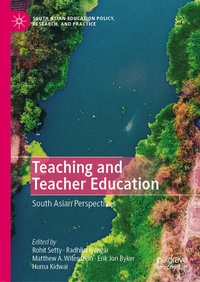
This edited volume brings together diverse thinkers and practitioners from the field of teaching and teacher education as it pertains to educational development in South Asia. In this volume, authors draw from their research, practice, and field experiences, showcasing how teaching and teacher education are currently being carried out, understood, theorized, debated, and implemented for the education of children and teachers alike in South Asia. The volume also includes practitioner voices, which are often marginalized in academic discourse. This book acts as a key reference text for academics and practitioners interested in the intersection of education and development in the region, and in particular what it takes to pull off ambitious teaching and teacher education in South Asia.
Series
Edition
Language
Place of publication
Publishing group
Springer International Publishing
Target group
Professional and scholarly
Illustrations
9 s/w Abbildungen, 28 farbige Abbildungen
XV, 363 p. 37 illus., 28 illus. in color.
Dimensions
Height: 216 mm
Width: 153 mm
Thickness: 25 mm
Weight
ISBN-13
978-3-030-26878-7 (9783030268787)
DOI
10.1007/978-3-030-26879-4
Schweitzer Classification
Rohit Setty
was a USIEF Fulbright-Nehru Fellow with the National Council of Educational Research and Training's Regional Institute of Education, Mysore, India, and holds a PhD from the University of Michigan, USA.
Radhika Iyengar
is Associate Research Scholar at the Center for Sustainable Development at the Earth Institute, Columbia University, USA.
Matthew A. Witenstein
is Assistant Professor in the Department of Educational Administration at University of Dayton, USA.
Erik Jon Byker
is Assistant Professor in the Department of Reading and Elementary Education at the University of North Carolina at Charlotte, USA.
Huma Kidwai
is Education Specialist with the World Bank's East Africa Division (Education-Global Practice). She holds an EdD from Teachers College, Columbia University, USA.
1. Introduction: Focusing on Practice.- 2. Outcome-based Education (OBE) in Accounting in Sri Lanka: Insights for Teacher Education.- 3. Paradoxes in Teacher Education: Voices from the Indian Context.- 4. Continuous Professional Development (CPD) and Teacher change in India and South Asian Nations: An Analysis of Literature and Policy Documents.- 5. "What Can We Do If They Are Not Getting?": Perspectives of Teachers on Inclusive Education in a Low-Fee paying Private English Medium School.- 6. Exploring the Gender Gap in Reading in Pakistan.- 7. Mapping workflows and perceptions of Dehli's government school teachers. 8. Active learning reform in the Maldives: What works for whom under what circumstances.- 9. Barriers to Effectiveness in the Classroom: Three Cases of Novice Teachers in Bangladesh.- 10. People, not numbers: Using data to humanize and strengthen teacher support systems in India.- 11. Designing for Technology Enabled Reflective Practice: Teachers' Voices on Participating ina Connected Learning Practice.- 12. Transformative Problem-Posing Teacher Education: A Framework for Engaging with Teachers' Beliefs through Teacher Education in India.- 13. Not under my Parachute: How co-curricular offerings exacerbate inequities under the Right to Education Act.- 14. Teacher Preparation for Environmental Education and Education for Sustainable Development in India.- 15. Pastoral Care Teaching: Effectively and Affectively.- 16. The Sastras of Teacher Education in South Asia: Conclusion.