

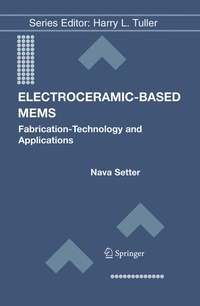
Electroceramic-Based MEMS
Fabrication-Technology and Applications
Published on 3. March 2005
Book
Hardback
XII, 414 pages
978-0-387-23310-9 (ISBN)
Description
The concept of micromachining of silicon to form micron-scale structures such as cantilevers, free-standing bridges, membranes, and channels and its combination with microelectronics fabrication methodology and technology has resulted in the em- gence of a new category of functional systems called MEMS (microelectomechanical systems). MEMS are miniature systems containing devices or arrays of devices that combine electronics with other components such as sensors, transducers and actuators, and are fabricated by IC (Integrated Circuits) batch processing techniques. The ?eld of electroceramics (inorganic, non-metallic materials, often polycr- talline, with useful electrical and other functional properties) provides a vast number of active materials for sensors, actuators, and electrical and electronic components. Electroceramic thin ?lms can add therefore many useful functionalities to MEMS.
At the same time, because the fabrication of ceramics is commonly a high temperature process that often necessitates an oxygen containing atmosphere, because most cer- ics are inert and corrosion resistant, and because the properties of electroceramics are verysensitivetotheprocessingconditions,theintegrationofelectroceramiclayersonto silicon or other substrates and their patterning into functional elements need complex technologies that are still under development. This situation is re?ected in the current positionofelectroceramic-basedMEMSinthemarket:Whilethepotentialisexcellent, ?rst devices are being commercialized only these present days.
At the same time, because the fabrication of ceramics is commonly a high temperature process that often necessitates an oxygen containing atmosphere, because most cer- ics are inert and corrosion resistant, and because the properties of electroceramics are verysensitivetotheprocessingconditions,theintegrationofelectroceramiclayersonto silicon or other substrates and their patterning into functional elements need complex technologies that are still under development. This situation is re?ected in the current positionofelectroceramic-basedMEMSinthemarket:Whilethepotentialisexcellent, ?rst devices are being commercialized only these present days.
More details
Series
Edition
2005 ed.
Language
English
Place of publication
New York
United States
Target group
Professional and scholarly
Research
Product notice
sewn/stitched
Paper over boards
Illustrations
XII, 414 p.
Dimensions
Height: 245 mm
Width: 166 mm
Thickness: 33 mm
Weight
774 gr
ISBN-13
978-0-387-23310-9 (9780387233109)
DOI
10.1007/b101200
Schweitzer Classification
Other editions
Additional editions
Book
12/2010
Springer
€213.99
Shipment within 15-20 days
E-Book
03/2006
1st Edition
Springer Science+Business Media
€213.99
Available for download
Content
Applications and Devices.- MEMS-Based Thin Film and Resonant Chemical Sensors.- Microactuators Based on Thin Films.- Micromachined Ultrasonic Transducers and Acoustic Sensors Based on Piezoelectric Thin Films.- Thick-Film Piezoelectric and Magnetostrictive Devices.- Micromachined Infrared Detectors Based on Pyroelectric Thin Films.- RF Bulk Acoustic Wave Resonators and Filters.- High Frequency Tuneable Devices Based on Thin Ferroelectric Films.- MEMS for Optical Functionality.- Materials, Fabrication-Technology, and Functionality.- Ceramic Thick Films for MEMS.- Thin Film Piezoelectrics for MEMS.- Science and Technology of High Dielectric Constant Thin Films and Materials Integration for Application to High Frequency Devices.- Permittivity, Tunability and Loss in Ferroelectrics for Reconfigurable High Frequency Electronics.- Microfabrication of Piezoelectric MEMS.- Non-Conventional Micro- and Nanopatterning Techniques for Electroceramics.- Low-Cost Patterning of Ceramic Thin Films.