

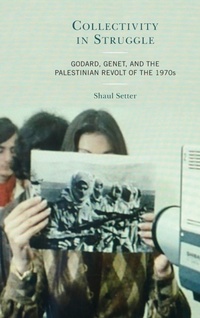
Collectivity in Struggle
Godard, Genet, and the Palestinian Revolt of the 1970s
Published on 15. January 2021
Book
Hardback
194 pages
978-1-4985-7202-6 (ISBN)
Description
We live in a neoliberal regime that works to dismantle social institutions and eradicate forms of collective gathering. Over and against this state of affairs, Collectivity in Struggle revisits a crucial moment in recent history when the formation of collectivity sat at the heart of a radical emancipatory struggle and called for a creative endeavor, both artistic and political. The book examines two projects developed in the 1970s vis-a-vis the Palestinian revolt: Jean-Luc Godard's cinematic engagement with the Palestinian forces and Jean Genet's textual enterprise alongside them. Through an inverse reading that uncovers from the seemingly discrete and finalized artworks -Godard's film or Genet's book-the process of their becoming, Shaul Setter explores the ways in which these projects portray and conceptualize the revolutionary stage of the Palestinian revolt, its abrupt end, and two different modes of prolonging it. Concentrating on their formal experimentation, their potentiality for collective enunciation, their conflicted positioning on the threshold of colonial European culture and the hidden Semitic languages inscribed in them-Setter claims that these two projects insist on the writerly aspects of revolutionary political action.
Reviews / Votes
Recalling and invoking the artistic-political projects of Godard and Genet as mediating forces in the ongoing Palestinian struggle against superpowers and imperialism, Shaul Setter invites us to go beyond the melancholic gesture of declaring these interventions as failures. His careful engagement with the texts and with their collective revolutionary potentiality is presented as an alternative to an otherwise limited identitarian politics: liberal or radical. Setter's returns us to Genet and Godard, as well as to Palestine by reviving a mode of political engagement that may have failed to actualize in the past, but can and must still be envisioned as a historical potential that has not yet caught up with the present. -- Gil Hochberg, Columbia University This book is a unique piece of scholarship. It is interdisciplinary in a very creative manner and offers a special unique view on the year 1968 in world history. It manages to create connections where there seems to be none, resisting rigid disciplinary boundaries, putting together East and West, France and Palestine. Setter rereads Palestine from France and rereads French intellectual artistic scene from Palestine. The book establishes, reads, and interprets the relations between politics and aesthetics, writing and doing, the word and the deed, creating links between aesthetical imagination and political action. -- Raef Zreik, Tel Aviv UniversityMore details
Language
English
Place of publication
United States
Publishing group
Bloomsbury Publishing Plc
Target group
Professional and scholarly
Dimensions
Height: 235 mm
Width: 157 mm
Thickness: 15 mm
Weight
440 gr
ISBN-13
978-1-4985-7202-6 (9781498572026)
Copyright in bibliographic data and cover images is held by Nielsen Book Services Limited or by the publishers or by their respective licensors: all rights reserved.
Schweitzer Classification
Other editions
Additional editions

E-Book
01/2021
1st Edition
Lexington Books
€90.99
Available for download

E-Book
01/2021
1st Edition
Bloomsbury eBooks US
€90.99
Available for download
Person
Shaul Setter is a teaching fellow in the department of literature at Tel Aviv University.
Content
Preface
Chapter 1: Collectivity in Theory, Collectivity in Action
Chapter 2: Collective Enunciation and its Afterlife: Jean-Luc Godard's Audiovisual Enterprise with the Palestinians
Chapter 3: The Writerly Revolution: Jean Genet within the Fiction of Palestine
Chapter 4: Writing from Right to Left: Semitic Forms in French Letters
Afterward
Chapter 1: Collectivity in Theory, Collectivity in Action
Chapter 2: Collective Enunciation and its Afterlife: Jean-Luc Godard's Audiovisual Enterprise with the Palestinians
Chapter 3: The Writerly Revolution: Jean Genet within the Fiction of Palestine
Chapter 4: Writing from Right to Left: Semitic Forms in French Letters
Afterward