

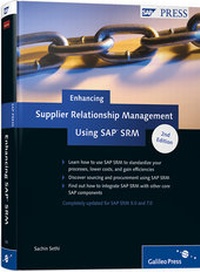
Enhancing Supplier Relationship Management Using SAP SRM
A detailed and practical understanding of SAP SRM
2nd Edition
Published on 28. November 2009
Book
Hardback
700 pages
978-1-59229-312-4 (ISBN)
Description
This completely updated edition of our best selling title give is a detailed and practical guide to the essentials of SAP SRM 7.0, including its functionality, new product enhancements, and best practices for optimizing business processes. Throughout the book, you'll find tips and tricks, practical examples, expert analysis on the changes in SAP SRM 7, and information on how SRM integrates with core SAP ERP components. And you'll find new coverage of Master Data Management, Organizational Structure, and e-Sourcing. This is the one resource you need to get the most out of SAP SRM.
Galileo Press heißt von jetzt an Rheinwerk Verlag.
Galileo Press heißt von jetzt an Rheinwerk Verlag.
More details
Other editions
Previous edition

Sachin Sethi
Enhancing Supplier Relationship Management Using SAP SRM
A detailed and practical understanding of SAP SRM
Book
06/2007
1st Edition
SAP PRESS
€69.95
Article exhausted; check for reprint
Person
Author
Sachin Sethi, the resident SAP SRM solution expert at searchsap.com, has more than nine years of consulting experience implementing eBusiness solutions and ERP applications. A certified SAP SRM Solutions expert, Sachin has worked with the SAP SRM/EBP product since its initial BBP 1.0 release.
Content
1. Introduction to Supplier Relationship Management. 29
. 1.1. e-Procurement and SRM. 30
. 1.2. The SRM Vendor Landscape. 34
. 1.3. Why SAP SRM. 34
. 1.4. Summary. 37
2. SAP SRM -- An Introduction. 41
. 2.1. Evolution of SAP SRM. 41
. 2.2. SAP SRM and SAP Enterprise Applications. 42
. 2.3. Benefits of SAP SRM. 43
. 2.4. Dissecting SAP SRM. 48
. 2.5. SAP Components. 50
. 2.6. Summary. 54
3. Operational Procurement. 55
. 3.1. Self-Service Procurement. 59
. 3.2. Services Procurement. 128
. 3.3. Plan-Driven Procurement. 135
. 3.4. Summary. 138
4. Strategic Sourcing and Contract Management. 139
. 4.1. Strategic Sourcing. 140
. 4.2. Contract Management. 171
. 4.3. What's New in Sourcing and Contract Management. 190
. 4.4. Summary. 196
5. Supplier Enablement. 197
. 5.1. Supplier Enablement Using SAP SRM. 199
. 5.2. Supplier Registration. 202
. 5.3. Supplier Collaboration: Order Collaboration. 208
. 5.4. Supplier Collaboration: Inventory and Replenishment. 229
. 5.5. Design Collaboration Using SAP PLM. 231
. 5.6. Design Collaboration Using SAP SRM. 233
. 5.7. Summary. 236
6. Catalog and Content Management -- Crafting Your Catalog Strategy. 239
. 6.1. Building a Robust Catalog Strategy. 241
. 6.2. Catalog and Content Management Using SAP SRM. 252
. 6.3. Relevant URL Links. 269
. 6.4. Relevant OSS Notes. 269
. 6.5. Summary. 270
7. Choosing Implementation Scenarios. 271
. 7.1. Overview -- SAP SRM Implementation Scenarios. 271
. 7.2. The Classic Scenario. 273
. 7.3. The Extended Classic Scenario. 278
. 7.4. The Standalone Scenario. 284
. 7.5. Decoupled Scenario. 288
. 7.6. Things to Remember and to Watch Out For. 290
. 7.7. Relevant OSS Notes. 291
. 7.8. Summary. 291
8. Organizational Structure. 293
. 8.1. Overview of the Organizational Structure in SAP SRM. 295
. 8.2. The Details Area of the Organizational Structure. 301
. 8.3. Uploading Attributes via a Function Module. 314
. 8.4. Customizing Attribute Maintenance. 316
. 8.5. Deleting Organizational Objects in SRM. 319
. 8.6. Best Practices for Creating and Managing the Organizational Structure. 320
. 8.7. Integration with SAP ERP HCM -- A Key Decision. 322
. 8.8. Pros and Cons of Creating an Organizational Structure in SAP EB or Distributing from SAP ERP HCM. 328
. 8.9. Impact of the Extended Classic Scenario on SAP SRM Organizational Structure. 330
. 8.10. System Refresh Procedure Steps. 331
. 8.11. Things to Remember. 333
. 8.12. What's New in the Organizational Structure. 333
. 8.13. Summary. 334
9. Integration with SAP ERP Financials and SAP Project System. 335
. 9.1. Financial Accounting in SAP. 336
. 9.2. Integration of SAP ERP Financials with SAP SRM. 339
. 9.3. Overview of the Purchase-to-Pay Cycle. 348
. 9.4. Budget Check in SAP SRM. 353
. 9.5. Integration with Project System. 357
. 9.6. Limitation of Extended Classic Scenario for SAP Public Sector Solution. 362
. 9.7. Integration with cProjects. 364
. 9.8. Relevant OSS Notes. 365
. 9.9. Summary. 366
10. The Role of Workflow in SAP SRM. 367
. 10.1. Workflow in SAP SRM. 370
. 10.2. Standard Delivered Workflows in SAP SRM. 375
. 10.3. Online and Offline Approvals. 394
. 10.4. Implementation Best Practices. 401
. 10.5. Security and Authorizations in Workflow. 404
. 10.6. Responsibility Rules vs. Custom Z tables. 408
. 10.7. What's New in SAP SRM 7.0 Workflow. 409
. 10.8. Relevant OSS Notes. 412
. 10.9. Summary. 412
11. Managing Security in SAP SRM. 413
. 11.1. Overview of Security in SAP. 414
. 11.2. Security in SAP SRM. 416
. 11.3. User Creation in SAP SRM for SAP EB (Internal). 423
. 11.4. User Creation in SRM for SAP EB (External). 435
. 11.5. Deleting Users in SAP SRM. 437
. 11.6. Checking Users in SAP SRM. 438
. 11.7. Roles and Authorizations in SAP SRM. 440
. 11.8. Impact of Organizational Structure in SAP SRM on Security. 446
. 11.9. Position-Based Security in SAP SRM. 451
. 11.10. Relevant OSS Notes. 454
. 11.11. Summary. 454
12. Dependency of Master Data in SAP SRM and SAP ERP. 455
. 12.1. Middleware. 457
. 12.2. Locations, Payment Terms, and Pricing Conditions. 460
. 12.3. Interlinkages. 463
. 12.4. Vendor Lists, Contracts, and Catalogs. 463
. 12.5. Delivery Addresses. 467
. 12.6. External Business Partners in SAP SRM. 470
. 12.7. Relevant OSS Notes. 480
. 12.8. Summary. 480
13. Architecture and Technology of SAP SRM. 481
. 13.1. SAP SRM Functionalities and Matrix. 483
. 13.2. SAP SRM Architecture Based on Business Scenario. 487
. 13.3. SAP SRM Business Scenarios Using SAP NetWeaver PI. 494
. 13.4. User Interface ITS to WebDynpro in SAP SRM. 495
. 13.5. SRM Sizing. 496
. 13.6. Summary. 497
14. Upgrade -- A How-To Approach. 499
. 14.1. Why Upgrade. 499
. 14.2. Answer the Question: Technical or Functional. 503
. 14.3. Understand Your Current Environment. 505
. 14.4. Expected Changes in New SRM Release. 509
. 14.5. Upgrade -- Tools and Resources. 511
. 14.6. Best Practices -- Upgrade Impact. 514
. 14.7. SAP SRM 7.0 -- Major Changes. 520
. 14.8. SAP SRM Upgrade -- Lessons Learned. 524
. 14.9. Upgrade Assessment -- via a Questionnaire. 525
. 14.10. Relevant OSS Notes. 528
. 14.11. Summary. 528
15. Performance Reporting via SAP NetWeaver BW. 529
. 15.1. SAP NetWeaver BW with SAP SRM. 530
. 15.2. Standard SAP NetWeaver BW Business Content for SAP SRM. 540
. 15.3. SAP SRM Implementation Scenario Impact on SAP NetWeaver BW Reporting. 549
. 15.4. Delivered Reports in SRM 7.0. 556
. 15.5. Things to Remember. 558
. 15.6. Relevant OSS Notes. 559
. 15.7. Summary. 559
16. SAP NetWeaver Portal and SAP SRM. 561
. 16.1. SRM Business Packages for SAP NetWeaver Portal. 563
. 16.2. Portal Security. 567
. 16.3. What's New in SAP SRM 7.0. 570
. 16.4. Relevant OSS Notes and Links. 574
. 16.5. Summary. 574
17. Customer Case Studies. 575
. 17.1. Case Study #1: New SAP ERP and SAP SRM Implementation. 575
. 17.2. Case Study #2: Existing SAP Customer with New SAP SRM and E-Sourcing Implementation. 580
. 17.3. Summary. 584
18. SAP E-Sourcing. 585
. 18.1. SAP E-Sourcing. 588
. 18.2. SAP E-Sourcing 5.1 Architecture. 592
. 18.3. SAP E-Sourcing Integration with SAP ERP and SAP SRM. 593
. 18.4. Relevant OSS Notes and Links. 595
. 18.5. Summary. 596
19. SAP Solution Manager and SAP SRM. 597
. 19.1. Solution Manager Relevance to SAP SRM. 599
. 19.2. Configuring the Solution Manager for SAP SRM. 604
. 19.3. Relevant OSS Notes and Links. 610
. 19.4. Summary. 610
20. Procurement for Public Sector. 613
. 20.1. SAP SRM and SAP Procurement for Public Sector. 613
. 20.2. What Is Different in SAP PPS. 616
. 20.3. Summary. 620
21. Selected Configuration in SAP SRM. 623
. 21.1. Integrate Organizational Structure with SAP ERP HCM. 623
. 21.2. Workflow: Restriction for Changing and Adding Approvers in the Shopping Cart. 632
. 21.3. MRP Integration with SAP SRM. 634
. 21.4. Other Configuration with SAP SRM. 639
. 21.5. Summary. 639
. 21.6. Book Conclusion. 639
A. SRM Functionality Matrix. 643
B. Jobs that Require Scheduling. 645
. B.1. Jobs Required in SAP SRM. 645
. B.2. Jobs Required in SAP ERP. 649
C. Using Different Browsers with SAP SRM. 651
D. Using Business Add-Ins with SAP SRM. 653
. D.1. Implementing a BAdI. 653
. D.2. Examples of BAdIs in SAP SRM. 655
. D.3. List of BAdIs in SAP SRM. 659
E. Customer Fields in SAP SRM. 669
. E.1. Customer-Specific Fields in SAP SRM Document Types. 669
. E.2. Related OSS NOTES. 672
F. Business Objects in SAP SRM. 673
G. Authorization Objects. 675
H. Quiz for Testing your SAP SRM Knowledge. 679
. H.1. Questions. 679
. H.2. Answers. 683
. H.3. Explanations for the Answers. 683
I. System Refresh Procedures. 691
J. Organization Structure Attributes. 693
K. Useful Transactions and Function Modules. 703
L. The Author. 709
. Index. 711
. 1.1. e-Procurement and SRM. 30
. 1.2. The SRM Vendor Landscape. 34
. 1.3. Why SAP SRM. 34
. 1.4. Summary. 37
2. SAP SRM -- An Introduction. 41
. 2.1. Evolution of SAP SRM. 41
. 2.2. SAP SRM and SAP Enterprise Applications. 42
. 2.3. Benefits of SAP SRM. 43
. 2.4. Dissecting SAP SRM. 48
. 2.5. SAP Components. 50
. 2.6. Summary. 54
3. Operational Procurement. 55
. 3.1. Self-Service Procurement. 59
. 3.2. Services Procurement. 128
. 3.3. Plan-Driven Procurement. 135
. 3.4. Summary. 138
4. Strategic Sourcing and Contract Management. 139
. 4.1. Strategic Sourcing. 140
. 4.2. Contract Management. 171
. 4.3. What's New in Sourcing and Contract Management. 190
. 4.4. Summary. 196
5. Supplier Enablement. 197
. 5.1. Supplier Enablement Using SAP SRM. 199
. 5.2. Supplier Registration. 202
. 5.3. Supplier Collaboration: Order Collaboration. 208
. 5.4. Supplier Collaboration: Inventory and Replenishment. 229
. 5.5. Design Collaboration Using SAP PLM. 231
. 5.6. Design Collaboration Using SAP SRM. 233
. 5.7. Summary. 236
6. Catalog and Content Management -- Crafting Your Catalog Strategy. 239
. 6.1. Building a Robust Catalog Strategy. 241
. 6.2. Catalog and Content Management Using SAP SRM. 252
. 6.3. Relevant URL Links. 269
. 6.4. Relevant OSS Notes. 269
. 6.5. Summary. 270
7. Choosing Implementation Scenarios. 271
. 7.1. Overview -- SAP SRM Implementation Scenarios. 271
. 7.2. The Classic Scenario. 273
. 7.3. The Extended Classic Scenario. 278
. 7.4. The Standalone Scenario. 284
. 7.5. Decoupled Scenario. 288
. 7.6. Things to Remember and to Watch Out For. 290
. 7.7. Relevant OSS Notes. 291
. 7.8. Summary. 291
8. Organizational Structure. 293
. 8.1. Overview of the Organizational Structure in SAP SRM. 295
. 8.2. The Details Area of the Organizational Structure. 301
. 8.3. Uploading Attributes via a Function Module. 314
. 8.4. Customizing Attribute Maintenance. 316
. 8.5. Deleting Organizational Objects in SRM. 319
. 8.6. Best Practices for Creating and Managing the Organizational Structure. 320
. 8.7. Integration with SAP ERP HCM -- A Key Decision. 322
. 8.8. Pros and Cons of Creating an Organizational Structure in SAP EB or Distributing from SAP ERP HCM. 328
. 8.9. Impact of the Extended Classic Scenario on SAP SRM Organizational Structure. 330
. 8.10. System Refresh Procedure Steps. 331
. 8.11. Things to Remember. 333
. 8.12. What's New in the Organizational Structure. 333
. 8.13. Summary. 334
9. Integration with SAP ERP Financials and SAP Project System. 335
. 9.1. Financial Accounting in SAP. 336
. 9.2. Integration of SAP ERP Financials with SAP SRM. 339
. 9.3. Overview of the Purchase-to-Pay Cycle. 348
. 9.4. Budget Check in SAP SRM. 353
. 9.5. Integration with Project System. 357
. 9.6. Limitation of Extended Classic Scenario for SAP Public Sector Solution. 362
. 9.7. Integration with cProjects. 364
. 9.8. Relevant OSS Notes. 365
. 9.9. Summary. 366
10. The Role of Workflow in SAP SRM. 367
. 10.1. Workflow in SAP SRM. 370
. 10.2. Standard Delivered Workflows in SAP SRM. 375
. 10.3. Online and Offline Approvals. 394
. 10.4. Implementation Best Practices. 401
. 10.5. Security and Authorizations in Workflow. 404
. 10.6. Responsibility Rules vs. Custom Z tables. 408
. 10.7. What's New in SAP SRM 7.0 Workflow. 409
. 10.8. Relevant OSS Notes. 412
. 10.9. Summary. 412
11. Managing Security in SAP SRM. 413
. 11.1. Overview of Security in SAP. 414
. 11.2. Security in SAP SRM. 416
. 11.3. User Creation in SAP SRM for SAP EB (Internal). 423
. 11.4. User Creation in SRM for SAP EB (External). 435
. 11.5. Deleting Users in SAP SRM. 437
. 11.6. Checking Users in SAP SRM. 438
. 11.7. Roles and Authorizations in SAP SRM. 440
. 11.8. Impact of Organizational Structure in SAP SRM on Security. 446
. 11.9. Position-Based Security in SAP SRM. 451
. 11.10. Relevant OSS Notes. 454
. 11.11. Summary. 454
12. Dependency of Master Data in SAP SRM and SAP ERP. 455
. 12.1. Middleware. 457
. 12.2. Locations, Payment Terms, and Pricing Conditions. 460
. 12.3. Interlinkages. 463
. 12.4. Vendor Lists, Contracts, and Catalogs. 463
. 12.5. Delivery Addresses. 467
. 12.6. External Business Partners in SAP SRM. 470
. 12.7. Relevant OSS Notes. 480
. 12.8. Summary. 480
13. Architecture and Technology of SAP SRM. 481
. 13.1. SAP SRM Functionalities and Matrix. 483
. 13.2. SAP SRM Architecture Based on Business Scenario. 487
. 13.3. SAP SRM Business Scenarios Using SAP NetWeaver PI. 494
. 13.4. User Interface ITS to WebDynpro in SAP SRM. 495
. 13.5. SRM Sizing. 496
. 13.6. Summary. 497
14. Upgrade -- A How-To Approach. 499
. 14.1. Why Upgrade. 499
. 14.2. Answer the Question: Technical or Functional. 503
. 14.3. Understand Your Current Environment. 505
. 14.4. Expected Changes in New SRM Release. 509
. 14.5. Upgrade -- Tools and Resources. 511
. 14.6. Best Practices -- Upgrade Impact. 514
. 14.7. SAP SRM 7.0 -- Major Changes. 520
. 14.8. SAP SRM Upgrade -- Lessons Learned. 524
. 14.9. Upgrade Assessment -- via a Questionnaire. 525
. 14.10. Relevant OSS Notes. 528
. 14.11. Summary. 528
15. Performance Reporting via SAP NetWeaver BW. 529
. 15.1. SAP NetWeaver BW with SAP SRM. 530
. 15.2. Standard SAP NetWeaver BW Business Content for SAP SRM. 540
. 15.3. SAP SRM Implementation Scenario Impact on SAP NetWeaver BW Reporting. 549
. 15.4. Delivered Reports in SRM 7.0. 556
. 15.5. Things to Remember. 558
. 15.6. Relevant OSS Notes. 559
. 15.7. Summary. 559
16. SAP NetWeaver Portal and SAP SRM. 561
. 16.1. SRM Business Packages for SAP NetWeaver Portal. 563
. 16.2. Portal Security. 567
. 16.3. What's New in SAP SRM 7.0. 570
. 16.4. Relevant OSS Notes and Links. 574
. 16.5. Summary. 574
17. Customer Case Studies. 575
. 17.1. Case Study #1: New SAP ERP and SAP SRM Implementation. 575
. 17.2. Case Study #2: Existing SAP Customer with New SAP SRM and E-Sourcing Implementation. 580
. 17.3. Summary. 584
18. SAP E-Sourcing. 585
. 18.1. SAP E-Sourcing. 588
. 18.2. SAP E-Sourcing 5.1 Architecture. 592
. 18.3. SAP E-Sourcing Integration with SAP ERP and SAP SRM. 593
. 18.4. Relevant OSS Notes and Links. 595
. 18.5. Summary. 596
19. SAP Solution Manager and SAP SRM. 597
. 19.1. Solution Manager Relevance to SAP SRM. 599
. 19.2. Configuring the Solution Manager for SAP SRM. 604
. 19.3. Relevant OSS Notes and Links. 610
. 19.4. Summary. 610
20. Procurement for Public Sector. 613
. 20.1. SAP SRM and SAP Procurement for Public Sector. 613
. 20.2. What Is Different in SAP PPS. 616
. 20.3. Summary. 620
21. Selected Configuration in SAP SRM. 623
. 21.1. Integrate Organizational Structure with SAP ERP HCM. 623
. 21.2. Workflow: Restriction for Changing and Adding Approvers in the Shopping Cart. 632
. 21.3. MRP Integration with SAP SRM. 634
. 21.4. Other Configuration with SAP SRM. 639
. 21.5. Summary. 639
. 21.6. Book Conclusion. 639
A. SRM Functionality Matrix. 643
B. Jobs that Require Scheduling. 645
. B.1. Jobs Required in SAP SRM. 645
. B.2. Jobs Required in SAP ERP. 649
C. Using Different Browsers with SAP SRM. 651
D. Using Business Add-Ins with SAP SRM. 653
. D.1. Implementing a BAdI. 653
. D.2. Examples of BAdIs in SAP SRM. 655
. D.3. List of BAdIs in SAP SRM. 659
E. Customer Fields in SAP SRM. 669
. E.1. Customer-Specific Fields in SAP SRM Document Types. 669
. E.2. Related OSS NOTES. 672
F. Business Objects in SAP SRM. 673
G. Authorization Objects. 675
H. Quiz for Testing your SAP SRM Knowledge. 679
. H.1. Questions. 679
. H.2. Answers. 683
. H.3. Explanations for the Answers. 683
I. System Refresh Procedures. 691
J. Organization Structure Attributes. 693
K. Useful Transactions and Function Modules. 703
L. The Author. 709
. Index. 711