

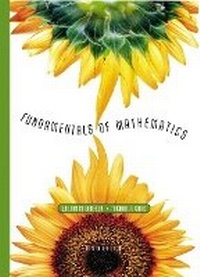
Fundamentals of Mathematics
9th Edition
Published on 8. January 2001
Book
Hardback
803 pages
978-0-13-060610-5 (ISBN)
Description
For courses in Liberal Arts Mathematics.
This text succeeds at what other texts only attempt: it demystifies mathematics. It presents the fundamentals of a variety of mathematical disciplines in a straightforward, easy-to-understand manner. The emphasis is on developing skills and confidence in mathematics for students with a wide range of abilities. The only prerequisite is a working knowledge of arithmetic. Extensive content revisions and the introduction of new material make this edition even more accessible than previous editions.
This text succeeds at what other texts only attempt: it demystifies mathematics. It presents the fundamentals of a variety of mathematical disciplines in a straightforward, easy-to-understand manner. The emphasis is on developing skills and confidence in mathematics for students with a wide range of abilities. The only prerequisite is a working knowledge of arithmetic. Extensive content revisions and the introduction of new material make this edition even more accessible than previous editions.
More details
Edition
9th edition
Language
English
Place of publication
United States
Publishing group
Pearson Education (US)
Target group
Professional and scholarly
Dimensions
Height: 254 mm
Width: 203 mm
ISBN-13
978-0-13-060610-5 (9780130606105)
Copyright in bibliographic data and cover images is held by Nielsen Book Services Limited or by the publishers or by their respective licensors: all rights reserved.
Schweitzer Classification
Other editions
New editions
William M. Setek | Michael A. Gallo
Fundamentals of Mathematics
Book
05/2004
10th Edition
Pearson
€76.74
Article exhausted; check for reprint
Content
(NOTE: Each chapter ends with a Summary, Vocabulary Check, Review Exercises, and Chapter Quiz.)
1. Fundamentals of Problem Solving.
Introduction. Problem-Solving Tools. Understanding Symbols and Context. Decisions and Pattern Recognition. Inductive and Deductive Reasoning. Inductive Reasoning-Sequences and Series (Optional). Problem-Solving Strategies.
2. Sets.
Introduction. Notation and Description. Subsets. Set Operations. Pictures of Sets (Venn Diagrams). An Application of Sets and Venn Diagrams. Cartesian Products.
3. Logic.
Introduction. Statements and Symbols. Dominance of Connectives. Truth Tables. More Truth Tables-Conditional and Biconditional Statements. DeMorgan's Law and Equivalent Statements. The Conditional (Optional). Valid Arguments. Picturing Statements with Venn Diagrams (Optional). Valid Arguments and Venn Diagrams (Optional). Switching Networks (Optional).
4. Probability.
Introduction. Definition of Probability. Sample Spaces. Tree Diagrams. Odds and Expectations. Compound Probability. Counting, Ordered Arrangements, and Permutations (Optional). Combinations (Optional). More Probability (Optional).
5. Statistics.
Introduction. Sampling. Measures of Central Tendency. Measures of Dispersion. Measures of Position (Percentiles). Pictures of Data. The Normal Curve. Correlation and Regression. Uses and Misuses of Statistics.
6. Mathematical Systems.
Introduction. Clock Arithmetic. More New Systems. Modular Systems. Mathematical Systems Without Numbers. Axiomatic Systems.
7. Systems of Numeration.
Introduction. Early Counting Systems. Grouping Systems (Simple and Multiplicative). Place-Value Systems. Numeration in Bases Other Than 10. Base 5 Arithmetic and Other Bases. The Language of Computers: Binary and Hexadecimal Bases.
8. Sets of Numbers and Their Structure: Elementary Number Theory.
Introduction. Natural Numbers-Primes and Composites. Greatest Common Divisor and Least Common Multiple. Integers. Rational Numbers. Irrational Numbers and the Set of Real Numbers. Percents, Decimals, and Fractions. Scientific Notation (Optional). An Application of Number Theory: Cryptography (Optional).
9. An Introduction to Algebra.
Introduction. Basic Concepts of Algebra. Open Sentences and Their Graphs. More Open Sentences. Applications of Linear Equations (Problem Solving). Linear Equations in Two Variables. Graphing Equations. Inequalities in Two Variables.
10. Selected Topics in Algebra.
Introduction. The Slope of a Line. The Equation of a Straight Line. Graphing y = ax2 + bx + c. Linear Programming. Solving Quadratic Equations.
11. An Introduction to Geometry.
Introduction. Points and Lines. Planes. Angles. Polygons. Perimeter and Area. Solids. Congruent and Similar Triangles. Other Geometries.
12. Consumer Mathematics.
Introduction. Markups and Markdowns. Simple Interest. Compound Interest. Effective Rate of Interest. Life Insurance. Installment Buying. Mortgages. Financial Planning and Investment Strategies.
13. An Introduction to the Metric System.
Introduction. History of Systems of Measurement. Length and Area. Volume. Mass (Weight). Temperature.
Appendix: Tables.
Glossary.
Answers to Odd-Numbered Exercises, All Review Exercises, and Chapter Quizzes.
1. Fundamentals of Problem Solving.
Introduction. Problem-Solving Tools. Understanding Symbols and Context. Decisions and Pattern Recognition. Inductive and Deductive Reasoning. Inductive Reasoning-Sequences and Series (Optional). Problem-Solving Strategies.
2. Sets.
Introduction. Notation and Description. Subsets. Set Operations. Pictures of Sets (Venn Diagrams). An Application of Sets and Venn Diagrams. Cartesian Products.
3. Logic.
Introduction. Statements and Symbols. Dominance of Connectives. Truth Tables. More Truth Tables-Conditional and Biconditional Statements. DeMorgan's Law and Equivalent Statements. The Conditional (Optional). Valid Arguments. Picturing Statements with Venn Diagrams (Optional). Valid Arguments and Venn Diagrams (Optional). Switching Networks (Optional).
4. Probability.
Introduction. Definition of Probability. Sample Spaces. Tree Diagrams. Odds and Expectations. Compound Probability. Counting, Ordered Arrangements, and Permutations (Optional). Combinations (Optional). More Probability (Optional).
5. Statistics.
Introduction. Sampling. Measures of Central Tendency. Measures of Dispersion. Measures of Position (Percentiles). Pictures of Data. The Normal Curve. Correlation and Regression. Uses and Misuses of Statistics.
6. Mathematical Systems.
Introduction. Clock Arithmetic. More New Systems. Modular Systems. Mathematical Systems Without Numbers. Axiomatic Systems.
7. Systems of Numeration.
Introduction. Early Counting Systems. Grouping Systems (Simple and Multiplicative). Place-Value Systems. Numeration in Bases Other Than 10. Base 5 Arithmetic and Other Bases. The Language of Computers: Binary and Hexadecimal Bases.
8. Sets of Numbers and Their Structure: Elementary Number Theory.
Introduction. Natural Numbers-Primes and Composites. Greatest Common Divisor and Least Common Multiple. Integers. Rational Numbers. Irrational Numbers and the Set of Real Numbers. Percents, Decimals, and Fractions. Scientific Notation (Optional). An Application of Number Theory: Cryptography (Optional).
9. An Introduction to Algebra.
Introduction. Basic Concepts of Algebra. Open Sentences and Their Graphs. More Open Sentences. Applications of Linear Equations (Problem Solving). Linear Equations in Two Variables. Graphing Equations. Inequalities in Two Variables.
10. Selected Topics in Algebra.
Introduction. The Slope of a Line. The Equation of a Straight Line. Graphing y = ax2 + bx + c. Linear Programming. Solving Quadratic Equations.
11. An Introduction to Geometry.
Introduction. Points and Lines. Planes. Angles. Polygons. Perimeter and Area. Solids. Congruent and Similar Triangles. Other Geometries.
12. Consumer Mathematics.
Introduction. Markups and Markdowns. Simple Interest. Compound Interest. Effective Rate of Interest. Life Insurance. Installment Buying. Mortgages. Financial Planning and Investment Strategies.
13. An Introduction to the Metric System.
Introduction. History of Systems of Measurement. Length and Area. Volume. Mass (Weight). Temperature.
Appendix: Tables.
Glossary.
Answers to Odd-Numbered Exercises, All Review Exercises, and Chapter Quizzes.