

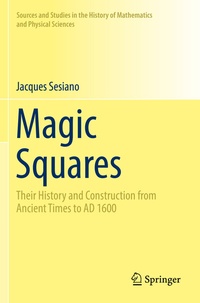
Magic Squares
Their History and Construction from Ancient Times to AD 1600
Published on 14. August 2020
Book
Paperback/Softback
XII, 313 pages
978-3-030-17995-3 (ISBN)
Description
The science of magic squares witnessed an important development in the Islamic world during the Middle Ages, with a great variety of construction methods being created and ameliorated. The initial step was the translation, in the ninth century, of an anonymous Greek text containing the description of certain highly developed arrangements, no doubt the culmination of ancient research on magic squares.
Reviews / Votes
"This is certainly a definitive comprehensive treatise on the history of magic squares from their known beginnings to 1600. There is a wealth of material, containing methods of construction as well as individual magic squares, including bordered and pandiagonal magic squares, that is astonishing." (Victor V. Pambuccian, zbMATH 1422.01002, 2019)More details
Product info
Book
Series
Edition
1st ed. 2019
Language
English
Place of publication
Cham
Switzerland
Publishing group
Springer International Publishing
Target group
Professional and scholarly
Illustrations
XII, 313 p.
Dimensions
Height: 235 mm
Width: 155 mm
Thickness: 18 mm
Weight
499 gr
ISBN-13
978-3-030-17995-3 (9783030179953)
DOI
10.1007/978-3-030-17993-9
Schweitzer Classification
Other editions
Additional editions
Book
05/2019
Springer
€128.39
Shipment within 7-9 days
Content
I. Introduction.- II. Ordinary magic squares.- A. Squares of odd orders.- B. Squares of evenly-even orders.- C. Squares of evenly-odd orders.- III. Composite magic squares.- A. Equal subshares displaying different sums.- B. Equal subshares displaying equal sums.- C. Division into unequal parts.- IV. Bordered magic squares.- A. Squares of odd orders.- B. Squares of evenly-even orders.- C. Squares of evenly-odd orders.- V. Bordered squares with separation by parity.- 1. The main square and its parts.- 2. Filling the inner square.- 3. Filling the remainder of the square by trial and error.- A. Methodical filling of the oblique square.- B. Methodical placing of the even numbers.- C. Particular case of the order 5.- VI. Magic squares with non-consecutive numbers.- A. Squares of odd orders.- B. Squares of evenly-even orders.- C. Squares of evenly-odd orders.- VII. 1. Literal squares.- 2. Squares with one empty cell.- 3. Squares with divided cells.- 4. Magic triangles.- 5. Magic crosses.- 6. Magic circles.- 7. Magic rectangles.- 8. Magic cubes.- Appendices.- Bibliography.- Index.