

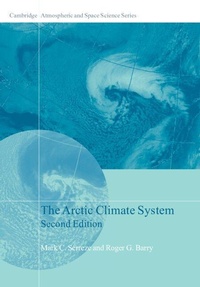
The Arctic Climate System
2nd Edition
Published on 21. July 2014
Book
Hardback
415 pages
978-1-107-03717-5 (ISBN)
Description
This second edition brings this definitive book up to date with the many advances in our understanding of Arctic climate since the first edition was published in 2005. The book has also been extensively reorganized to weave issues of Arctic change throughout the text, rather than confining them to a single chapter. It is the first to provide an integrated assessment of the Arctic climate system, recognizing that a true understanding of how the Arctic functions lies in appreciating the interactions among its various components. The book begins with a historical perspective, followed by discussion of the basic physical and climatic characteristics of the Arctic. Following a review of past climates (paleoclimates), the book closes with an assessment of the Arctic's uncertain future. Though targeted mainly at advanced students and researchers, this book is accessible to anyone with an interest in the Arctic and a basic understanding of climate science.
Reviews / Votes
Review of the first edition: '... comprehensive and up-to-date book ... A wealth of valuable information about the recent climate of the Arctic is presented ... [in] this excellent volume ... This is one of the best books on the Arctic climate system and should be required reading for all scientists and students engaged in the study of the Arctic environment.' Polar Geography Review of the first edition: 'I do like this book, which indicates current knowledge concerning the climate of the Arctic and its interaction with the lower latitudes as of today. The authors made a major effort to include recent advances ... This book will be essential for all climatologists interested in the Arctic.' Polar Record Review of the first edition: 'The authors demonstrate their expert knowledge and understanding of the topic of climate and provide a comprehensive coverage of this topic, which is likely to appeal to and be useful to many readers.' Journal of Glaciology Review of the first edition: 'Researchers and students will delight in The Arctic Climate System, and I can honestly report that if I could have only one text or resource on Arctic climatology, this would be it. Perhaps the best recommendation I can give is to report that I have already adopted this text for the graduate course that I teach in Arctic Climate Dynamics. I expect it will maintain this place for many years and future editions.' Arctic: Journal of the Arctic Institute of North AmericaMore details
Series
Edition
2nd Revised edition
Language
English
Place of publication
Cambridge
United Kingdom
Target group
Professional and scholarly
Edition type
Revised edition
Illustrations
Worked examples or Exercises; 5 Tables, unspecified; 31 Plates, color; 93 Maps; 6 Halftones, unspecified; 64 Line drawings, unspecified
Dimensions
Height: 260 mm
Width: 183 mm
Thickness: 29 mm
Weight
1035 gr
ISBN-13
978-1-107-03717-5 (9781107037175)
Copyright in bibliographic data and cover images is held by Nielsen Book Services Limited or by the publishers or by their respective licensors: all rights reserved.
Schweitzer Classification
Other editions
Additional editions
Mark C. Serreze
Arctic Climate System
E-Book
07/2014
Cambridge University Press
€91.49
Available for download
Mark C. Serreze | Roger G. Barry
The Arctic Climate System
E-Book
07/2014
2nd Edition
Cambridge University Press
€106.99
Available for download
Persons
Mark C. Serreze is the Director of the National Snow and Ice Data Center (NSIDC), part of the Cooperative Institute for Environmental Sciences (CIRES) at the University of Colorado Boulder. He is also a fellow of CIRES and a Professor in the Department of Geography. His Arctic research interests are wide-ranging, and include atmosphere-sea ice interactions, synoptic climatology, hydro-climatology, boundary layer problems, numerical weather prediction, and climate change. Dr Serreze has conducted fieldwork in the Canadian Arctic on sea ice and ice caps, and on the Alaskan tundra. Roger G. Barry is a Distinguished Professor of Geography Emeritus at the University of Colorado Boulder and the former director of NSIDC. He is currently the Director of the International CLIVAR Project Office at the National Oceanography Centre in Southampton, UK. He has written more than 250 research papers, and his books include Mountain Weather and Climate, 3rd edition (Cambridge University Press, 2008); Atmosphere, Weather and Climate, 9th edition (with Richard Chorley, 2009); Synoptic Climatology: Methods and Applications (with A. H. Perry, 1973); Synoptic and Dynamic Climatology (with Andrew Carleton, 2011); and The Global Cryosphere: Past, Present and Future (with Thian Gan, Cambridge University Press, 2011). In 1999, Dr Barry was elected a Fellow of the American Geophysical Union in recognition of his contributions to research in climatology and cryospheric science. In 2009-10 he spent nine months on a Humboldt Fellowship at the Glaciology Commission in Munich.
Content
1. The evolution of knowledge about the Arctic and its climate; 2. Physical characteristics and basic climate features; 3. The basic atmospheric and ocean energy budgets; 4. The atmospheric circulation; 5. Energy exchanges at the surface; 6. Precipitation, net precipitation, and river discharge; 7. Arctic ocean-sea ice-climate interactions; 8. Climate regimes of the Arctic; 9. Modeling the Arctic climate system; 10. Arctic paleoclimates; 11. The uncertain future.