

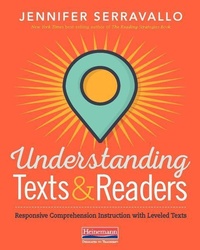
Understanding Texts and Readers
Description
calls out with precision how plot and setting, character, vocabulary and figurative language, and themes and ideas change as fiction across levels
specifies how the complexity of main idea, key details, vocabulary, and text features increases in nonfiction texts
points out what to expect from a reader as text characteristics change
provides samples of student responses to texts at each level
shares progressions across levels to support instructional planning.
Even if you haven't read the book your reader is responding to, you'll have the background necessary to make great teaching decisions for all your readers. "Understanding subtle shifts and increases in demands from level to level," writes Jennifer Serravallo, "can guide what a teacher asks a student, what the teacher expects of the student, and what the teacher, therefore, teaches the student."
Want to become a master of matching kids to books? Looking to take the difficult out of differentiation? Or do you want to dramatically increase the power and responsiveness of Jen's Reading Strategies Book? Understanding Texts & Readers shows you how to move forward when students need to make progress.
Samples Preview a sample chapter from Understanding Texts and Readers
More details
Person
Jennifer Serravallo is the author of The New York Times' bestselling The Reading Strategies Book 2.0 and The Writing Strategies Book, which have been translated into Spanish, French, and Chinese. These and her other popular books and resources help teachers make goal-directed responsive strategy instruction, conferring, and small group work doable in every classroom. Her newest titles are The Reading Strategies Book 2.0; Teaching Writing in Small Groups; A Teacher's Guide to Reading Conferences, and the assessment and teaching resource Complete Comprehension for Fiction and Nonfiction. Jen is a frequently invited speaker at national and regional conferences and travels throughout the US and Canada to provide full-day workshops and to work with teachers and students in classrooms. She is also an experienced online educator who regularly offers live webinar series and full-day online workshops. Jen began her career in education as an NYC public school teacher. Now as a consultant, she has spent the last fifteen+ years helping teachers across the country create literacy classrooms where students are joyfully engaged, and the instruction is meaningfully individualized to students' goals. Jen is also a member of Parents Magazine Board of Advisors for education and literacy. Jen holds a BA from Vassar College and an MA from Teachers College, where she has also taught graduate and undergraduate classes. Learn more about Jen and her work at Hein.pub/serravallo, on Twitter @jserravallo, or Instagram @jenniferserravallo.
Content
Comprehension Goals and Considerations
Reader and Text Variables that Impact Comprehension
Merging Levels and Comprehension: What to Expect in the Parts Ahead Part II: Fiction: Texts, Readers, and Comprehension
Studying Fiction and Supporting Readers: A Framework for Comprehension
Understanding Fiction Texts: A Level-by-Level Guide to Characteristics
Understanding Fiction Readers: A Goal-by-Goal Guide to Readers' Comprehension of Increasingly Complex Texts
Plot and Setting
Character
Vocabulary and Figurative Language
Themes and Ideas Part III: Nonfiction: Texts, Readers, and Comprehension
Studying Nonfiction and Supporting Readers: A Framework for Comprehension
Understanding Nonfiction Texts: A Level-by-Level Guide to Characteristics
Understanding Nonfiction Readers: A Goal-by-Goal Guide to Readers' Comprehension of Increasingly Complex Texts
Main Idea
Key Details
Vocabulary
Text Features Part IV: Assessment and Instruction: Bringing Your Understanding of Texts and Readers to the Classroom
Knowing Students: Interests, Language, Culture, Background Knowledge, and More
Assessing and Evaluating Comprehension
Matching Readers With "Just Right" Books
Conducting Goal-Setting Conferences
Using a Variety of Reading Strategies for Teaching Comprehension
Using a Variety Structures: Methods for Teaching Comprehension
Conclusion: The Alchemy of Reading