

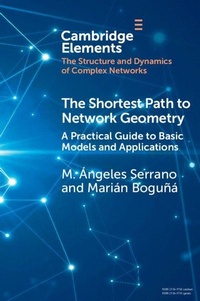
The Shortest Path to Network Geometry
A Practical Guide to Basic Models and Applications
Published on 6. January 2022
Book
Paperback/Softback
54 pages
978-1-108-79108-3 (ISBN)
Description
Real networks comprise from hundreds to millions of interacting elements and permeate all contexts, from technology to biology to society. All of them display non-trivial connectivity patterns, including the small-world phenomenon, making nodes to be separated by a small number of intermediate links. As a consequence, networks present an apparent lack of metric structure and are difficult to map. Yet, many networks have a hidden geometry that enables meaningful maps in the two-dimensional hyperbolic plane. The discovery of such hidden geometry and the understanding of its role have become fundamental questions in network science giving rise to the field of network geometry. This Element reviews fundamental models and methods for the geometric description of real networks with a focus on applications of real network maps, including decentralized routing protocols, geometric community detection, and the self-similar multiscale unfolding of networks by geometric renormalization.
More details
Series
Language
English
Place of publication
Cambridge
United Kingdom
Edition type
New edition
Product notice
Paperback (trade)
Illustrations
Worked examples or Exercises
Dimensions
Height: 222 mm
Width: 145 mm
Thickness: 6 mm
Weight
88 gr
ISBN-13
978-1-108-79108-3 (9781108791083)
Copyright in bibliographic data and cover images is held by Nielsen Book Services Limited or by the publishers or by their respective licensors: all rights reserved.
Schweitzer Classification
Other editions
Additional editions
M. Angeles Serrano | Marian Boguna
The Shortest Path to Network Geometry
A Practical Guide to Basic Models and Applications
E-Book
01/2022
Cambridge University Press
€15.49
Available for download
Persons
Content
1. From networks to maps; 2. Geometric models for static topologies; 3. Mapping real networks; 4. Mesoscale organization and community detection; 5. Self-similarity and renormalization; 6. Navigability; 7. Geometry of weighted, multiplex, and growing networks; 8. Conclusions; References.