

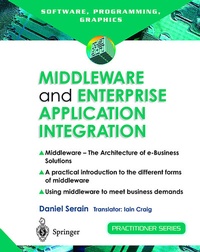
Middleware and Enterprise Application Integration
The Architecture of e-Business Solutions
2nd Edition
Published on 5. August 2002
Book
Paperback/Softback
XII, 288 pages
978-1-85233-570-0 (ISBN)
Description
The Internet and Java have galvanized the world of middleware, by making it part of the e-commerce revolution. Middleware is a layer of software that lets business applications inter-operate, easing the problem of constructing complex applications, (which can include market places, CRM and Internet access).
Middleware and Enterprise Application Integration is a practical introduction to the different forms of middleware (RPC, message queues, hub and spoke, CORBA and Java) and how they can be combined to produce complex architectures that are suited to business needs.
This book is aimed at consultants, managers and designers of complex business software for e-commerce, and shows how the new technologies can be made to meet new demands from business, without going into technical details.
"This book should to be read by everyone working in the IT industry that is involved in the design, coding or integration of applications. Practitioners are faced with a multitude of technology choices for middleware and integration, this work provides comprehensive discussion of the available technologies and will help in the decision making process.
For anyone who wishes to broaden their understanding of today's middleware technologies it's hard to find a better starting point, all IT Managers in need of more technical knowledge should read this book. For students it is an excellent general text covering the issues of middleware and integration.
Buy this book and read it, I'm sure you'll learn much of worth!"
(Dr Dave Watson, Program Director, Hursley Services & Technology, UK)
Middleware and Enterprise Application Integration is a practical introduction to the different forms of middleware (RPC, message queues, hub and spoke, CORBA and Java) and how they can be combined to produce complex architectures that are suited to business needs.
This book is aimed at consultants, managers and designers of complex business software for e-commerce, and shows how the new technologies can be made to meet new demands from business, without going into technical details.
"This book should to be read by everyone working in the IT industry that is involved in the design, coding or integration of applications. Practitioners are faced with a multitude of technology choices for middleware and integration, this work provides comprehensive discussion of the available technologies and will help in the decision making process.
For anyone who wishes to broaden their understanding of today's middleware technologies it's hard to find a better starting point, all IT Managers in need of more technical knowledge should read this book. For students it is an excellent general text covering the issues of middleware and integration.
Buy this book and read it, I'm sure you'll learn much of worth!"
(Dr Dave Watson, Program Director, Hursley Services & Technology, UK)
Reviews / Votes
From the reviews of the second edition:
"Middleware and EAI offer the promise of 'joined-up computing'. . The main approaches to middleware and EAI are surveyed . . The content is clearly laid out and easy to read, especially as it is printed in a large font. . It is a good introduction to the subject for consultants, managers and designers of complex business software." (Carey Gray, Computer Bulletin-online, May, 2003)
More details
Series
Edition
2nd ed. 2002
Language
English
Place of publication
London
United Kingdom
Target group
College/higher education
Professional and scholarly
Professional/practitioner
Edition type
Revised edition
Illustrations
165 s/w Abbildungen
165 Illustrations, black and white; XII, 288 p. 165 illus.
Dimensions
Height: 24.2 cm
Width: 17 cm
Weight
1540 gr
ISBN-13
978-1-85233-570-0 (9781852335700)
DOI
10.1007/978-1-4471-0133-8
Schweitzer Classification
Other editions
Previous edition
Persons
Content
1. Overview of Enterprise Application Integration.- 1.1 Problems to Solve.- 1.2 Application Integration: Semantic Level and System Level.- 1.3 Different Sorts of Middleware.- 1.4 Middleware and e-Business Architectures.- 1.5 Object-oriented Modelling for Constructing Architectures.- 1.6 Conclusion.- 2. RPC-based Middleware.- 2.1 The Client-Server Model.- 2.2 Client-Server and Procedure Call.- 2.3 Principles of the Remote Procedure Call Architecture.- 2.4 Concept of Contract Between Client and Server.- 2.5 Structure of Communication.- 2.6 The Standard.- 3. CORBA: Standard Object-based Middleware.- 3.1 Introduction.- 3.2 The CORBA Conceptual Model.- 3.3 The CORBA Architecture.- 3.4 The CORBA 2.0 Standard.- 3.5 Object Services.- 3.6 The CORBA 3.0 Standard.- 4. OLE/COM: Object-based Middleware from Microsoft.- 4.1 Introduction.- 4.2 The COM Object Model.- 4.3 OLE2.- 4.4 The DCOM Model.- 4.5 Microsoft Transaction Server (MTS).- 5. Comparison Between CORBA and OLE/COM.- 5.1 Introduction.- 5.2 Code Reuse: Inheritance and Aggregation.- 5.3 Composite Document Handling: OLE2 (COM) and OpenDoc (CORBA).- 5.4 Bridge Between CORBA and DCOM.- 5.5 Summary Table.- 6. Java RMI and Java Beans.- 6.1 The Java Language.- 6.2 Distributed Processing According to Java.- 6.3 Internet: Downloading and Execution of Applets.- 6.4 Remote Method Call: Java RMI.- 6.5 Component-based Software: Java Beans and ActiveX.- 7. Message-based Middleware.- 7.1 Introduction.- 7.2 Principal Functions.- 7.3 Evaluation of the Principal Products.- 8. Introduction to the Internet.- 8.1 The Network of Networks.- 8.2 Definition of the Principal Terms.- 8.3 The World Wide Web.- 9. e-Business Architectures.- 9.1 Information Publication on the Web.- 9.2 Interaction with an Enterprise Server.- 9.3 Transactions with an Application Server.- 9.4 Integrating the Application Server with the Back-office.- 9.5 B2B Example: Marketplaces.- 10. Conclusion.- 10.1 Choose Your Middleware.- 10.2 The Complete Approach: From Business Needs to Middleware Infrastructure.- Appendix A: Introduction to Object Technology.- A.1 The Concept of an Object.- A.2 Principal Characteristics of Object Technology.- Appendix B: MethodF": A Method for Object-oriented Analysis and Design.- B.1 Introduction.- B.2 Specification Phase.- B.3 Analysis Phase.- B.4 Design Phase.- B.5 Implementation Phase.- B.6 Summary of MethodF's Principal Steps.- Appendix C: Glossary.- Bibliography/Cybography.