

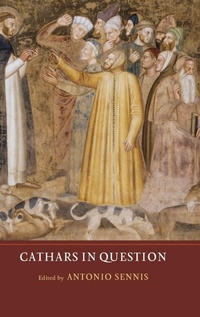
Cathars in Question
Published on 18. August 2016
Book
Hardback
341 pages
978-1-903153-68-0 (ISBN)
Description
The question of the reality of Cathars and other heresies is debated in this provocative collection.
Cathars have long been regarded as posing the most organised challenge to orthodox Catholicism in the medieval West, even as a "counter-Church" to orthodoxy in southern France and northern Italy. Their beliefs, understood to be inspired by Balkan dualism, are often seen as the most radical among medieval heresies. However, recent work has fiercely challenged this paradigm, arguing instead that "Catharism" is a construct, mis-named and mis-represented by generations of scholars, and its supposedly radical views were a fantastical projection of the fears of orthodox commentators.
This volume brings together a wide range of views from some of the most distinguished internationalscholars in the field, in order to address the debate directly while also opening up new areas for research. Focussing on dualism and anti-materialist beliefs in southern France, Italy and the Balkans, it considers a number of crucial issues. These include: what constitutes popular belief; how (and to what extent) societies of the past were based on the persecution of dissidents; and whether heresy can be seen as an invention of orthodoxy. At the same time, the essays shed new light on some key aspects of the political, cultural, religious and economic relationships between the Balkans and more western regions of Europe in the Middle Ages.
Antonio Sennis is Senior Lecturer in Medieval History at University College London Contributors: John H. Arnold, Peter Biller, Caterina Bruschi, David d'Avray, Joerg Feuchter, Bernard Hamilton, R.I. Moore, Mark Gregory Pegg, Rebecca Rist, Lucy J. Sackville, Antonio Sennis, Claire Taylor, Julien Thery-Astruc, Yuri Stoyanov
Cathars have long been regarded as posing the most organised challenge to orthodox Catholicism in the medieval West, even as a "counter-Church" to orthodoxy in southern France and northern Italy. Their beliefs, understood to be inspired by Balkan dualism, are often seen as the most radical among medieval heresies. However, recent work has fiercely challenged this paradigm, arguing instead that "Catharism" is a construct, mis-named and mis-represented by generations of scholars, and its supposedly radical views were a fantastical projection of the fears of orthodox commentators.
This volume brings together a wide range of views from some of the most distinguished internationalscholars in the field, in order to address the debate directly while also opening up new areas for research. Focussing on dualism and anti-materialist beliefs in southern France, Italy and the Balkans, it considers a number of crucial issues. These include: what constitutes popular belief; how (and to what extent) societies of the past were based on the persecution of dissidents; and whether heresy can be seen as an invention of orthodoxy. At the same time, the essays shed new light on some key aspects of the political, cultural, religious and economic relationships between the Balkans and more western regions of Europe in the Middle Ages.
Antonio Sennis is Senior Lecturer in Medieval History at University College London Contributors: John H. Arnold, Peter Biller, Caterina Bruschi, David d'Avray, Joerg Feuchter, Bernard Hamilton, R.I. Moore, Mark Gregory Pegg, Rebecca Rist, Lucy J. Sackville, Antonio Sennis, Claire Taylor, Julien Thery-Astruc, Yuri Stoyanov
Reviews / Votes
New methodological approaches have been opened up and existing narratives and conclusions completely reevaluated. . . . [I]t does indeed seems appropriate to say goodbye to the 'Cathars' and 'Catharism' as they have up to now been known historically. * SPECULUM * This important collection of essays addresses a fundamental question. * JOURNAL OF ECCLESIASTICAL HISTORY * An enjoyable and stimulating read. This is a volume that is indispensable for historians of medieval heresy, but its sharp focus on important methodological questions ensures that there is much of interest here for historians beyond this field. * JOURNAL OF RELIGIOUS HISTORY, LITERATURE AND CULTURE * [A] rich and thought-provoking collection. * FRENCH HISTORY *More details
Series
Language
English
Place of publication
York
United Kingdom
Target group
Professional and scholarly
Product notice
Cloth over boards
Dimensions
Height: 240 mm
Width: 161 mm
Thickness: 23 mm
Weight
681 gr
ISBN-13
978-1-903153-68-0 (9781903153680)
Copyright in bibliographic data and cover images is held by Nielsen Book Services Limited or by the publishers or by their respective licensors: all rights reserved.
Schweitzer Classification
Other editions
Additional editions
E-Book
08/2016
1st Edition
De Gruyter
€48.99
Available for download
Persons
L.J. SACKVILLE is Senior Lecturer in the Department of History at the University of York. PETE BILLER is Professor Emeritus in the Department of History at the University of York.
Content
Questions about the Cathars - Antonio Sennis
The Paradigm of Catharism; or, the Historians' Illusion - Mark Pegg
The Cathar Middle Ages as a Methodological and Historiographical Problem - John H Arnold
The Heretical Dissidence of the 'Good Men' in the Albigeois [1276-1329]: Localism and Resistance to Roman Clericalism - Julien Thery-Astruc
The Heretici of Languedoc: Local Holy Men and Women or Organized Religious Group? New Evidence from Inquisitorial, Notarial and Historiographical Sources - Joerg Feuchter
Cathar Links with the Balkans and Byzantium - Bernard Hamilton
Pseudepigraphic and Parabiblical Narratives and Elements in Medieval Eastern Christian Dualism and Their Implications for the Rise and Evolution of Catharism - Yuri Stoyanov
The Cathars from Non-Catholic Sources - David d'Avray
Converted-Turned-Inquisitors and the Image of the Adversary: Ranier Sacconi Explains Cathars - Caterina Bruschi
The Textbook Heretic: Moneta of Cremona's Cathars - Lucy Sackville
'Lupi rapaces in ovium vestimentis': Heretics and Heresy in Papal Correspondence - Rebecca Rist
Looking for the 'Good Men' in the Languedoc: an alternative to 'Cathars'? - Claire Taylor
Principles at Stake: The debate of April 2013 in retrospect - R I Moore
Goodbye to Catharism? - Peter Biller
The Paradigm of Catharism; or, the Historians' Illusion - Mark Pegg
The Cathar Middle Ages as a Methodological and Historiographical Problem - John H Arnold
The Heretical Dissidence of the 'Good Men' in the Albigeois [1276-1329]: Localism and Resistance to Roman Clericalism - Julien Thery-Astruc
The Heretici of Languedoc: Local Holy Men and Women or Organized Religious Group? New Evidence from Inquisitorial, Notarial and Historiographical Sources - Joerg Feuchter
Cathar Links with the Balkans and Byzantium - Bernard Hamilton
Pseudepigraphic and Parabiblical Narratives and Elements in Medieval Eastern Christian Dualism and Their Implications for the Rise and Evolution of Catharism - Yuri Stoyanov
The Cathars from Non-Catholic Sources - David d'Avray
Converted-Turned-Inquisitors and the Image of the Adversary: Ranier Sacconi Explains Cathars - Caterina Bruschi
The Textbook Heretic: Moneta of Cremona's Cathars - Lucy Sackville
'Lupi rapaces in ovium vestimentis': Heretics and Heresy in Papal Correspondence - Rebecca Rist
Looking for the 'Good Men' in the Languedoc: an alternative to 'Cathars'? - Claire Taylor
Principles at Stake: The debate of April 2013 in retrospect - R I Moore
Goodbye to Catharism? - Peter Biller