

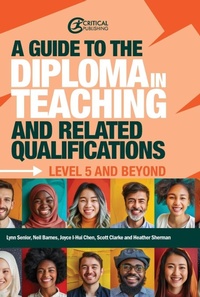
A Guide to the Diploma in Teaching and Related Qualifications
Description
More details
Other editions
Additional editions
Persons
Lynn Senior has held a variety of teaching and management roles in further and higher education. She was the Director of the Education and Training Consortium, University of Huddersfield, for four years and has a total of over 30 years' experience within the sectors.
Neil Barnes is the Head of Professional Accreditation and Quality in the Faculty for Education, Health and Human Sciences at the University of Greenwich.
Joyce I-Hui Chen has worked in a range of educational sectors for more than 20 years, abroad and in the UK. She is a quality enhancement manager at the College of West Anglia, managing initial teacher education programmes, a LSRN co-convenor for East Anglia and one of the co-founders of CWARIF (the College of West Anglia Research and Innovation Forum).
Scott Clarke is the centre manager and programme leader for teacher education at the City of Liverpool College where he leads and teaches on both the pre-service and in-service Cert Ed and PGCE.
Heather Sherman has over a decade of experience working in the secondary and further education and skills sectors, starting her career as a secondary history teacher.
Content
PART 1: INTRODUCTION Glossary Chapter 1 The FES sectorA Brief history and overview of the sector Routes into teaching post-14 (Level 5 and above) Professional standards Occupational standards ATLS/QTLS The inspection process PART 2 LEARNERS AND LEARNING Chapter 2 THE FES learner The Learner and their characteristics The post 14 educational offer (BTEC, A Level, apprenticsehips etc) Embedding of English and mathematics Legal and Regulatory Practices (SEND/PREVENT) Chapter 3 SEND in the FES Sector What is a SEND learner? Range of needs and characteristics of the SEND learner, recognizing SEND in the classroom Inclusive practice for the SEND Learner Chapter 4 The emotional health of the learner Mental health and well-being - definitions Trauma informed pedagogy Behavioural issues such as Oppositional Defiant Disorder (ODD) and Conduct Disorder (CD) Anxiety, Depression Eating disorders Self harm Post-Covid issues Recognising and supporting young people with mental health Signposting Chapter 5 The learning processContemporary learning theory and neuroscience Role and currency of research and evidence Application of theory to practice Encouraging learners to be independent and aim high PART 3 TEACHERS AND TEACHING Chapter 6 The FES Teacher The role and responsibilities of a teacher What makes a good teacher? Working with and learning from other teachers Other sources of support The dual professional Chapter 7 Planning for teaching and learning Rigorous curriculum thinking and Curriculum for inclusive practice Person-centred approach Planning and delivering sessions Developing inclusive resources to meet learner needs. Teacher expectations of learners including classroom management F2F and remote delivery Assessment and feedback The Reflective Teacher Effective Communication Chapter 8 Inclusive teachingEquality, Inclusion and Diversity in teaching Decolonising the curriculum CHAPTER 9 Effective digital and on-line pedagogies Range of Ed Tech AI, AR, VR etc Managing digital delivery On-Line pedagogies Digital technologies legal and regulatory responsibility PART 4 PROFESSIONAL PRACTICE FOR THE TEACHER Chapter 10 Teaching practice requirements Preparation for placement