

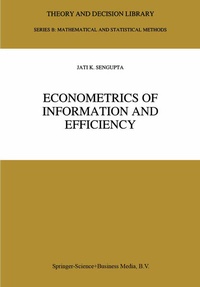
Econometrics of Information and Efficiency
Published on 8. December 2010
Book
Paperback/Softback
X, 258 pages
978-90-481-4288-0 (ISBN)
Description
Econometrics as an applied discipline attempts to use information in a most efficient manner, yet the information theory and entropy approach developed by Shannon and others has not played much of a role in applied econometrics.
Econometrics of Information and Efficiency
bridges the gap.
Broadly viewed, information theory analyzes the uncertainty of a given set of data and its probabilistic characteristics. Whereas the economic theory of information emphasizes the value of information to agents in a market, the entropy theory stresses the various aspects of imprecision of data and their interactions with the subjective decision processes. The tools of information theory, such as the maximum entropy principle, mutual information and the minimum discrepancy are useful in several areas of statistical inference, e.g., Bayesian estimation, expected maximum likelihood principle, the fuzzy statistical regression. This volume analyzes the applications of these tools of information theory to the most commonly used models in econometrics.
The outstanding features of Econometrics of Information and Efficiency are:
Broadly viewed, information theory analyzes the uncertainty of a given set of data and its probabilistic characteristics. Whereas the economic theory of information emphasizes the value of information to agents in a market, the entropy theory stresses the various aspects of imprecision of data and their interactions with the subjective decision processes. The tools of information theory, such as the maximum entropy principle, mutual information and the minimum discrepancy are useful in several areas of statistical inference, e.g., Bayesian estimation, expected maximum likelihood principle, the fuzzy statistical regression. This volume analyzes the applications of these tools of information theory to the most commonly used models in econometrics.
The outstanding features of Econometrics of Information and Efficiency are:
- A critical survey of the uses of information theory in economics and econometrics;
- An integration of applied information theory and economic efficiency analysis;
- The development of a new economic hypothesis relating information theory to economic growth models;
- New lines of research are emphasized.
Reviews / Votes
` I would recommend it highly to graduate students and researchers who are engaged in information-based economics. 'The Statistician, 44:2, 1995
More details
Series
Edition
Softcover reprint of hardcover 1st ed. 1993
Language
English
Place of publication
Dordrecht
Netherlands
Target group
Professional and scholarly
Research
Illustrations
X, 258 p.
Dimensions
Height: 235 mm
Width: 155 mm
Thickness: 15 mm
Weight
417 gr
ISBN-13
978-90-481-4288-0 (9789048142880)
DOI
10.1007/978-94-015-8202-5
Schweitzer Classification
Other editions
Additional editions
Jati Sengupta
Econometrics of Information and Efficiency
Book
07/1993
Kluwer Academic Publishers
€160.49
Shipment within 15-20 days
Content
1 Introduction to Information.- 2 Applied Information Theory.- 3 Information Theory in Econometrics.- 4 Applications in Control Theory and Operations Research.- 5 Economic Theories of Information.- 6 Econometrics and Entropy Theory.- References.