

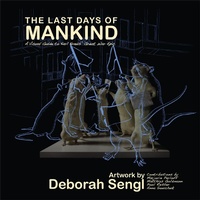
The Last Days of Mankind
A Visual Guide to Karl Kraus' Great War Epic
Will be published approx. on 14. February 2019
Book
Hardback
176 pages
978-0-9997544-1-2 (ISBN)
Description
The Great War drama by Viennese satirist Karl Kraus, restaged by Sengl in "stunning display" of taxidermied rat-actors, with commentary.
When the age died by its own hand, that hand was Karl Kraus'.
- Bertolt Brecht
PUBLISHERS WEEKLY - TOP 10 IN ART, ARCHITECTURE & PHOTOGRAPHY, Fall 2018
With critical success over the past four years, artist Deborah Sengl (b. 1974) has exhibited taxidermied rats, drawings and paintings in order to restage Karl Kraus' nearly-unperformable play The Last Days of Mankind (Die Letzten Tage der Menschheit, 1915-22). Featuring Sengl's entire installation, the DoppelHouse Press edition also includes essays that examine her ambitious dramaturgy, which condenses Kraus' ten-to-fifteen hour drama into an abridged reading of its themes: human barbarism, the role of journalism in war, the sway of popular opinion and the absurdities of nationalism. Select translations of Kraus' original provide a window to see his other "war" - a war on the misuses of language itself.
Published in conjunction with the centenary anniversary of the Armistice, which ended The Great War but bred another soon to come, this edition of The Last Days of Mankind offers an agit-prop protest crossing the boundaries of art and spanning the knowledge of the century that has passed since Kraus penned his play. Deborah Sengl offers her stylistic model for envisioning human folly through animal actors, who become more than human, while confronting a violence particular to humankind, laced with selfishness and greed.
Contributors include modernist poetry scholar Marjorie Perloff (The Edge of Irony, University of Chicago Press 2015); arts writer Matthias Goldmann; Paul Reitter (editor/contributor to Jonathan Franzen's The Kraus Project, Harper, 2013); and Associate Professor of German, Anna Souchuk.
When the age died by its own hand, that hand was Karl Kraus'.
- Bertolt Brecht
PUBLISHERS WEEKLY - TOP 10 IN ART, ARCHITECTURE & PHOTOGRAPHY, Fall 2018
With critical success over the past four years, artist Deborah Sengl (b. 1974) has exhibited taxidermied rats, drawings and paintings in order to restage Karl Kraus' nearly-unperformable play The Last Days of Mankind (Die Letzten Tage der Menschheit, 1915-22). Featuring Sengl's entire installation, the DoppelHouse Press edition also includes essays that examine her ambitious dramaturgy, which condenses Kraus' ten-to-fifteen hour drama into an abridged reading of its themes: human barbarism, the role of journalism in war, the sway of popular opinion and the absurdities of nationalism. Select translations of Kraus' original provide a window to see his other "war" - a war on the misuses of language itself.
Published in conjunction with the centenary anniversary of the Armistice, which ended The Great War but bred another soon to come, this edition of The Last Days of Mankind offers an agit-prop protest crossing the boundaries of art and spanning the knowledge of the century that has passed since Kraus penned his play. Deborah Sengl offers her stylistic model for envisioning human folly through animal actors, who become more than human, while confronting a violence particular to humankind, laced with selfishness and greed.
Contributors include modernist poetry scholar Marjorie Perloff (The Edge of Irony, University of Chicago Press 2015); arts writer Matthias Goldmann; Paul Reitter (editor/contributor to Jonathan Franzen's The Kraus Project, Harper, 2013); and Associate Professor of German, Anna Souchuk.
Reviews / Votes
No folly, no mendacity is exempt from Kraus' gaze.- Marjorie Perloff Sengl expressly states that she is not in a position to offer a quick solution for all the injustices of our times. But her works urge us to cast a more open and more empathic view of our environment, and that would already be a very commendable first step.- Acid Rain Certainly eye-catching.
- Publishers Weekly The Last Days of Mankind is, naturally enough, about the First World War, and about all war, but it is also about what our civilization is and about who we are. That is why, like all great works of art, it is, and will always remain, a 'contemporary' work. Those questions; who we are, what are our beliefs and values, what do we stand for, are as urgent today as they were in 1914-18 and its aftermath. Kraus, like the other three great writers he stands beside (Aristophanes, Juvenal, Swift) [...] is the voice we need to hear.- Michael Russell, author of City of Shadows and City of Lies [Deborah Sengl's] stunning display of 176 taxidermied rats as actors presenting forty-four scenes from The Last Days of Mankind deliver[s] a bracing test of [the play's] potential. [...] The preparation, costuming and posing of the rats as well as the meticulous attention to miniature props - facsimiles of period newspapers, a factory owner's top hat and bow tie, the sample cases of traveling salesmen, infantry rifles - reflect a deep knowledge of Kraus' text and disciplined commitment to an unconventional representation of its meaning. The powerful effect of this large assemblage of monochromatic tableaux is heightened by juxtaposition with the preparatory drawings, which were exhibited next to them and are beautifully reproduced in the catalogue. These delicate line drawings all use color, sparingly but pointedly, so that the viewer is inevitably drawn to a comparison with the corresponding tableaux. Seen up close, as they are in the catalogue photographs, which include some unsettling enlargements, every white rat's cocked head, gaping mouth, or crooked claw points back to the linguistic physiognomy of the speakers of a war-contaminated language who people Kraus' drama.
- Leo Lensing, "Karl Kraus at War", Times Literary Supplement When the age died by its own hand, that hand was Karl Kraus'.
- Bertolt Brecht Modern fables for adults.- Widewalls The initial reaction to seeing the white rats wearing the tiny corsets and holding rat-sized guns results in deeply conflicted emotions. Cuteness and horror collide in these miniature scenes. [...] Sengl continues the legacy of acid-tongued Austrian artists from Kraus and Kafka to more contemporary voices like Thomas Bernhard and Elfriede Jelinek. Her adaptation of Kraus' war epic, The Last Days of Mankind, makes it more accessible to audiences and helps to render the experimental play into a more comprehensible whole.
- New York Journal of Books
More details
Language
English
Place of publication
Los Angeles
United States
Edition type
Abridged edition
Product notice
Paper over boards
Illustrations
Illustrations
Dimensions
Height: 206 mm
Width: 206 mm
Thickness: 15 mm
Weight
612 gr
ISBN-13
978-0-9997544-1-2 (9780999754412)
Copyright in bibliographic data and cover images is held by Nielsen Book Services Limited or by the publishers or by their respective licensors: all rights reserved.
Schweitzer Classification
Persons
Deborah Sengl (b. 1974, Vienna) is an Austrian artist whose paintings, drawings and sculptures pose questions about the role of individual identity in modern society. She uses taxidermied animal actors staged in tableaux and two-dimensional works of human-animal chimera that suggest a cathartic release of violence and trauma associated with institutions, culture, politics, consumerism, poverty, and leisure. Recent solo exhibitions include the Essl Museum of Contemporary Art; IFK, Linz; Museum of Modern Art, Carinthia; Galerie Geschler (Berlin); Galerie Hilger (Vienna); and the National Gallery in Tirana, Albania. She studied art at both the University of Applied Arts in Vienna and the University of Art in Berlin, and has made a secondary career in costume design.
Content
Deborah Sengl's Karl Kraus
Marjorie Perloff
The Mousetrap
The Turn to Abstraction
Representation
"The Document Is a Figure"
Matthias Goldmann
Conversion of Horror into Words
Operetta Figures Play out the Tragedy of Mankind
Come Forward and Be Silent
Masks of the Tragic Carnival
Flesh for Blood and Blood for Ink
The Word Died
Trench Rats
Anna C. Souchuk
Miniatures
Taxidermy and Tableau: An Invitation to Look at Animals
Metaphorical Animals: The Role of Rats in the Stories Humans Tell
The Last Days of Mankind [installation images and excerpts from Karl Kraus' play]
Deborah Sengl
Afterword
Paul Reitter
Bibliography
Index
Acknowledgments
Marjorie Perloff
The Mousetrap
The Turn to Abstraction
Representation
"The Document Is a Figure"
Matthias Goldmann
Conversion of Horror into Words
Operetta Figures Play out the Tragedy of Mankind
Come Forward and Be Silent
Masks of the Tragic Carnival
Flesh for Blood and Blood for Ink
The Word Died
Trench Rats
Anna C. Souchuk
Miniatures
Taxidermy and Tableau: An Invitation to Look at Animals
Metaphorical Animals: The Role of Rats in the Stories Humans Tell
The Last Days of Mankind [installation images and excerpts from Karl Kraus' play]
Deborah Sengl
Afterword
Paul Reitter
Bibliography
Index
Acknowledgments