

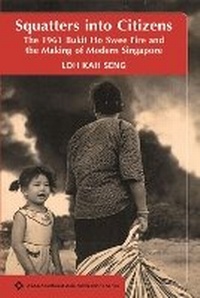
Squatters Into Citizens
The 1961 Bukit Ho Swee Fire and the Making of Modern Singapore
Will be published approx. on 1. September 2013
Book
Paperback/Softback
300 pages
978-87-7694-122-2 (ISBN)
Description
The crowded, bustling, 'squatter' kampongs so familiar across Southeast Asia have long since disappeared from Singapore, leaving few visible traces of their historical influence on the life in the city-state. In one such settlement, located in an area known as Bukit Ho Swee, a great fire in 1961 destroyed the kampong and left 16,000 people homeless, creating a national emergency that led to the first big public housing project of the new Housing and Development Board (HDB). HDB flats now house more than four-fifths of the Singapore population, making the aftermath of the Bukit Ho Swee fire a seminal event in modern Singapore.
Loh Kah Seng grew up in one-room rental flats in the HDB estate built after the fire. Drawing on oral history interviews, official records and media reports, he describes daily life in squatter communities and how people coped with the hazard posed by fires. His examination of the catastrophic events of 25 May 1961 and the steps taken by the new government of the People's Action Party in response to the disaster show the immediate consequences of the fire and how relocation to public housing changed the people's lives. Through a narrative that is both vivid and subtle, the book explores the nature of memory and probes beneath the hard surfaces of modern Singapore to understand the everyday life of the people who live in the city.
Loh Kah Seng grew up in one-room rental flats in the HDB estate built after the fire. Drawing on oral history interviews, official records and media reports, he describes daily life in squatter communities and how people coped with the hazard posed by fires. His examination of the catastrophic events of 25 May 1961 and the steps taken by the new government of the People's Action Party in response to the disaster show the immediate consequences of the fire and how relocation to public housing changed the people's lives. Through a narrative that is both vivid and subtle, the book explores the nature of memory and probes beneath the hard surfaces of modern Singapore to understand the everyday life of the people who live in the city.
Reviews / Votes
"This excellent book makes a major contribution to our understanding of the social history of post-war/postcolonial Singapore, and more generally to the interdisciplinary field of disaster studies. The author's study of the 1961 Kampong Bukit Ho Swee fire demonstrates the role of this event and its aftermath in establishing Singapore as a high-modernist nation-state. Loh Kah Seng makes extensive use of oral history interviews in this important book, located at the intersection of history, ethnography and sociology, to provide new perspectives on Singapore's housing system - one of the most distinctive in the world." (James Francis Warren, Murdoch University, author of 'Rickshaw Coolie: A People's History of Singapore, 1880 - 1940')More details
Series
Language
English
Place of publication
Copenhagen
Denmark
Target group
College/higher education
Dimensions
Height: 229 mm
Width: 152 mm
ISBN-13
978-87-7694-122-2 (9788776941222)
Copyright in bibliographic data and cover images is held by Nielsen Book Services Limited or by the publishers or by their respective licensors: all rights reserved.
Schweitzer Classification
Person
Loh Kah Seng is Assistant Professor at the Institute of East Asian Studies, Sogang University.
Content
Preface and Acknowledgements 1. Fire: A Catalyst for Modern Singapore 2. Hopeful Migrants in the Urban Kampongs 3. A 'Black Area' 4. 'A Roar from the Oppressed People' 5. Fires and Experiments with Emergency Housing 6. The Inferno 7. State of Emergency 8. Nine Months 9. Bukit Ho Swee Estate 10. Memory, Myth and Identity Conclusion Bibliography Index