

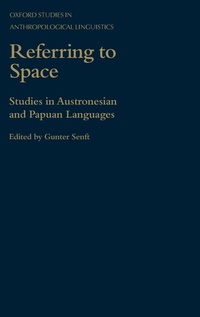
Referring to Space
Studies in Austronesian and Papuan Languages
Published on 27. November 1997
Book
Hardback
340 pages
978-0-19-823647-4 (ISBN)
Description
The first aim of this anthology is to illustrate the variety of resources that Austronesian and Papuan languages offer their speakers for referring to space. The languages here described are spread from Madagascar to Tonga, and there are many differences between them. They also offer a striking contrast to Indo-European languages, and call into question universalistic claims about human spatial concepts and spatial reference based solely on evidence from Indo-European languages and their speakers.
There are, however, striking parallels between the kinds of systems that languages offer and that their speakers employ when referring to space. Understanding the differences in the ways that coordinate systems are used requires not only linguistic, but also cultural, historical, and geographical knowledge. Thus the second aim of the collection is to illustrate the necessity of an interdisciplinary approach to the topic of space if we are to understand the underlying logic of conceptions of space manifest in verbal expressions.
The first three papers offer overviews of the conception of space in Austronesian languages and analyse the coordinate systems employed for spatial reference. The seven papers which follow offer anthropological linguistic descriptions of directionals and locatives in Austronesian and Papuan languages, and the last three contributions offer a more structurally-oriented perspective.
There are, however, striking parallels between the kinds of systems that languages offer and that their speakers employ when referring to space. Understanding the differences in the ways that coordinate systems are used requires not only linguistic, but also cultural, historical, and geographical knowledge. Thus the second aim of the collection is to illustrate the necessity of an interdisciplinary approach to the topic of space if we are to understand the underlying logic of conceptions of space manifest in verbal expressions.
The first three papers offer overviews of the conception of space in Austronesian languages and analyse the coordinate systems employed for spatial reference. The seven papers which follow offer anthropological linguistic descriptions of directionals and locatives in Austronesian and Papuan languages, and the last three contributions offer a more structurally-oriented perspective.
Reviews / Votes
This valuable collection offers a firm empirical and methodologically rigorous account of the psychological, linguistic, and conceptual processes by which human beings relate to space. As such, it provides a foundation for all of the other contemporary interests in space, place, and locality across the disciplines of anthrology, cultural studies, history and comparative aesthetics. * James F. Weiner, Anthropological Linguistics, 42, No.2. * An attraction of this book is that it covers both Austronesian and Papuan languages, something which is needed on other topics as well ... The papers are uniformly excellent and the book is edited to a high standard ... it is certainly a very welcome addition to the literature. * R H Barnes, Anthropos 94.1999 *More details
Series
Language
English
Place of publication
Oxford
United Kingdom
Target group
Professional and scholarly
Illustrations
line figures, tables
Dimensions
Height: 240 mm
Width: 161 mm
Thickness: 23 mm
Weight
675 gr
ISBN-13
978-0-19-823647-4 (9780198236474)
Copyright in bibliographic data and cover images is held by Nielsen Book Services Limited or by the publishers or by their respective licensors: all rights reserved.
Schweitzer Classification