

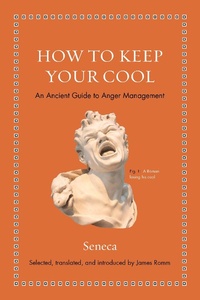
How to Keep Your Cool
An Ancient Guide to Anger Management
Published on 19. February 2019
Book
Hardback
240 pages
978-0-691-18195-0 (ISBN)
Description
Timeless wisdom on controlling anger in personal life and politics from the Roman Stoic philosopher and statesman Seneca
In his essay "On Anger" (De Ira), the Roman Stoic thinker Seneca (c. 4 BC-65 AD) argues that anger is the most destructive passion: "No plague has cost the human race more dear." This was proved by his own life, which he barely preserved under one wrathful emperor, Caligula, and lost under a second, Nero. This splendid new translation of essential selections from "On Anger," presented with an enlightening introduction and the original Latin on facing pages, offers readers a timeless guide to avoiding and managing anger. It vividly illustrates why the emotion is so dangerous and why controlling it would bring vast benefits to individuals and society.
Drawing on his great arsenal of rhetoric, including historical examples (especially from Caligula's horrific reign), anecdotes, quips, and soaring flights of eloquence, Seneca builds his case against anger with mounting intensity. Like a fire-and-brimstone preacher, he paints a grim picture of the moral perils to which anger exposes us, tracing nearly all the world's evils to this one toxic source. But he then uplifts us with a beatific vision of the alternate path, a path of forgiveness and compassion that resonates with Christian and Buddhist ethics.
Seneca's thoughts on anger have never been more relevant than today, when uncivil discourse has increasingly infected public debate. Whether seeking personal growth or political renewal, readers will find, in Seneca's wisdom, a valuable antidote to the ills of an angry age.
In his essay "On Anger" (De Ira), the Roman Stoic thinker Seneca (c. 4 BC-65 AD) argues that anger is the most destructive passion: "No plague has cost the human race more dear." This was proved by his own life, which he barely preserved under one wrathful emperor, Caligula, and lost under a second, Nero. This splendid new translation of essential selections from "On Anger," presented with an enlightening introduction and the original Latin on facing pages, offers readers a timeless guide to avoiding and managing anger. It vividly illustrates why the emotion is so dangerous and why controlling it would bring vast benefits to individuals and society.
Drawing on his great arsenal of rhetoric, including historical examples (especially from Caligula's horrific reign), anecdotes, quips, and soaring flights of eloquence, Seneca builds his case against anger with mounting intensity. Like a fire-and-brimstone preacher, he paints a grim picture of the moral perils to which anger exposes us, tracing nearly all the world's evils to this one toxic source. But he then uplifts us with a beatific vision of the alternate path, a path of forgiveness and compassion that resonates with Christian and Buddhist ethics.
Seneca's thoughts on anger have never been more relevant than today, when uncivil discourse has increasingly infected public debate. Whether seeking personal growth or political renewal, readers will find, in Seneca's wisdom, a valuable antidote to the ills of an angry age.
Reviews / Votes
"This is a well-produced, stimulating book and a worthy addition to an excellent series."---Ray Morris, Classics for All "This is wisdom down the ages." * Paradigm Explorer *More details
Series
Language
English
Place of publication
New Jersey
United States
Product notice
Trade binding
Dimensions
Height: 177 mm
Width: 118 mm
Thickness: 22 mm
Weight
272 gr
ISBN-13
978-0-691-18195-0 (9780691181950)
Copyright in bibliographic data and cover images is held by Nielsen Book Services Limited or by the publishers or by their respective licensors: all rights reserved.
Schweitzer Classification
Other editions
Additional editions
E-Book
02/2019
1st Edition
Princeton University Press
from
€67.95
Available for download
Persons
James Romm is the editor and translator of Seneca's How to Die: An Ancient Guide to the End of Life (Princeton) and the author of Dying Every Day: Seneca at the Court of Nero (Knopf). He has written for the New York Review of Books and the Wall Street Journal, among other publications. He is the James H. Ottaway Jr. Professor of Classics at Bard College and lives in Barrytown, New York.