

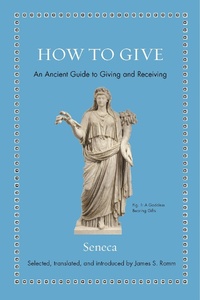
How to Give
An Ancient Guide to Giving and Receiving
Published on 20. October 2020
Book
Hardback
288 pages
978-0-691-19209-3 (ISBN)
Description
Timeless wisdom on generosity and gratitude from the great Stoic philosopher Seneca
To give and receive well may be the most human thing you can do-but it is also the closest you can come to divinity. So argues the great Roman Stoic thinker Seneca (c. 4 BCE-65 CE) in his longest and most searching moral treatise, "On Benefits" (De Beneficiis). James Romm's splendid new translation of essential selections from this work conveys the heart of Seneca's argument that generosity and gratitude are among the most important of all virtues.
For Seneca, the impulse to give to others lies at the very foundation of society; without it, we are helpless creatures, worse than wild beasts. But generosity did not arise randomly or by chance. Seneca sees it as part of our desire to emulate the gods, whose creation of the earth and heavens stands as the greatest gift of all. Seneca's soaring prose captures his wonder at that gift, and expresses a profound sense of gratitude that will inspire today's readers.
Complete with an enlightening introduction and the original Latin on facing pages, How to Give is a timeless guide to the profound significance of true generosity.
To give and receive well may be the most human thing you can do-but it is also the closest you can come to divinity. So argues the great Roman Stoic thinker Seneca (c. 4 BCE-65 CE) in his longest and most searching moral treatise, "On Benefits" (De Beneficiis). James Romm's splendid new translation of essential selections from this work conveys the heart of Seneca's argument that generosity and gratitude are among the most important of all virtues.
For Seneca, the impulse to give to others lies at the very foundation of society; without it, we are helpless creatures, worse than wild beasts. But generosity did not arise randomly or by chance. Seneca sees it as part of our desire to emulate the gods, whose creation of the earth and heavens stands as the greatest gift of all. Seneca's soaring prose captures his wonder at that gift, and expresses a profound sense of gratitude that will inspire today's readers.
Complete with an enlightening introduction and the original Latin on facing pages, How to Give is a timeless guide to the profound significance of true generosity.
Reviews / Votes
"In a helpful running commentary that accompanies his vigorous translation, [James] Romm glosses Seneca to mean that the best gifts are given anonymously and received gratefully. . . . For the stoically inclined, a fine vade mecum come donation time." * Kirkus Reviews * "Engaging. . . . [Seneca] has seldom seemed wiser."---Steven Donoghue, Open Letters "[Romm] is very helpful in his introduction . . . [and his] short summations show a clear mastery of his material."---Ray Morris, Classics for All "Thoughtful advice. . . . How to Give is as much about receiving as it is about giving."---John J. Miller, National Review "This new translation of Seneca the Younger's De Beneficiis has insights for both givers and receivers, confirming that the questions surrounding philanthropy-and how to receive as well as to give graciously-are of enduring importance."---Austin Detwiler, Philanthropy DailyMore details
Series
Language
English
Place of publication
New Jersey
United States
Product notice
Trade binding
Dimensions
Height: 180 mm
Width: 122 mm
Thickness: 25 mm
Weight
345 gr
ISBN-13
978-0-691-19209-3 (9780691192093)
Copyright in bibliographic data and cover images is held by Nielsen Book Services Limited or by the publishers or by their respective licensors: all rights reserved.
Schweitzer Classification
Other editions
Additional editions
E-Book
10/2020
1st Edition
Princeton University Press
€16.49
Available for download
Persons
James Romm is the editor and translator of Seneca's How to Keep Your Cool and How to Die (both Princeton) and the author of Dying Every Day: Seneca at the Court of Nero. He has written for the Wall Street Journal, the New York Review of Books, and the London Review of Books, among other publications. He is the James H. Ottaway Jr. Professor of Classics at Bard College and lives in Barrytown, New York.