

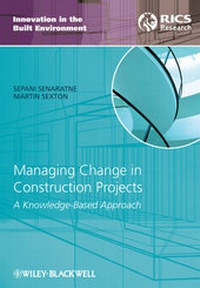
Managing Change in Construction Projects
A Knowledge-Based Approach
Published on 4. February 2011
Book
Hardback
200 pages
978-1-4443-3515-6 (ISBN)
Description
Managing Change in Construction Projects: a knowledge-based approach offers a new perspective on construction project change by viewing the process of change management as a knowledge-intensive activity, where team members bring their tacit and explicit knowledge into the situation; share, create and capture this collective knowledge for future re-use in similar situations.
Through this knowledge-based approach, construction teams can successfully resolve and learn from change events, leading to an overall improved performance of the industry.
The book will make a significant contribution to our understanding of construction project change by offering new theoretical and practical insights and models grounded in results of case studies conducted within two collaborative construction project team settings.
By demonstrating how the social construction of knowledge works in construction settings, the authors challenge the prevailing change management solutions based on 'hard' IT approaches. They put forward a balanced view that incorporates both IT-based and socially constructed approaches to effective management of construction project change.
* helps construction managers to improve and learn through the process of construction project change
* presents new theoretical models and offers practical guidelines
* first research-based book to directly address project change from a knowledge-based perspective
* draws on detailed studies with construction companies, including Ballast Construction and Kier Construction.
* encourages a move from the information driven, process integrated approach to a knowledge-based view
Reviews / Votes
"Managing Change in Construction Projects is a book that seems not to know its purpose. It is a beautifully written research publication, but one that presents in the style of a PhD or major research project, and seems well described by the abstract for the first author's thesis, although no such acknowledgement or reference is givens." (Construction Management and Economics, 1 February 2012) "This volume will appeal to advanced students of management theory and high level planners in the building industry." (Book News, 1 March 2011)More details
Product info
gebunden
Series
Edition
1. Auflage
Language
English
Place of publication
Hoboken
United Kingdom
Publishing group
John Wiley and Sons Ltd
Target group
Professional and scholarly
Product notice
sewn/stitched
Paper over boards
Dimensions
Height: 246 mm
Width: 175 mm
Thickness: 15 mm
Weight
576 gr
ISBN-13
978-1-4443-3515-6 (9781444335156)
Schweitzer Classification
Other editions
Additional editions
E-Book
01/2011
Wiley-Blackwell
€103.99
Available for download
E-Book
01/2011
Wiley-Blackwell
€103.99
Available for download
Persons
Sepani Senaratne, Senior Lecturer, Department of Building Economics, University of Moratuwa, Sri Lanka.
Professor Martin Sexton, Director of Research, School of Construction Management and Engineering, University of Reading, UK
Content
About the Authors.
Chapter 1 Introduction.
1.1 Background.
1.2 Need for the Investigation.
1.3 Questions to Research.
1.4 Summary and Link.
Chapter 2 Key Issues from the Literature.
2.1 Introduction.
2.2 Construction Project Environment.
2.3 Construction Project Change Management.
2.4 Knowledge Management Perspective.
2.5 Role of Knowledge During Reactive Change Process.
2.6 Towards a Knowledge-Based Reactive Change Process.
2.7 Summary and Link.
Chapter 3 Research Methodology.
3.1 Introduction.
3.2 Case Study Research Design.
3.3 Data Collection Process.
3.4 Data Analysis Process.
3.5 Summary and Link.
Chapter 4 Case Study Results.
4.1 Introduction.
4.2 Case Study: Project A.
4.3 Case Study: Project B.
4.4 Summary and Link.
Chapter 5 Cross-Case Analysis.
5.1 Introduction.
5.2 Contextual Factors of Change: P1 Discussion.
5.3 Knowledge Properties During Change: P2 Discussion.
5.4 Knowledge Identification and Utilisation During
Change: P3 Discussion.
5.5 Intra-Project Knowledge Creation During Change:
P4 Discussion.
5.6 Inter-Project Knowledge Transfer During Change:
P5 Discussion.
5.7 Summary and Link.
Chapter 6 Conclusions.
6.1 Introduction.
6.2 Summary of Propositions.
6.3 Comment on the Conceptual Model.
6.4 Conclusions about the Overall Research Problem.
6.5 Implications for Theory.
6.6 Implications for Practice.
Appendix A Interview Guidelines.
Appendix B Example of an Interview Transcript.
Appendix C Comparison Between Propositions and Codes.
References.
Index.