

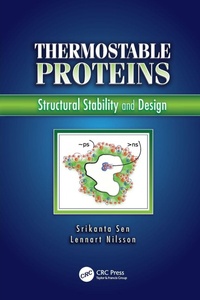
Thermostable Proteins
Structural Stability and Design
1st Edition
Published on 22. May 2017
Book
Paperback/Softback
188 pages
978-1-138-11482-1 (ISBN)
Description
Thermostable Proteins: Structural Stability and Design provides a comprehensive, updated account of the physical basis of enhanced stability of thermophilic proteins and the design of tailor-made thermostable proteins, paving the way for their possible industrial applications. This book is devoted to understanding the survival mechanisms of "thermophilic life forms" at the molecular level with an emphasis on design strategies.
The review chapters presented in Thermostable Proteins span a wide range of protein thermostability research. Basic structural, thermodynamic, and kinetic principles are explained and molecular strategies for the adaptation to high temperatures are delineated. In addition, this book covers:
Computing and simulation methods in current and future thermostability research, especially in nonempirical situations
How rigidity theory is used to improve the thermal adaptation of mesophiles
Subtilisin-like serine proteases and their significant engineering applications
The state of knowledge concerning structure-function relations and the origins of their structural stability
Computational and experimental approaches for the design of proteins with increased thermal stability based on sequences or three-dimensional structures
Understanding the molecular basis of how thermostable and hyperthermostable proteins gain and maintain their stability and biological function at high temperatures remains an important scientific challenge. A more detailed knowledge of protein stability not only deepens our understanding of protein structure but also helps in obtaining insights into processes that drive protein activities-folding, unfolding, and misfolding-essential to biological function.
The review chapters presented in Thermostable Proteins span a wide range of protein thermostability research. Basic structural, thermodynamic, and kinetic principles are explained and molecular strategies for the adaptation to high temperatures are delineated. In addition, this book covers:
Computing and simulation methods in current and future thermostability research, especially in nonempirical situations
How rigidity theory is used to improve the thermal adaptation of mesophiles
Subtilisin-like serine proteases and their significant engineering applications
The state of knowledge concerning structure-function relations and the origins of their structural stability
Computational and experimental approaches for the design of proteins with increased thermal stability based on sequences or three-dimensional structures
Understanding the molecular basis of how thermostable and hyperthermostable proteins gain and maintain their stability and biological function at high temperatures remains an important scientific challenge. A more detailed knowledge of protein stability not only deepens our understanding of protein structure but also helps in obtaining insights into processes that drive protein activities-folding, unfolding, and misfolding-essential to biological function.
More details
Language
English
Place of publication
London
United Kingdom
Publishing group
Taylor & Francis Ltd
Target group
College/higher education
Scientists working in the areas of (i) understanding protein structures and stabilities, (ii) protein designing, (iii) understanding the physical mechanisms of extremophiles at the molecular level, and (iv) interdisciplinary areas of soft condensed matter physics
Illustrations
53 s/w Abbildungen, 32 farbige Abbildungen, 5 s/w Tabellen
5 Tables, black and white; 32 Illustrations, color; 53 Illustrations, black and white
Dimensions
Height: 234 mm
Width: 156 mm
Thickness: 10 mm
Weight
295 gr
ISBN-13
978-1-138-11482-1 (9781138114821)
Copyright in bibliographic data and cover images is held by Nielsen Book Services Limited or by the publishers or by their respective licensors: all rights reserved.
Schweitzer Classification
Other editions
Additional editions
E-Book
04/2016
1st Edition
CRC Press
€104.99
Available for download
E-Book
04/2016
1st Edition
CRC Press
€104.99
Available for download
Book
10/2011
1st Edition
CRC Press
€297.20
Shipment within 15-20 days
Persons
Dr. Srikanta Sen is currently working as a Senior Fellow at Chembiotek, a TCG Life Sciences group of companies in India. He has developed the Molecular Modeling and Computational Biology group of Chembiotek and has been leading the group for the last ten years. He received his M.Sc. degree in physics from Calcutta University, India. He pursued his Ph.D. work at the Theory Division of Saha Institute of Nuclear Physics, Calcutta and received his Ph.D. degree in Physics in 1991 from Calcutta University. He did his post-doctoral research between 1992 - 1998 at Umea University, Stockholm University and Karolinska Institute in Sweden. He then worked in Indian Institute of Chemical Biology in Calcutta, India for two years. He moved over to Chembiotek in 2001.
His research interest includes application of statistical mechanics to biomolecular systems; molecular modeling based investigations of structural, dynamical and interactional behaviors of biomolecules and their complexes; protein design; pharmacophore modeling; molecular docking and virtual screening of compounds to find leads in drug discovery projects; drug design; as well as QSPR based prediction of properties of compounds from their structures. He has also developed many computational tools to facilitate the research work of his group.
Prof. Lennart Nilsson is currently working at Karolinska Institutet, Stockholm, Sweden, where he leads a research group in Molecular Modeling since 20 years. He obtained his M.Sc. degree in engineering physics as well as his PhD in theoretical physics (1983) from the Royal Institute of Technology, Stockholm. He did his post-doctoral research 1983-1984 at Harvard University.
His research interests include protein-nucleic acid interactions, especially transcription factors and the ribosome, and questions concerning information transfer in biomolecular complexes. He is one of the core developers of the CHARMM molecular simulation program.
His research interest includes application of statistical mechanics to biomolecular systems; molecular modeling based investigations of structural, dynamical and interactional behaviors of biomolecules and their complexes; protein design; pharmacophore modeling; molecular docking and virtual screening of compounds to find leads in drug discovery projects; drug design; as well as QSPR based prediction of properties of compounds from their structures. He has also developed many computational tools to facilitate the research work of his group.
Prof. Lennart Nilsson is currently working at Karolinska Institutet, Stockholm, Sweden, where he leads a research group in Molecular Modeling since 20 years. He obtained his M.Sc. degree in engineering physics as well as his PhD in theoretical physics (1983) from the Royal Institute of Technology, Stockholm. He did his post-doctoral research 1983-1984 at Harvard University.
His research interests include protein-nucleic acid interactions, especially transcription factors and the ribosome, and questions concerning information transfer in biomolecular complexes. He is one of the core developers of the CHARMM molecular simulation program.
Content
Delineation of the Conformational Thermostability of Hyperthermophilic Proteins Based on Structural and Biophysical Analyses. Role of Packing, Hydration, and Fluctuations on Thermostability. Analyzing Protein Rigidity for Understanding and Improving Thermal Adaptation. Thermostable Subtilases (Subtilisin-Like Serine Proteinases). Combined Computational and Experimental Approaches to Sequence-Based Design of Protein Thermal Stability. Designing Thermophilic Proteins: A Structure-Based Computational Approach. Index.