

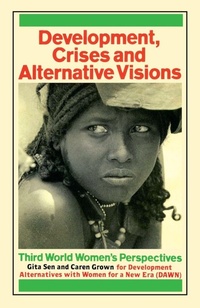
Development Crises and Alternative Visions
Third World Women's Perspectives
1st Edition
Published on 1. March 1998
Book
Paperback/Softback
124 pages
978-1-85383-000-6 (ISBN)
Description
More than half of the world's farmers are women. They are the majority of the poor, the uneducated and are the first to suffer from drought and famine. Yet their subordination is reinforced by well-meaning development policies that perpetuate social inequalities. During the 1975-85 United Nations Decade for the Advancement of Women their position actually worsened.
This book analyses three decades of policies towards Third World women. Focusing on global economic and political crises - debt, famine, militarization, fundamentalism - the authors show how women's moves to organize effective strategies for basic survival are central to an understanding of the development process.
This book analyses three decades of policies towards Third World women. Focusing on global economic and political crises - debt, famine, militarization, fundamentalism - the authors show how women's moves to organize effective strategies for basic survival are central to an understanding of the development process.
More details
Language
English
Place of publication
London
United Kingdom
Publishing group
Taylor & Francis Ltd
Target group
College/higher education
Dimensions
Height: 198 mm
Width: 129 mm
Thickness: 7 mm
Weight
143 gr
ISBN-13
978-1-85383-000-6 (9781853830006)
Copyright in bibliographic data and cover images is held by Nielsen Book Services Limited or by the publishers or by their respective licensors: all rights reserved.
Schweitzer Classification
Other editions
Additional editions
E-Book
11/2013
1st Edition
Routledge
€52.49
Available for download
E-Book
11/2013
1st Edition
Routledge
€52.49
Available for download
Persons
Gita Sen and Caren Grown represent DAWN, a network of activists and researchers, largely in the Third World, committed to developing new strategies to attain social and economic justice, peace and development, free of all oppression by gender, class, race and nation.
Content
Preamble * Introduction * 1. Gender and Class in Development Experience - From the Vantage Point of Poor Women * The Colonial Heritage * Resource Inequalities and 'Open' Economic Policies * Basic Needs Strategies * The Development Project Experience * Population Programmes and Reproductive Rights * 2. Systematic Crises, Reproduction Failures, and Women's Potential - The Food-Fuel-Water Crises * The Balance of Payments and Debt Crises * Militarization and Violence * A Crises of Culture * 3. Alternative Visions, Strategies, and Methods - Visions * Strategies * Empowering Ourselves Through Organizations: Types and Methods * Notes * Bibliography