

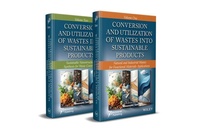
Conversion and Utilization of Wastes into Sustainable Products, 2 Volume Set
1st Edition
Will be published approx. on 26. August 2026
Book
Hardback
1360 pages
978-1-394-37133-4 (ISBN)
Description
Conversion and Utilization of Wastes into Sustainable Products, Volume 1: Natural and Industrial Wastes for Functional Materials Applications
Master the foundational strategies for transforming diverse waste streams into high-performance, carbon-based functional materials with this essential first volume, bridging the gap between innovative green fabrication and real-world industrial application.
Growing pollution of the natural environment and depletion of conventional resources have become key motives for searching for eco-friendly, renewable, and sustainable alternative energy sources. Particular attention is paid to natural and industrial waste, which can be converted into fuels and energy that meet the growing needs of humanity. Natural and biowaste materials can be used as a template to create innovative nanocomposites and green nanocatalysts from biodegradable, earth-abundant, affordable, and renewable sources to prevent the accumulation and aggregation of nanomaterials. These two volumes highlight the latest research into the role of waste to create a cleaner, more sustainable future.
This volume compiles and analyzes the most recent studies on waste conversion for value-added product production, exploring the relationships among the fabrication methods, their resulting structures and properties, and their performance in various applications. It also discusses current-state-of-the-art uses of carbon-based functional materials, which have proven their effectiveness and efficiency in many applications. This volume explores recent material-development strategies for converting diverse waste streams into carbon-based functional materials, highlighting greener, more sustainable, and environmentally benign alternatives with significant potential for both industry and academia.
Readers will find the volume:
Highlights recent material development strategies to convert various types of waste into valuable carbon-based functional materials;
Discusses current state-of-the-art uses of carbon-based functional materials that have proven their effectiveness and efficiency for applications;
Explores relationships between fabrication methods, the resulting structures and properties, and their performance in various applications.
Audience
Materials scientists, nanoscientists, nanotechnologists, chemical and biological engineers, and biochemists working in the field of nanostructure synthesis and nanoscience.
Conversion and Utilization of Wastes into Sustainable Products, Volume 2: Sustainable Nanostructures Synthesis for Waste Conversion Advance your expertise in sustainability by mastering the transformation of industrial and electronic waste into sophisticated nanostructures that power high-efficiency remediation systems and bioelectrochemical technologies.
Growing pollution of the natural environment and depletion of conventional resources have become key motives for searching for eco-friendly, renewable, and sustainable alternative energy sources. Particular attention is paid to natural and industrial waste, which can be converted into fuels and energy that meet the growing needs of humanity. Natural and biowaste materials can be used as a template to create innovative nanocomposites and green nanocatalysts from biodegradable, earth-abundant, affordable, and renewable sources to prevent the accumulation and aggregation of nanomaterials. These two volumes highlight the latest research into the role of waste to create a cleaner, more sustainable future.
This volume examines current data and methodologies for transforming waste into sophisticated nanostructures that support environmentally responsible material design. It compiles and analyzes recent studies on nanostructures derived from waste generated across multiple sectors, including agriculture, industry, healthcare, electronics, personal hygiene products, and environmental remediation. The book addresses the growing challenge of electronic waste, which poses significant environmental and economic risks, and the integration of waste-derived nanomaterials into advanced treatment systems, advanced oxidation processes, and bioelectrochemical technologies, to enhance remediation efficiency and reduce operating costs. Through case studies and real-world data, this volume serves as an essential guide to a brighter future using growing global waste.
Readers will find the volume:
Highlights recent material-development strategies to convert various types of waste into valuable nano-based functional materials;
Discusses modern sustainable waste treatment strategies that emphasize converting wastes and e-wastes into energy, fuels, and products to systematically utilize biomass resources;
Explores recent progress in waste-derived synthesis of nanostructures for anti-microbial and biomedical applications.
Audience
Materials scientists, nanoscientists, nanotechnologists, chemical and biological engineers, and biochemists working in the field of nanostructure synthesis and nanoscience.
Master the foundational strategies for transforming diverse waste streams into high-performance, carbon-based functional materials with this essential first volume, bridging the gap between innovative green fabrication and real-world industrial application.
Growing pollution of the natural environment and depletion of conventional resources have become key motives for searching for eco-friendly, renewable, and sustainable alternative energy sources. Particular attention is paid to natural and industrial waste, which can be converted into fuels and energy that meet the growing needs of humanity. Natural and biowaste materials can be used as a template to create innovative nanocomposites and green nanocatalysts from biodegradable, earth-abundant, affordable, and renewable sources to prevent the accumulation and aggregation of nanomaterials. These two volumes highlight the latest research into the role of waste to create a cleaner, more sustainable future.
This volume compiles and analyzes the most recent studies on waste conversion for value-added product production, exploring the relationships among the fabrication methods, their resulting structures and properties, and their performance in various applications. It also discusses current-state-of-the-art uses of carbon-based functional materials, which have proven their effectiveness and efficiency in many applications. This volume explores recent material-development strategies for converting diverse waste streams into carbon-based functional materials, highlighting greener, more sustainable, and environmentally benign alternatives with significant potential for both industry and academia.
Readers will find the volume:
Highlights recent material development strategies to convert various types of waste into valuable carbon-based functional materials;
Discusses current state-of-the-art uses of carbon-based functional materials that have proven their effectiveness and efficiency for applications;
Explores relationships between fabrication methods, the resulting structures and properties, and their performance in various applications.
Audience
Materials scientists, nanoscientists, nanotechnologists, chemical and biological engineers, and biochemists working in the field of nanostructure synthesis and nanoscience.
Conversion and Utilization of Wastes into Sustainable Products, Volume 2: Sustainable Nanostructures Synthesis for Waste Conversion Advance your expertise in sustainability by mastering the transformation of industrial and electronic waste into sophisticated nanostructures that power high-efficiency remediation systems and bioelectrochemical technologies.
Growing pollution of the natural environment and depletion of conventional resources have become key motives for searching for eco-friendly, renewable, and sustainable alternative energy sources. Particular attention is paid to natural and industrial waste, which can be converted into fuels and energy that meet the growing needs of humanity. Natural and biowaste materials can be used as a template to create innovative nanocomposites and green nanocatalysts from biodegradable, earth-abundant, affordable, and renewable sources to prevent the accumulation and aggregation of nanomaterials. These two volumes highlight the latest research into the role of waste to create a cleaner, more sustainable future.
This volume examines current data and methodologies for transforming waste into sophisticated nanostructures that support environmentally responsible material design. It compiles and analyzes recent studies on nanostructures derived from waste generated across multiple sectors, including agriculture, industry, healthcare, electronics, personal hygiene products, and environmental remediation. The book addresses the growing challenge of electronic waste, which poses significant environmental and economic risks, and the integration of waste-derived nanomaterials into advanced treatment systems, advanced oxidation processes, and bioelectrochemical technologies, to enhance remediation efficiency and reduce operating costs. Through case studies and real-world data, this volume serves as an essential guide to a brighter future using growing global waste.
Readers will find the volume:
Highlights recent material-development strategies to convert various types of waste into valuable nano-based functional materials;
Discusses modern sustainable waste treatment strategies that emphasize converting wastes and e-wastes into energy, fuels, and products to systematically utilize biomass resources;
Explores recent progress in waste-derived synthesis of nanostructures for anti-microbial and biomedical applications.
Audience
Materials scientists, nanoscientists, nanotechnologists, chemical and biological engineers, and biochemists working in the field of nanostructure synthesis and nanoscience.
More details
Language
English
Place of publication
United States
Publishing group
John Wiley & Sons Inc
Target group
Professional and scholarly
ISBN-13
978-1-394-37133-4 (9781394371334)
Copyright in bibliographic data and cover images is held by Nielsen Book Services Limited or by the publishers or by their respective licensors: all rights reserved.
Schweitzer Classification
Other editions
Additional editions

E-Book
05/2026
1st Edition
Wiley-Scrivener
€427.99
Available for download

E-Book
05/2026
1st Edition
Wiley-Scrivener
€427.99
Available for download
Person
Mousumi Sen, PhD, is an Assistant Professor in the Department of Chemistry at Amity University, Noida, India. She has published numerous peer-reviewed research articles in journals of high repute, as well as authored and edited books and book chapters. Her research focuses on the development of biotechnological processes for bioprocessing and conversion of waste to generate bioenergy, biofuels, and biobased chemicals.
Content
Conversion and Utilization of Wastes into Sustainable Products, Volume 1: Natural and Industrial Wastes for Functional Materials Applications
Preface xxiii
Part 1: Technologies for Converting Wastes to Energy 1
1 Technologies for Converting Food Waste to Energy: Current State and Prospects 3
A. Asha Monicka, M. Suguna Devakumari and G. Jeevarathinam
2 Biomass Materials as Potential Sources of Future Sustainability 25
A. Surendra Babu, Ashok Kumar Chakka and P. Sankarganesh
3 Carbon-Based Waste-Derived Functional Materials and Their Diverse Applications 53
Anindya S. Manna, Rajesh Nandi, Antara Roy, Sandip Das, Nilay Karchaudhuri, Subhasis Samai and Dilip K. Maiti
4 Waste to Energy (WTE) Biomass-Based Energy Systems: The Future Scope of Biomass Waste Energy Source 109
Tista Sengupta, Dripta De Joarder, Poulami Hota, Tithi Maity and Dilip K. Maiti
5 Biomass Waste as Sustainable Raw Material for Energy and Fuels 145
Sakthivel Sangeetha, Dineshkumar T., Pragalyaashree M.M. and Freeda Blessie R.
6 Techniques for Transforming Wastes Into Useful Resources 185
Dineshkumar T., Sakthivel Sangeetha, Pragalyaashree M.M. and Freeda Blessie R.
7 Biomass Waste Processing: Technological Progress and Upgrading 225
Aditi Negi and Jeyan A. Moses
Part 2: Waste Derived Carbon Based Materials for Environmental Remediation 249
8 Waste-Derived Carbon-Based Absorbents for Removal of Water-Soluble Organic Molecules 251
Komal Gupta and Poonam Rajesh Prasad
9 Biomass Wastes for Functional Material Synthesis and Their Applications 283
Sudipta Kr. Kundu, Krishna Chattopadhyay, Ankita Chakraborty, Soumyadeep Mitra and Dilip K. Maiti
10 Plant-Based Nanocomposites with Plant Waste 319
Leya B., Nivetha T.U., Freeda Blessie R. and M.M. Pragalyaashree
11 Recent Advancements in Waste-Derived Functional Materials for Wastewater Remediation 353
Susmita Das, Kajari Dutta and Pritha Saha
12 Waste-Derived Adsorbents for the Removal of Pollutants 375
Biswajit Panda
13 Photocatalysts Made from Waste to Degrade Pollutants 411
Ashna Gupta, Nida Khan, Nayeem Ahmed, Waqas A. Khan and Zeba N. Siddiqui
14 Carbon-Based Wastewater Treatment Material Made from Biomass Waste 457
Pranav Shreyaskar and Poonam Rajesh Prasad
Part 3: Waste Valorization for Functional Carbon Materials: The Latest Developments and Their Use 487
15 Nature's Source of Functional Carbon: Carbon Materials Derived from Biomass and the Latest Developments in their Use 489
M. Suguna Devakumari and A. Asha Monicka
16 Extraction of Natural Polymers from Biomass Wastes through Various Approaches for Further Applications in Food, Agriculture, and Medicine 519
Swetha Priya Gali, Srinivasan K. and R. Meenatchi
17 Feasible and Cost-Effective Approaches for the Conversion of Biomass Wastes into Value-Added Products 567
Somashree Bandyopadhaya and Debabrata Bera
18 Roots, Tubers, and Bulbs: Beyond the Usual Suspects: A Potential Resource 603
Arushi Phillips and Mousumi Sen
19 Waste Valorization for Sustainable Value-Added Products 641
Mousumi Sen
References 662
Index 669
Conversion and Utilization of Wastes into Sustainable Products, Volume 2: Sustainable Nanostructures Synthesis for Waste Conversion
Preface xxiii
Part 1: Organic Nanostructures Synthesis from Biogenic Wastes and Their Application 1
1 Development of Organic Nanoparticles from Biowastes and Their Incorporation into Edible Coatings 3
Antara Roy, Anindya S. Manna, Nilay Karchaudhuri and Dilip K. Maiti
2 Production of Nanocellulose from a Range of Agricultural Waste Biomass and Its Potential Use in the Food Industry 37
Leya B., Nivetha T. U., Freeda Blessie R. and M. M. Pragalyaashree
3 Synthesis of Nanoparticles Using Biodegradable Waste Extracts: A Green Approach and Its Applications 71
Shikha Pandhi, Arpit Shrivastava, Shweta Kulshreshtha, Alok Kumar Singh and Priya Kumari
4 Synthesis of Nanoparticles Using Different Biogenic Wastes 97
Aranya Das, Poulami Hota, Sk Ajarul and Dilip K. Maiti
5 Conversion of Biomass into Nanocellulose: Methods and Applications 145
Mitushree Ghosh, Ram Singh Kuri, Vikas Yadav, Ashvani Yadav, Rohit Kumar and Virendra Prasad
6 Fruit Waste (Peel) as Bio-Reductant to Synthesize Silver Nanoparticles with Antimicrobial, Antioxidant, and Cytotoxic Activities 179
Sounak Dutta and Dilip Kumar Maiti
7 Green Synthesis of Nanoparticles from Biowaste 217
Mousumi Sen and Himakshi Adhikari
Part 2: Waste Derived Carbon Nanostructures: A Novel Approach 243
8 Techniques for Transforming Waste Biomass into Valuable Carbon Nanomaterials: Current Advancements and Uses 245
Nivetha T.U., Leya B., Pragalyaashree M.M. and Freeda Blessie R.
9 An Overview of Nanomaterials made from Biomass Waste for Electrochemical Devices 283
Danya K., Ayisha Fidha, Leya B. and Freeda Blessie R.
10 Synthesis of Nanoparticles Using Animal and Fisheries Wastes 319
Tithi Maity and Dilip K. Maiti
11 Waste-Derived Carbon Nanostructures (WD-CNS): A Novel Approach to Waste Utilization 339
M. Suguna Devakumari and A. Asha Monicka
12 Vegetable Waste for Biosynthesis of Various Nanoparticles 361
Rajarshi Sarkar, Dripta De Joarder and Dilip K. Maiti
13 Green Synthesis of Nanoparticles from Biodegradable Waste Extracts and Their Applications 377
Uttam Kumar Das, Tanmoy Dutta, Aniruddha Mondal and Dilip Kumar Maiti
Part 3: Biowaste Mediated Inorganic Nanostructures Synthesis and Their Advanced Application 413
14 Photocatalytic Environmental Remediation Using Magnetic Mixed Metal Oxide Nanomaterials Derived from Industrial Waste 415
Krishna Chattopadhyay, Manas Mandal and Dilip K. Maiti
15 Sustainable Synthesis of Metal, Metal Oxide, and MOF Nanoparticles from Waste-Printed Circuit Boards 435
Yashmi Jain, Geetika Jain and Sandip Chakrabarti
16 Biowaste-Based Nanocatalysts for Wastewater Treatment 469
Rajesh Nandi, Sudipta Kr Kundu, Sukla Ghosh and Dilip K. Maiti
17 Green-Synthesized Biowaste-Derived Nanomaterials for Environmental Remediation 507
Anindya S. Manna, Shresthashree Swain, Nilay Karchaudhuri and Dilip K. Maiti
18 Synthesis and Characterization of Carbon Nanocomposite from Biowaste as Heavy Metal Adsorbent for Effluent Treatment 535
Anindya S. Manna, Tanmoy Ghosh, Antara Roy, Nilay Karchaudhuri and Dilip K. Maiti
19 Current Trends in Biowaste-Mediated Metal/Metal Oxide Nanoparticles for Site-Targeted Drug Delivery 565
Tista Sengupta, Palash Pandit, Krishnanka Shekhar Gayen and Dilip K. Maiti
20 Nanomaterials from Waste: Synthesis and their Advanced Applications 591
Srikanta Samanta, Anindya S. Manna, Sukla Ghosh, Nilay Karchaudhuri and Dilip K. Maiti
Acknowledgments 610
References 610
Index 617
Preface xxiii
Part 1: Technologies for Converting Wastes to Energy 1
1 Technologies for Converting Food Waste to Energy: Current State and Prospects 3
A. Asha Monicka, M. Suguna Devakumari and G. Jeevarathinam
2 Biomass Materials as Potential Sources of Future Sustainability 25
A. Surendra Babu, Ashok Kumar Chakka and P. Sankarganesh
3 Carbon-Based Waste-Derived Functional Materials and Their Diverse Applications 53
Anindya S. Manna, Rajesh Nandi, Antara Roy, Sandip Das, Nilay Karchaudhuri, Subhasis Samai and Dilip K. Maiti
4 Waste to Energy (WTE) Biomass-Based Energy Systems: The Future Scope of Biomass Waste Energy Source 109
Tista Sengupta, Dripta De Joarder, Poulami Hota, Tithi Maity and Dilip K. Maiti
5 Biomass Waste as Sustainable Raw Material for Energy and Fuels 145
Sakthivel Sangeetha, Dineshkumar T., Pragalyaashree M.M. and Freeda Blessie R.
6 Techniques for Transforming Wastes Into Useful Resources 185
Dineshkumar T., Sakthivel Sangeetha, Pragalyaashree M.M. and Freeda Blessie R.
7 Biomass Waste Processing: Technological Progress and Upgrading 225
Aditi Negi and Jeyan A. Moses
Part 2: Waste Derived Carbon Based Materials for Environmental Remediation 249
8 Waste-Derived Carbon-Based Absorbents for Removal of Water-Soluble Organic Molecules 251
Komal Gupta and Poonam Rajesh Prasad
9 Biomass Wastes for Functional Material Synthesis and Their Applications 283
Sudipta Kr. Kundu, Krishna Chattopadhyay, Ankita Chakraborty, Soumyadeep Mitra and Dilip K. Maiti
10 Plant-Based Nanocomposites with Plant Waste 319
Leya B., Nivetha T.U., Freeda Blessie R. and M.M. Pragalyaashree
11 Recent Advancements in Waste-Derived Functional Materials for Wastewater Remediation 353
Susmita Das, Kajari Dutta and Pritha Saha
12 Waste-Derived Adsorbents for the Removal of Pollutants 375
Biswajit Panda
13 Photocatalysts Made from Waste to Degrade Pollutants 411
Ashna Gupta, Nida Khan, Nayeem Ahmed, Waqas A. Khan and Zeba N. Siddiqui
14 Carbon-Based Wastewater Treatment Material Made from Biomass Waste 457
Pranav Shreyaskar and Poonam Rajesh Prasad
Part 3: Waste Valorization for Functional Carbon Materials: The Latest Developments and Their Use 487
15 Nature's Source of Functional Carbon: Carbon Materials Derived from Biomass and the Latest Developments in their Use 489
M. Suguna Devakumari and A. Asha Monicka
16 Extraction of Natural Polymers from Biomass Wastes through Various Approaches for Further Applications in Food, Agriculture, and Medicine 519
Swetha Priya Gali, Srinivasan K. and R. Meenatchi
17 Feasible and Cost-Effective Approaches for the Conversion of Biomass Wastes into Value-Added Products 567
Somashree Bandyopadhaya and Debabrata Bera
18 Roots, Tubers, and Bulbs: Beyond the Usual Suspects: A Potential Resource 603
Arushi Phillips and Mousumi Sen
19 Waste Valorization for Sustainable Value-Added Products 641
Mousumi Sen
References 662
Index 669
Conversion and Utilization of Wastes into Sustainable Products, Volume 2: Sustainable Nanostructures Synthesis for Waste Conversion
Preface xxiii
Part 1: Organic Nanostructures Synthesis from Biogenic Wastes and Their Application 1
1 Development of Organic Nanoparticles from Biowastes and Their Incorporation into Edible Coatings 3
Antara Roy, Anindya S. Manna, Nilay Karchaudhuri and Dilip K. Maiti
2 Production of Nanocellulose from a Range of Agricultural Waste Biomass and Its Potential Use in the Food Industry 37
Leya B., Nivetha T. U., Freeda Blessie R. and M. M. Pragalyaashree
3 Synthesis of Nanoparticles Using Biodegradable Waste Extracts: A Green Approach and Its Applications 71
Shikha Pandhi, Arpit Shrivastava, Shweta Kulshreshtha, Alok Kumar Singh and Priya Kumari
4 Synthesis of Nanoparticles Using Different Biogenic Wastes 97
Aranya Das, Poulami Hota, Sk Ajarul and Dilip K. Maiti
5 Conversion of Biomass into Nanocellulose: Methods and Applications 145
Mitushree Ghosh, Ram Singh Kuri, Vikas Yadav, Ashvani Yadav, Rohit Kumar and Virendra Prasad
6 Fruit Waste (Peel) as Bio-Reductant to Synthesize Silver Nanoparticles with Antimicrobial, Antioxidant, and Cytotoxic Activities 179
Sounak Dutta and Dilip Kumar Maiti
7 Green Synthesis of Nanoparticles from Biowaste 217
Mousumi Sen and Himakshi Adhikari
Part 2: Waste Derived Carbon Nanostructures: A Novel Approach 243
8 Techniques for Transforming Waste Biomass into Valuable Carbon Nanomaterials: Current Advancements and Uses 245
Nivetha T.U., Leya B., Pragalyaashree M.M. and Freeda Blessie R.
9 An Overview of Nanomaterials made from Biomass Waste for Electrochemical Devices 283
Danya K., Ayisha Fidha, Leya B. and Freeda Blessie R.
10 Synthesis of Nanoparticles Using Animal and Fisheries Wastes 319
Tithi Maity and Dilip K. Maiti
11 Waste-Derived Carbon Nanostructures (WD-CNS): A Novel Approach to Waste Utilization 339
M. Suguna Devakumari and A. Asha Monicka
12 Vegetable Waste for Biosynthesis of Various Nanoparticles 361
Rajarshi Sarkar, Dripta De Joarder and Dilip K. Maiti
13 Green Synthesis of Nanoparticles from Biodegradable Waste Extracts and Their Applications 377
Uttam Kumar Das, Tanmoy Dutta, Aniruddha Mondal and Dilip Kumar Maiti
Part 3: Biowaste Mediated Inorganic Nanostructures Synthesis and Their Advanced Application 413
14 Photocatalytic Environmental Remediation Using Magnetic Mixed Metal Oxide Nanomaterials Derived from Industrial Waste 415
Krishna Chattopadhyay, Manas Mandal and Dilip K. Maiti
15 Sustainable Synthesis of Metal, Metal Oxide, and MOF Nanoparticles from Waste-Printed Circuit Boards 435
Yashmi Jain, Geetika Jain and Sandip Chakrabarti
16 Biowaste-Based Nanocatalysts for Wastewater Treatment 469
Rajesh Nandi, Sudipta Kr Kundu, Sukla Ghosh and Dilip K. Maiti
17 Green-Synthesized Biowaste-Derived Nanomaterials for Environmental Remediation 507
Anindya S. Manna, Shresthashree Swain, Nilay Karchaudhuri and Dilip K. Maiti
18 Synthesis and Characterization of Carbon Nanocomposite from Biowaste as Heavy Metal Adsorbent for Effluent Treatment 535
Anindya S. Manna, Tanmoy Ghosh, Antara Roy, Nilay Karchaudhuri and Dilip K. Maiti
19 Current Trends in Biowaste-Mediated Metal/Metal Oxide Nanoparticles for Site-Targeted Drug Delivery 565
Tista Sengupta, Palash Pandit, Krishnanka Shekhar Gayen and Dilip K. Maiti
20 Nanomaterials from Waste: Synthesis and their Advanced Applications 591
Srikanta Samanta, Anindya S. Manna, Sukla Ghosh, Nilay Karchaudhuri and Dilip K. Maiti
Acknowledgments 610
References 610
Index 617