

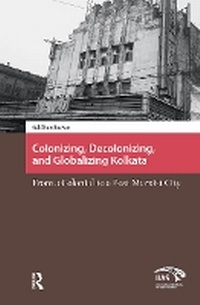
Colonizing, Decolonizing, and Globalizing Kolkata
From a Colonial to a Post-Marxist City
1st Edition
Will be published approx. on 1. December 2025
Book
Paperback/Softback
290 pages
978-1-041-17723-4 (ISBN)
Description
Colonizing, Decolonizing, and Globalizing Kolkata offers an extended analysis of the architecture and urban planning of Kolkata from the earliest days of colonialism through independence and on into the twenty-first century, all set in the larger context of Indian cities' architecture and urban planning. What Siddhartha Sen shows is the transformation of a colonial city into a Marxist one - and ongoing attempts to further transform Kolkata into a global city. Richly illustrated, the book carefully situates architecture, design, and urban planning within Kolkata's political economy and social milieu.
More details
Series
Language
English
Place of publication
London
United Kingdom
Publishing group
Taylor & Francis Ltd
Target group
Professional and scholarly
Academic
Dimensions
Height: 234 mm
Width: 156 mm
Weight
540 gr
ISBN-13
978-1-041-17723-4 (9781041177234)
Copyright in bibliographic data and cover images is held by Nielsen Book Services Limited or by the publishers or by their respective licensors: all rights reserved.
Schweitzer Classification
Other editions
Additional editions
Siddhartha Sen
Colonizing, Decolonizing, and Globalizing Kolkata
From a Colonial to a Post-Marxist City
E-Book
10/2025
Routledge
€60.49
Available for download
Siddhartha Sen
Colonizing, Decolonizing, and Globalizing Kolkata
From a Colonial to a Post-Marxist City
E-Book
10/2025
Routledge
€60.49
Available for download
Siddhartha Sen
Colonizing, Decolonizing, and Globalizing Kolkata
From a Colonial to a Post-Marxist City
Book
06/2017
Amsterdam University Press
€166.50
Shipment within 15-20 days
Person
Siddhartha Sen is the Interim Assistant Dean of the School of Architecture and Planning and the Director of Graduate Program in City and Regional Planning at Morgan State University in Baltimore, USA. He is a recognized scholar on Indian urbanization and the nonprofit sector in India.
Content
Acknowledgement, Dedication, List of Illustrations, Chapter 1: Overture Introduction Scope of the Book Analytical Framework The Concept of the State in India Socialism, Communism and Marxism Data Sources Organisation of the Book Chapter 2: Colonising Kolkata: From a City of Huts to a City of Palaces Founding of Kolkata Kolkata's Early Urbanism Spatial Restructuring of Kolkata and the Emergence of Social and Political Control as the Dominant Planning Paradigm City of Palaces Kolkata's Transformation to City of Palaces Emergence of Architecture as a Symbol of Power Creating a Healthier and Beautiful City for the British: Emergence of a New Paradigm for Planning Early Municipal Administration in Kolkata 87 The Rise of the British and Demise of other European Settlements around Kolkata 88 Haora's Urbanism 93 Chapter 3: Building a Neo-Classical, Beautiful, and Clean City: The Rise and Decline of British Imperial Urbanism Consolidation of British Power: Making Kolkata a Neo-Classical City The Neo-Classical Architectural Influence on the Bengali Elite Orientalist Discourse on Architecture and Kolkata The Absence of Indo-Saracenic Style in Kolkata Victoria Memorial Hall: Neo-Classical Revival in Kolkata Modern Indian Architecture Movement Limited Modernism in Kolkata Transforming Kolkata into a Cleaner and Healthier City for the British Shifting the Discourse to Bustees as Source of Diseas The Calcutta Improvement Trust and E. P. Richards's Plan for Kolkata Sir Patrick Geddes's Plan for Burra Bazaar Racial Segregation Municipal Administration in Kolkata and Expansion of its Boundaries Haora's Transformation to Coolie Town Chapter 4: Decolonising Kolkata: From an American Planning Paradigm to a Marxist City Chandigarh: A Defining Moment in India's Search for Post-Colonial Urbanism Revivalist Architecture and the Search for Post-Colonial Architectural Identity Lack of a Search for Post-Colonial Architecture in Kolkata In Search of a Post-Colonial Planning: An Overview The Initial Acts of Decolonisation in Kolkata Material Legacies of Colonial Planning and Kolkata's Post-Colonial Urban Problems Political Economy of Post-Colonial Kolkata and its Urban Problems Administrative Structure and Continuation of Colonial Legacy in the Immediate Post-Colonial Period Western Discourse on Kolkata and Advent of Western Planning Calcutta Metropolitan Planning Organisation (CMPO) and the Export of American Planning Paradigm to Kolkata The Fear of Communism and Formation of KMDA Infiltration of Grassroots Space by CPI-M and Its Allies New Towns around Kolkata Haora's Post-Colonial Urbanism Chapter 5: Globalising Kolkata: A Late Bloomer Emergence of New Market-Driven Architectural Forms in India Why Kolkata Became a Late Bloomer Making Kolkata Attractive to Capital: Operation Sunshine and Proposal to Remove Rickshaw Pullers Singur and Nandigram: The Changing Priorities of the Left Front Kolkata's Population Growth, Territorial Changes, and Administrative Structure Liberalisation and the Changing Role of KMDA and KMC Kolkata's Private Townships and Gated Communities: Emergence of Real Estate-Driven Development Kolkata's Office Buildings for the Service and Financial Sectors, SEZs, and IT Parks and Complexes Shopping Malls Emergence of New Planning Paradigms: State-Regulated Townships and Private Townships Rajarahat Haora's Global Urbanism Kolkata West International City Chapter 6: Concluding Remarks, Glossary of Terms, List of Abbreviations, Bibliography, Index.