

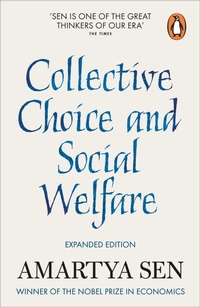
Collective Choice and Social Welfare
Expanded Edition
Published on 19. January 2017
Book
Paperback/Softback
640 pages
978-0-14-198250-2 (ISBN)
Description
Nobel Prize winner Amartya Sen's first great book, now reissued in a fully revised and expanded second edition
'Can the values which individual members of society attach to different alternatives be aggregated into values for society as a whole, in a way that is both fair and theoretically sound? Is the majority principle a workable rule for making decisions? How should income inequality be measured? When and how can we compare the distribution of welfare in different societies?'
These questions, from the citation by the Swedish Academy of Sciences when Amartya Sen was awarded the Nobel Memorial Prize in Economics, refer to his work in Collective Choice and Social Welfare, the most important of all his early books. Originally published in 1970, this classic work in welfare economics has been recognized for its ground-breaking role in integrating economics and ethics, and for its influence in opening up new areas of research in social choice, including aggregative assessment. It has also had a large influence on international organizations, including the United Nations, particularly in its work on human development. In its original version, the book showed that the 'impossibility theorems' in social choice theory-led by the pioneering work of Kenneth Arrow-need not be seen as destructive of the possibility of reasoned and democratic social choice.
Sen's ideas about social choice, welfare economics, inequality, poverty and human rights have continued to evolve since the book's first appearance. This expanded edition, which begins by reproducing the 1970 edition in its entirety, goes on to present eleven new chapters of new arguments and results. As in the original version, the new chapters alternate between non-mathematical chapters completely accessible to all, and those which present mathematical arguments and proofs. The reader who prefers to shun mathematics can follow all the non-mathematical chapters on their own, to receive a full, informal understanding. There is also a substantial new introduction which gives a superb overview of the whole subject of social choice.
'Can the values which individual members of society attach to different alternatives be aggregated into values for society as a whole, in a way that is both fair and theoretically sound? Is the majority principle a workable rule for making decisions? How should income inequality be measured? When and how can we compare the distribution of welfare in different societies?'
These questions, from the citation by the Swedish Academy of Sciences when Amartya Sen was awarded the Nobel Memorial Prize in Economics, refer to his work in Collective Choice and Social Welfare, the most important of all his early books. Originally published in 1970, this classic work in welfare economics has been recognized for its ground-breaking role in integrating economics and ethics, and for its influence in opening up new areas of research in social choice, including aggregative assessment. It has also had a large influence on international organizations, including the United Nations, particularly in its work on human development. In its original version, the book showed that the 'impossibility theorems' in social choice theory-led by the pioneering work of Kenneth Arrow-need not be seen as destructive of the possibility of reasoned and democratic social choice.
Sen's ideas about social choice, welfare economics, inequality, poverty and human rights have continued to evolve since the book's first appearance. This expanded edition, which begins by reproducing the 1970 edition in its entirety, goes on to present eleven new chapters of new arguments and results. As in the original version, the new chapters alternate between non-mathematical chapters completely accessible to all, and those which present mathematical arguments and proofs. The reader who prefers to shun mathematics can follow all the non-mathematical chapters on their own, to receive a full, informal understanding. There is also a substantial new introduction which gives a superb overview of the whole subject of social choice.
Reviews / Votes
With his masterly prose, ease of erudition and ironic humour, Sen is one of the few great world intellectuals on whom we may rely to make sense out of our existential confusion -- Nadime Gordimer Amartya Sen occupies a unique position among modern economists. He is an outstanding economic theorist, a world authority on social choice and welfare economics. He is a leading figure in development economics, carrying out path-breaking work on appraising the effectiveness of investment in poor countries -- Anthony B. Atkinson * New York Review of Books * The first edition in 1970 of this fine book was of immense importance and at the core of Amartya Sen's Nobel Prize. His contributions since, to our conceptions of rights, liberty, justice, identity, poverty, inequality and development, have been of still greater significance to our understanding of the fundamental challenges we face as individuals and societies in thinking about who we are and how we should act. The substantive and profound additions in this edition delve even deeper into the arguments of the original and relate them to the central questions and issues of his subsequent research and writing. Sen is one of the great minds of both the twentieth and twenty-first centuries. We owe him a huge debt -- Nicholas SternMore details
Edition
2nd expanded & updated Edition
Language
English
Place of publication
London
United Kingdom
Target group
College/higher education
Product notice
Paperback (UK-B)
Dimensions
Height: 195 mm
Width: 128 mm
Thickness: 35 mm
Weight
440 gr
ISBN-13
978-0-14-198250-2 (9780141982502)
Copyright in bibliographic data and cover images is held by Nielsen Book Services Limited or by the publishers or by their respective licensors: all rights reserved.
Schweitzer Classification
Other editions
Additional editions
E-Book
01/2017
1st Edition
Penguin Books Ltd
€10.99
Available for download
Person
Amartya Sen is one of the world's leading public intellectuals. He is Professor of Economics and Professor of Philosophy at Harvard. He was Master of Trinity College, Cambridge, from 1998 to 2004, and won the Nobel Prize for Economics in 1998. His many celebrated books include Development as Freedom (1999), The Argumentative Indian (2005) and The Idea of Justice (2010). They have been translated into more than 30 languages. In 2020 he was awarded the Peace Prize of the German Book Trade.