

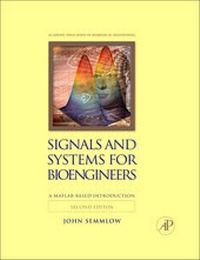
Signals and Systems for Bioengineers
A MATLAB-Based Introduction
2nd Edition
Published on 2. November 2011
Book
Hardback
604 pages
978-0-12-384982-3 (ISBN)
Description
Signals and Systems for Bioengineers, Second Edition, is the only textbook that relates important electrical engineering concepts to biomedical engineering and biological studies. It explains in detail the basic engineering concepts that underlie biomedical systems, medical devices, biocontrol, and biosignal analysis. It is perfect for the one-semester bioengineering course usually offered in conjunction with a laboratory on signals and measurements which presents the fundamentals of systems and signal analysis. The target course occupies a pivotal position in the bioengineering curriculum and will play a critical role in the future development of bioengineering students.
This book provides increased coverage of time-domain signal analysis as well as biomeasurement, using examples in ultrasound and electrophysiology. It also presents new applications in biocontrol, with examples from physiological systems modeling such as the respiratory system. It contains double the number of Matlab and non-Matlab exercises to provide ample practice solving problems - by hand and with computational tools. More biomedical figures are found throughout the book. For instructors using this text in their course, an accompanying website (www.elsevierdirect.com, in Semmlow page) includes support materials such as MATLAB data and functions needed to solve the problems, a few helpful routines, and all of the MATLAB examples.
Intended readers include biomedical engineering students, practicing medical technicians, mechanical engineers, and electrical engineers.
This book provides increased coverage of time-domain signal analysis as well as biomeasurement, using examples in ultrasound and electrophysiology. It also presents new applications in biocontrol, with examples from physiological systems modeling such as the respiratory system. It contains double the number of Matlab and non-Matlab exercises to provide ample practice solving problems - by hand and with computational tools. More biomedical figures are found throughout the book. For instructors using this text in their course, an accompanying website (www.elsevierdirect.com, in Semmlow page) includes support materials such as MATLAB data and functions needed to solve the problems, a few helpful routines, and all of the MATLAB examples.
Intended readers include biomedical engineering students, practicing medical technicians, mechanical engineers, and electrical engineers.
More details
Series
Edition
2nd edition
Language
English
Place of publication
San Diego
United States
Publishing group
Elsevier Science Publishing Co Inc
Target group
College/higher education
Professional and scholarly
Biomedical engineering students; practicing medical technicians; mechanical engineers; electrical engineers
Dimensions
Height: 235 mm
Width: 191 mm
Weight
1170 gr
ISBN-13
978-0-12-384982-3 (9780123849823)
Copyright in bibliographic data and cover images is held by Nielsen Book Services Limited or by the publishers or by their respective licensors: all rights reserved.
Schweitzer Classification
Other editions
New editions
Book
10/2024
4th Edition
Academic Press
€131.50
Shipment within 15-20 days
Book
12/2017
3rd Edition
Academic Press
€117.60
Article exhausted; check for reprint
Additional editions

Book
09/2011
2nd Edition
Academic Press
€55.70
The article will not be published
E-Book
08/2011
2nd Edition
Academic Press
€52.95
Available for download
Previous edition
Book
04/2005
Academic Press
€97.80
Article exhausted; check for reprint
Person
John Semmlow was a professor in the Department of Biomedical Engineering of Rutgers University and in the Department of Surgery of Robert Wood Johnson Medical School UMDNJ for 32 years. Over that period he published over 100 review journal articles and has been appointed a Fellow of the IEEE, the AIMBE, and the BMES. He retired in June of 2010, but still remains active in research, particularly cardiovascular diagnosis and human motor control. He is actively pursuing a 'second career' as an artist, designing and building computer controlled kinetic art: sculptures that move in interesting and intriguing ways.
Content
Introduction to Biological Systems and BiosignalsBasic Signal ProcessingFrequency TransformationsAnalog Analysis in Sinusoidal Steady StateAnalysis of Analog Models and ProcessesTransfer and Frequency Characteristics of Analog ModelsRelationships in Analog ModelsAnalysis of Transient Conditions ~ The Laplace TransformSystems Modeling and BehaviorAppendix A. DerivationsAppendix B. Laplace Transforms and Properties of the Fourier TransformAppendix C. Trigonometric and Other FormulaeAppendix D. Conversion Factors: UnitsAppendix E. Complex ArithmeticAppendix F. LF356 SpecificationsAppendix G. Determinants and Cramer's Rule