

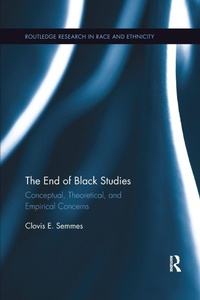
The End of Black Studies
Conceptual, Theoretical, and Empirical Concerns
1st Edition
Published on 10. December 2019
Book
Paperback/Softback
148 pages
978-0-367-87674-6 (ISBN)
Description
Following a history of racial oppression and segregation, Black Americans were able to move in greater numbers into previously all- or predominantly-White colleges and universities. However, they encountered normative structures that excluded or distorted the Black experience and denied Black perspectives. As a result, Black studies grew up reconstructing the humanity of a historically oppressed, devalued, and exploited group. Knowledge production in Black studies offers distinct insights into the strength and resiliency of the human spirit and poses exemplary models for enlightened social change.
This book examines the foundational parameters and historical mission of the field of African-American Studies, which emerged from a broad-based Black intellectual tradition defined by the metaproblem of cultural hegemony. Semmes seeks to broaden our thinking about the scope and content of Black studies. The End of Black Studies identifies Afrocentric or Black-centered approaches to knowledge production that are distinctly different from, yet inclusive of, a historiographical emphasis on ancient Egypt, but alternative to the claim of a singular African worldview.
This book will appeal to students and scholars interested in the field of Black Studies, including African American studies, Africana studies, Africology, and Pan-African studies. It will be a source of critical discussion for graduate seminars examining theory building and/or knowledge production (research and writing) in Black studies.
The End of Black Studies has received the 2017 Outstanding Book Award from the National Council for Black Studies. Read the Introduction for free online using our eBook widget >>
This book examines the foundational parameters and historical mission of the field of African-American Studies, which emerged from a broad-based Black intellectual tradition defined by the metaproblem of cultural hegemony. Semmes seeks to broaden our thinking about the scope and content of Black studies. The End of Black Studies identifies Afrocentric or Black-centered approaches to knowledge production that are distinctly different from, yet inclusive of, a historiographical emphasis on ancient Egypt, but alternative to the claim of a singular African worldview.
This book will appeal to students and scholars interested in the field of Black Studies, including African American studies, Africana studies, Africology, and Pan-African studies. It will be a source of critical discussion for graduate seminars examining theory building and/or knowledge production (research and writing) in Black studies.
The End of Black Studies has received the 2017 Outstanding Book Award from the National Council for Black Studies. Read the Introduction for free online using our eBook widget >>
More details
Series
Language
English
Place of publication
London
United Kingdom
Publishing group
Taylor & Francis Ltd
Target group
College/higher education
Postgraduate and Undergraduate
Dimensions
Height: 229 mm
Width: 152 mm
Thickness: 8 mm
Weight
228 gr
ISBN-13
978-0-367-87674-6 (9780367876746)
Copyright in bibliographic data and cover images is held by Nielsen Book Services Limited or by the publishers or by their respective licensors: all rights reserved.
Schweitzer Classification
Other editions
Additional editions
Book
09/2016
1st Edition
Routledge
€232.50
Shipment within 10-20 days
E-Book
08/2016
1st Edition
Routledge
€59.49
Available for download
E-Book
08/2016
Routledge
€59.49
Available for download
Person
Clovis E. Semmes is Professor Emeritus of African-American Studies at Eastern Michigan University, USA and Professor of Black Studies and Sociology at University of Missouri-Kansas City, USA.
Content
Introduction: The End of Black Studies: Conceptual, Theoretical, and Empirical Concerns
1. The End of Black Studies and the Closing of Oppositional Discourse
2. Minority Status and the Problem of Legitimacy
3. Religion and the Challenge of Afrocentric Thought
4. Existential Sociology or the Sociology of Group Survival , Elevation, and Liberation
5. Foundations in Africana Studies: Revisiting Negro Digest/Black World, 1961-1976.
6. The Normative Assault on Black Studies
7. Entrepreneur of Health: Dick Gregory, Black Consciousness, and the Human Potential Movement
8. E. Franklin Frazier's Theory of the Black Family: Vindication and Sociological Insight
Conclusions: Toward the End of Black Studies
1. The End of Black Studies and the Closing of Oppositional Discourse
2. Minority Status and the Problem of Legitimacy
3. Religion and the Challenge of Afrocentric Thought
4. Existential Sociology or the Sociology of Group Survival , Elevation, and Liberation
5. Foundations in Africana Studies: Revisiting Negro Digest/Black World, 1961-1976.
6. The Normative Assault on Black Studies
7. Entrepreneur of Health: Dick Gregory, Black Consciousness, and the Human Potential Movement
8. E. Franklin Frazier's Theory of the Black Family: Vindication and Sociological Insight
Conclusions: Toward the End of Black Studies