

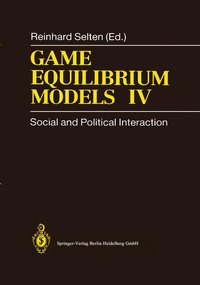
Game Equilibrium Models IV
Social and Political Interaction
Published on 15. December 2010
Book
Paperback/Softback
XI, 363 pages
978-3-642-08111-8 (ISBN)
Description
The four volumes of
Game Equilibrium Models
present applications of non-cooperative game theory. Problems of strategic interaction arising in biology, economics, political science and the social sciences in general are treated in 42 papers on a wide variety of subjects. Internationally known authors with backgrounds in various disciplines have contributed original research. The reader finds innovative modelling combined with advanced methods of analysis. The four volumes are the outcome of a research year at the Center for Interdisciplinary Studies of the University of Bielefeld. The close interaction of an international interdisciplinary group of researchers has produced an unusual collection of remarkable results of great interest for everybody who wants to be informed on the scope, potential, and future direction of work in applied game theory. Volume IV
Social and Political Interaction
contains game equilibrium models focussing on social and political interaction within communities or states or between states, i.e. national and international social and political interaction. Specific aspects of those interactions are modelled as non-cooperative games and their equilibria are analysed.
More details
Edition
Softcover reprint of the original 1st ed. 1991
Language
English
Place of publication
Berlin
Germany
Publishing group
Springer Berlin
Target group
Professional and scholarly
Research
Illustrations
XI, 363 p.
Dimensions
Height: 244 mm
Width: 170 mm
Thickness: 21 mm
Weight
655 gr
ISBN-13
978-3-642-08111-8 (9783642081118)
DOI
10.1007/978-3-662-07369-8
Schweitzer Classification
Other editions
Additional editions
E-Book
04/2013
Springer
€96.29
Available for download
Book
08/1991
Springer
€106.99
Shipment within 7-9 days
Persons
Content
to the Series "Game Equilibrium Models".- to Volume IV: "Social and Political Interaction".- Majority Voting in the Condorcet Paradox as a Problem of Equilibrium Selection.- Does Concession Always Prevent Pressure?.- The Distributiun of Foreign Language Skills as a Game Equilibrium.- Resisting the Draft. A Perfect Equilibrium Approach.- Altruism in Social Dilemmas - Failure to Catch It in a Parameter.- The Strategy of Challenges: Two Beheading Games in Mediaeval Literature.- Balance of Power in a Parlor Game.- Modelling Alliance Formation: A Noncooperative Approach.- The (Stability of the) Western Defense Alliance - A Game Theoretic Analysis -.- Implications of the Defense Efficiency Hypothesis for the Choice of Military Force Structures. Part I: Games with and without Complete Information about the Antagonist's Intentions.- Implicatidns of the Defense Efficiency Hypothesis for the Choice of Military Force Structures. Part II: A Sequential Game Including the Possibility of Restructuring Forces.- Inspector Leadership with Incomplete Information.