

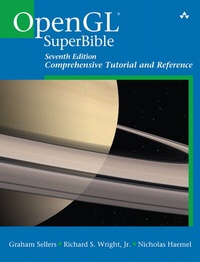
OpenGL Superbible: Comprehensive Tutorial and Reference
Description
OpenGL® SuperBible, Seventh Edition, is the definitive programmer's guide, tutorial, and reference for OpenGL 4.5, the world's leading 3D API for real-time computer graphics. The best introduction for any developer, it clearly explains OpenGL's newest APIs; key extensions; shaders; and essential, related concepts. You'll find up-to-date, hands-on guidance for all facets of modern OpenGL development-both desktop and mobile.
The authors explain what OpenGL does, how it connects to the graphics pipeline, and how it manages huge datasets to deliver compelling experiences. Step by step, they present increasingly sophisticated techniques, illuminating key concepts with worked examples. They introduce OpenGL on several popular platforms, and offer up-to-date best practices and performance advice.
This revised and updated edition introduces many new OpenGL 4.5 features, including important ARB and KHR extensions that are now part of the standard. It thoroughly covers the latest Approaching Zero Driver Overhead (AZDO) performance features, and demonstrates key enhancements with new example applications.
Coverage includes
- A practical introduction to real-time 3D graphics, including foundational math
- Core techniques for rendering, transformations, and texturing
- Shaders and the OpenGL Shading Language (GLSL) in depth
- Vertex processing, drawing commands, primitives, fragments, and framebuffers
- Compute shaders: harnessing graphics cards for more than graphics
- Pipeline monitoring and control
- Managing, loading, and arbitrating access to data
- Building larger applications and deploying them across platforms
- Advanced rendering: light simulation, artistic and non-photorealistic effects, and more
- Reducing CPU overhead and analyzing GPU behavior
- Supercharging performance with persistent maps, bindless textures, and fine-grained synchronization
- Preventing and debugging errors
- New applications: texture compression, text drawing, font rendering with distance fields, high-quality texture filtering, and OpenMP
Bonus material and sample code are available at openglsuperbible.com.
More details
Other editions
Additional editions
Previous edition
Persons
Graham Sellers, AMD Software Architect and Engineering Fellow, represents AMD at the OpenGL ARB. He has contributed to the core OpenGL specification and extensions, and holds several graphics and image processing patents.
Richard S. Wright, Jr., Senior Software Engineer for Software Bisque, developed multimedia astronomy and planetarium software using OpenGL. For more than a decade he taught OpenGL programming in Full Sail University's game development degree program.
Nicholas Haemel, Director of Camera Software at NVIDIA, has represented NVIDIA at the Khronos Group standards body and authored many OpenGL extensions.
Content
- Part I: Foundations
- Chapter 1: Introduction
- Chapter 2: Our First OpenGL Program
- Chapter 3: Following the Pipeline
- Chapter 4: Math for 3D Graphics
- Chapter 5: Data
- Chapter 6: Shaders and Programs
- Part II: In Depth
- Chapter 7: Vertex Processing and Drawing Commands
- Chapter 8: Primitive Processing
- Chapter 9: Fragment Processing and the Framebuffer
- Chapter 10: Compute Shaders
- Chapter 11: Advanced Data Management
- Chapter 12: Controlling and Monitoring the PipelinePart III: In Practice
- Chapter 13: Rendering Techniques
- Chapter 14: High-Performance OpenGL
- Chapter 15: Debugging and Stability
- Appendix A: Further Reading
- Appendix B: The SBM File Format
- Appendix C: The SuperBible Tools Glossary
- Index