

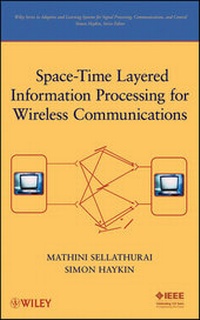
Space-Time Layered Information Processing for Wireless Communications
Published on 29. April 2009
Book
Hardback
204 pages
978-0-471-20921-8 (ISBN)
Description
Discover cutting-edge research in wireless communications
This book presents cutting-edge research in wireless communications, particularly in the fast-growing subject of multiple-input multiple-output (MIMO) wireless communication systems. It begins with an introduction, which includes historical notes and a review of turbo-information processing and MIMO wireless communications, and goes on to cover:
* MIMO channel capacity
* BLAST architectures
* Space-time turbo codes and turbo decoding principles
* Turbo-BLAST
* Turbo-MIMO systems
The material is complemented with abundant illustrations and computer experiments that are designed to help readers reinforce their understanding of the underlying subject matter. Space-Time Layered Information Processing for Wireless Communications is an ideal resource for researchers in academia and industry and an excellent textbook for related courses at the graduate level.
More details
Product info
gebunden
Series
Edition
1. Auflage
Language
English
Place of publication
United States
Publishing group
John Wiley & Sons Inc
Target group
College/higher education
Professional and scholarly
Product notice
sewn/stitched
Cloth over boards
Dimensions
Height: 236 mm
Width: 155 mm
Thickness: 18 mm
Weight
499 gr
ISBN-13
978-0-471-20921-8 (9780471209218)
Schweitzer Classification
Other editions
Additional editions
Mathini Sellathurai | Simon Haykin
Space-Time Layered Information Processing for Wireless Communications
E-Book
08/2009
Wiley-IEEE Press
€116.99
Available for download
Persons
Mathini Sellathurai, PhD, is Reader at the Institute of Electronics, Communications and Information Technology, Queen's University Belfast, United Kingdom. SIMON HAYKIN, PhD, is Distinguished University Professor at McMaster University, Ontario.
Content
List of Tables.
List of Figures.
1 Introduction.
1.1 Brief Historical Notes.
1.2 Turbo-Information Processing.
1.3 MIMO Wireless Communications.
1.4 Organization of the Book.
2 MIMO Channel Capacity.
2.1 Introduction.
2.2 Multiple-Input, Multiple-Output Antenna Systems.
2.3 Channel Capacity.
2.4 MIMO Capacity for a Channel Known at the Receiver.
2.5 Channel Known at the Transmitter.
2.6 Summary and Discussion.
3 BLAST Architectures.
3.1 BLAST Architecture.
3.2 Diagonal BLAST.
3.3 Vertical BLAST (V-BLAST).
3.4 Stratified Diagonal BLAST (SD-BLAST).
3.5 Simulations on BLAST for the Matrix Rayleigh Channel.
3.6 Multirate Layered Space-Time Architecture.
3.7 Outage Capacity.
3.8 Simulation Results.
3.9 Summary and Discussion.
4 Space-Time Turbo Codes and Turbo Decoding Principles.
4.1 Introduction.
4.2 Turbo Codes.
4.3 Interleaver Designs for Turbo Codes.
4.4 Space-Time Turbo Codes.
4.4.1 Example Space-Time Turbo Codes.
4.5 Multirate Layered Space-Time (MLST) Turbo Codes.
4.6 Summary and Discussion.
5 Turbo-BLAST.
5.1 Introduction.
5.2 T-BLAST: Basic Transmitter Considerations.
5.3 Optimal Detection.
5.4 Distance Spectrum of RLST Codes.
5.5 Iterative Decoding: Basic Considerations.
5.6 Design and Performance of SISO Detectors.
5.7 Simulations on T-BLAST.
5.8 Summary and Discussion.
5.9 Appendix.
6 Turbo-MIMO Systems.
6.1 Bit-Interleaved Coded Modulation.
6.2 Turbo-MIMO Theory and ST-BICM.
6.3 ST-BICM.
6.4 Iterative Detection and Decoding.
6.5 Suboptimal MIMO Detection.
6.6 Simulation for Narrowband Turbo-MIMO.
6.7 Wideband Turbo-MIMO (ST-BICM).
6.8 Summary.
Appendix 6.1.
Appendix 6.2.
Bibliography.
Index.