

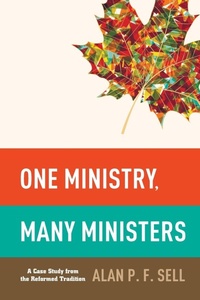
One Ministry, Many Ministers
A Case Study from the Reformed Tradition
Published on 24. October 2014
Book
Paperback/Softback
158 pages
978-1-62564-892-1 (ISBN)
Description
The heart of this book is the claim that the one church catholic comprises all who, on the ground of Christ's saving work, are called and gathered by God the Holy Spirit into a fellowship whose only Head is Christ himself; and that all thus called are granted the high privilege of sharing in a variety of ways in the one ministry of Christ. This is the vision of the Reformed churches past and present. Alan Sell argues that far from being a parochial enquiry, the nature of the ministry and the work and education of all the ministers are issues as relevant to the life and practice of particular local churches as they are to ecumenical discussions between the several Christian world communions.
More details
Language
English
Place of publication
Eugene
United States
Product notice
Paperback (trade)
Unsewn / adhesive bound
Dimensions
Height: 229 mm
Width: 152 mm
Thickness: 9 mm
Weight
242 gr
ISBN-13
978-1-62564-892-1 (9781625648921)
Copyright in bibliographic data and cover images is held by Nielsen Book Services Limited or by the publishers or by their respective licensors: all rights reserved.
Schweitzer Classification
Other editions
Additional editions
E-Book
10/2014
Pickwick Publications
€20.49
Available for download
Person
Alan P. F. Sell, a philosopher-theologian and ecumenist, is employed in research, writing, and lecturing in the United Kingdom and abroad. He has held academic posts in England, Canada, and Wales, and ecclesiastical posts in England and Geneva. He is the author or editor of over thirty books, of which the most recent are Convinced, Concise and Christian: The Thought of Huw Parri Owen (Pickwick, 2012) and Christ and Controversy: The Person of Christ in Nonconformist Thought and Ecclesial Experience (Pickwick, 2012). He has edited and contributed to The Great Ejectment of 1662: Its Antecedents, Aftermath, and Ecumenical Significance (Pickwick, 2012).