

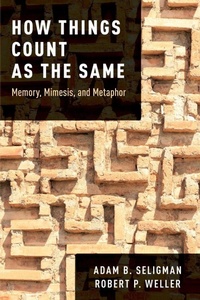
How Things Count as the Same
Memory, Mimesis, and Metaphor
Published on 16. October 2020
Book
Paperback/Softback
242 pages
978-0-19-754625-3 (ISBN)
Description
In their third book together, Adam B. Seligman and Robert P. Weller address a seemingly simple question: What counts as the same? Given the myriad differences that divide one individual from another, why do we recognize anyone as somehow sharing a common fate with us? For that matter, how do we live in harmony with groups who may not share the sense of a common fate? Such relationships lie at the heart of the problems of pluralism that increasingly face so much of the world today.
Note that "counting as" the same differs from "being" the same. Counting as the same is not an empirical question about how much or how little one person shares with another or one event shares with a previous event. Nothing is actually the same. That is why, as humans, we construct sameness all the time. In the process, of course, we also construct difference.
Creating sameness and difference leaves us with the perennial problem of how to live with difference instead of seeing it as a threat. How Things Count as the Same suggests that there are multiple ways in which we can count things as the same, and that each of them fosters different kinds of group dynamics and different sets of benefits and risks for the creation of plural societies. While there might be many ways to understand how people construct sameness, three stand out as especially important and form the focus of the book's analysis: Memory, Mimesis, and Metaphor.
Note that "counting as" the same differs from "being" the same. Counting as the same is not an empirical question about how much or how little one person shares with another or one event shares with a previous event. Nothing is actually the same. That is why, as humans, we construct sameness all the time. In the process, of course, we also construct difference.
Creating sameness and difference leaves us with the perennial problem of how to live with difference instead of seeing it as a threat. How Things Count as the Same suggests that there are multiple ways in which we can count things as the same, and that each of them fosters different kinds of group dynamics and different sets of benefits and risks for the creation of plural societies. While there might be many ways to understand how people construct sameness, three stand out as especially important and form the focus of the book's analysis: Memory, Mimesis, and Metaphor.
Reviews / Votes
...absorbing book... * Janet M. Powers, Religion * How Things Count as the Same is a profound and wide-ranging meditation on sameness and difference, and on the hugely consequential variations in the ways in which sameness is recognised, asserted, or established: sameness turns out to be a remarkably complex and varied social phenomenon. The latest fruit of a long-standing collaboration between an anthropologist and a religious studies scholar, this book combines imaginative and original theoretical reflection with discussion of wide-ranging historical and ethnographic cases, and throws new light on perennial questions of social existence as well as the most pressing political issues of our time. * James Laidlaw, William Wyse Professor of Social Anthropology, University of Cambridge * Seligman and Weller use the seemingly simple question 'What counts as the same?' to take us into a deep examination of the interrelationship between culture and the human mind. Their analysis of memory, mimesis, and metaphor as distinctly different and essential processes is most convincing. The breadth of examples points to the remarkable erudition of these two authors. A tour de force that is an important read for scholars across the humanities, social and cognitive sciences. * Christopher Winship, Diker-Tishman Professor of Sociology, Harvard University *More details
Language
English
Place of publication
New York
United States
Target group
Professional and scholarly
Dimensions
Height: 234 mm
Width: 156 mm
Thickness: 14 mm
Weight
415 gr
ISBN-13
978-0-19-754625-3 (9780197546253)
Copyright in bibliographic data and cover images is held by Nielsen Book Services Limited or by the publishers or by their respective licensors: all rights reserved.
Schweitzer Classification
Other editions
Additional editions
E-Book
11/2018
OUP eBook
€20.99
Available for download
E-Book
11/2018
OUP eBook
€20.99
Available for download
Persons
Adam B. Seligman is Professor of Religion at Boston University. He is the co-author of Rethinking Pluralism (2012) and Ritual and Its Consequences (2008).
Robert P. Weller is Professor of Anthropology at Boston University. He is the co-author of Rethinking Pluralism (2012) and Ritual and Its Consequences (2008).
Robert P. Weller is Professor of Anthropology at Boston University. He is the co-author of Rethinking Pluralism (2012) and Ritual and Its Consequences (2008).
Content
List of Figures
Acknowledgements
Introduction
1. What Counts as the Same?
2. How Memory Counts as the Same
3. Mimesis, or "Society Is Imitation"
4. Metaphor
5. Framing Gifts
6. Memory, Metaphor, and a Double Bind
7. Sign, Ground, and Interpretant
8. Conclusion
References Cited
Index
Acknowledgements
Introduction
1. What Counts as the Same?
2. How Memory Counts as the Same
3. Mimesis, or "Society Is Imitation"
4. Metaphor
5. Framing Gifts
6. Memory, Metaphor, and a Double Bind
7. Sign, Ground, and Interpretant
8. Conclusion
References Cited
Index