

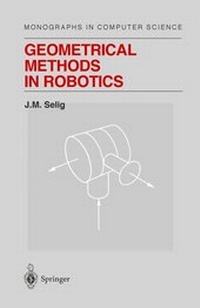
Geometrical Methods in Robotics
Published on 1. July 1996
Book
Hardback
XIV, 269 pages
978-0-387-94728-0 (ISBN)
Description
The main aim of this book is to introduce Lie groups and allied algebraic and geometric concepts to a robotics audience. These topics seem to be quite fashionable at the moment, but most of the robotics books that touch on these topics tend to treat Lie groups as little more than a fancy notation. I hope to show the power and elegance of these methods as they apply to problems in robotics. A subsidiary aim of the book is to reintroduce some old ideas by describing them in modem notation, particularly Study's Quadric-a description of the group of rigid motions in three dimensions as an algebraic variety (well, actually an open subset in an algebraic variety)-as well as some of the less well known aspects of Ball's theory of screws. In the first four chapters, a careful exposition of the theory of Lie groups and their Lie algebras is given. Except for the simplest examples, all examples used to illustrate these ideas are taken from robotics. So, unlike most standard texts on Lie groups, emphasis is placed on a group that is not semi-simple-the group of proper Euclidean motions in three dimensions. In particular, the continuous subgroups of this group are found, and the elements of its Lie algebra are identified with the surfaces of the lower Reuleaux pairs. These surfaces were first identified by Reuleaux in the latter half of the 19th century.
More details
Other editions
New editions
J.M. Selig
Geometric Fundamentals of Robotics
Book
11/2004
2nd Edition
Springer
€106.99
Shipment within 5-7 days
Additional editions
Content
1 Introduction.- 2 Lie Groups.- 3 Subgroups.- 4 Lie Algebra.- 5 A Little Kinematics.- 6 Line Geometry.- 7 Representation Theory.- 8 Screw Systems.- 9 Clifford Algebra.- 10 The Study Quadric.- 11 Statics.- 12 Dynamics.- 13 Differential Geometry.