

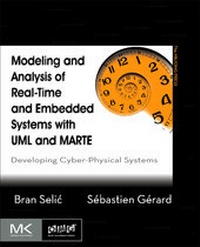
Modeling and Analysis of Real-Time and Embedded Systems with UML and MARTE
Developing Cyber-Physical Systems
Published on 26. November 2013
Book
Paperback/Softback
314 pages
978-0-12-416619-6 (ISBN)
Description
Modeling and Analysis of Real-Time and Embedded Systems with UML and MARTE explains how to apply the complex MARTE standard in practical situations. This approachable reference provides a handy user guide, illustrating with numerous examples how you can use MARTE to design and develop real-time and embedded systems and software.
Expert co-authors Bran Selic and Sebastien Gerard lead the team that drafted and maintain the standard and give you the tools you need apply MARTE to overcome the limitations of cyber-physical systems. The functional sophistication required of modern cyber-physical systems has reached a point where traditional code-centric development methods are proving less and less capable of delivering a reliable product in a timely manner. In Modeling and Analysis of Real-Time and Embedded Systems with UML and MARTE, you will learn how to take advantage of modern model-based engineering methods and corresponding industry standards to overcome these limitations. These methods take full advantage of computer-supported automation allowing timely detection of design flaws to reduce engineering risk, leading thereby to better overall product quality and greater productivity.
Expert co-authors Bran Selic and Sebastien Gerard lead the team that drafted and maintain the standard and give you the tools you need apply MARTE to overcome the limitations of cyber-physical systems. The functional sophistication required of modern cyber-physical systems has reached a point where traditional code-centric development methods are proving less and less capable of delivering a reliable product in a timely manner. In Modeling and Analysis of Real-Time and Embedded Systems with UML and MARTE, you will learn how to take advantage of modern model-based engineering methods and corresponding industry standards to overcome these limitations. These methods take full advantage of computer-supported automation allowing timely detection of design flaws to reduce engineering risk, leading thereby to better overall product quality and greater productivity.
More details
Series
Language
English
Place of publication
San Francisco
United States
Publishing group
Elsevier Science & Technology
Target group
Professional and scholarly
Real-time and embedded software developers, systems engineers; students in real-time and embedded software development courses.
Illustrations
Approx. 100 illustrations
Dimensions
Height: 235 mm
Width: 191 mm
Weight
560 gr
ISBN-13
978-0-12-416619-6 (9780124166196)
Copyright in bibliographic data and cover images is held by Nielsen Book Services Limited or by the publishers or by their respective licensors: all rights reserved.
Schweitzer Classification
Other editions
Additional editions
Bran Selic | Sebastien Gerard
Modeling and Analysis of Real-Time and Embedded Systems with UML and MARTE
Developing Cyber-Physical Systems
E-Book
10/2013
Morgan Kaufmann
€45.95
Available for download
Persons
Sebastien Gerard is a CEA LIST senior researcher in software engineering and computer science. He graduated in 1995 from ENSMA (the Superior School of Mechanics and Aeronautics in Poitiers, France) as a mechanical and aeronautics engineer, after which he obtained a doctorate in computer science in 2000. He is currently leading a research team of about 20 engineers at CEA LIST (an arm of the French Atomic Energy Agency, http://www-list.cea.fr/gb/index_gb.htm) within the LISE (Laboratory for Model-based Engineering of real-time and embedded (RT/E) systems). The principal objective of this research of this team is to achieve "correct-by-construction? design of RT/E systems from requirements to implementation?. Through his involvement in a numerous national and international research projects, Dr. Sebastien Gerard has worked with many industrial partners such as Peugeot Citroen, Airbus, ST Microelectronics, EADS, gaining extensive experience and insight into industrial problems and requirements. Dr. Sebastien Gerard is also deeply involved in various standardization activities, and is currently co-chairing both the UML 2 and MARTE (the UML extension for RT/E) standardization task forces. He is also core member of the European network of excellence, ArtistDesign (http://www.artist-embedded.org), where he is a prime on issues related to modeling and standardization. In addition, Dr. Sebastien Gerard is a member of the editorial board of the SoSyM journal, co-founder of the summer school on model-based development for DRES (http://www.mdd4dres.info) and a frequent member of program committees of major technical and scientific conferences (MODELS, ECRTS, ISORC, etc.).
Content
Preface
I: Introduction
1: An Overview of MARTE
II: Foundations
2: An Introduction to the UML Profile Mechanism
3: Specifying System Qualities (Non-Functional Properties)
4: Modeling Time and Resources
III: Modeling Real-Time Software Systems with MARTE
5: Basic Application Modeling
6: Platform Modeling
7: Specifying Deployment
8: Combining MARTE and SysML
9: Modeling Component Based Systems
10: Combining MARTE and SysML
IV: System analysis using MARTE
11: Foundations of System Analysis
12: Performance Analysis
13: Schedulability Analysis
V: Extending MARTE
14: Extending MARTE
APPENDICES
A. The Value Specification Language
B. The MARTE NFP Library Reference
C. MARTE tools
I: Introduction
1: An Overview of MARTE
II: Foundations
2: An Introduction to the UML Profile Mechanism
3: Specifying System Qualities (Non-Functional Properties)
4: Modeling Time and Resources
III: Modeling Real-Time Software Systems with MARTE
5: Basic Application Modeling
6: Platform Modeling
7: Specifying Deployment
8: Combining MARTE and SysML
9: Modeling Component Based Systems
10: Combining MARTE and SysML
IV: System analysis using MARTE
11: Foundations of System Analysis
12: Performance Analysis
13: Schedulability Analysis
V: Extending MARTE
14: Extending MARTE
APPENDICES
A. The Value Specification Language
B. The MARTE NFP Library Reference
C. MARTE tools