

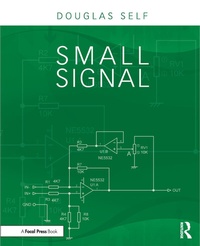
Small Signal Audio Design
2nd Edition
Published on 22. August 2014
Book
Paperback/Softback
752 pages
978-0-415-70973-6 (ISBN)
Description
Learn to use inexpensive and readily available parts to obtain state-of-the-art performance in all the vital parameters of noise, distortion, crosstalk and so on. With ample coverage of preamplifiers and mixers and a new chapter on headphone amplifiers, this practical handbook provides an extensive repertoire of circuits that can be put together to make almost any type of audio system.
A resource packed full of valuable information, with virtually every page revealing nuggets of specialized knowledge not found elsewhere. Essential points of theory that bear on practical performance are lucidly and thoroughly explained, with the mathematics kept to a relative minimum. Douglas' background in design for manufacture ensures he keeps a wary eye on the cost of things. Includes a chapter on power-supplies, full of practical ways to keep both the ripple and the cost down, showing how to power everything.
Douglas wears his learning lightly, and this book features the engaging prose style familiar to readers of his other books. You will learn why mercury cables are not a good idea, the pitfalls of plating gold on copper, and what quotes from Star Trek have to do with PCB design.
Learn how to:
make amplifiers with apparently impossibly low noise
design discrete circuitry that can handle enormous signals with vanishingly low distortion
use humble low-gain transistors to make an amplifier with an input impedance of more than 50 Megohms
transform the performance of low-cost-opamps, how to make filters with very low noise and distortion
make incredibly accurate volume controls
make a huge variety of audio equalisers
make magnetic cartridge preamplifiers that have noise so low it is limited by basic physics
sum, switch, clip, compress, and route audio signals
The second edition is expanded throughout (with added information on new ADCs and DACs, microcontrollers, more coverage of discrete op amp design, and many other topics), and includes a completely new chapter on headphone amplifiers.
A resource packed full of valuable information, with virtually every page revealing nuggets of specialized knowledge not found elsewhere. Essential points of theory that bear on practical performance are lucidly and thoroughly explained, with the mathematics kept to a relative minimum. Douglas' background in design for manufacture ensures he keeps a wary eye on the cost of things. Includes a chapter on power-supplies, full of practical ways to keep both the ripple and the cost down, showing how to power everything.
Douglas wears his learning lightly, and this book features the engaging prose style familiar to readers of his other books. You will learn why mercury cables are not a good idea, the pitfalls of plating gold on copper, and what quotes from Star Trek have to do with PCB design.
Learn how to:
make amplifiers with apparently impossibly low noise
design discrete circuitry that can handle enormous signals with vanishingly low distortion
use humble low-gain transistors to make an amplifier with an input impedance of more than 50 Megohms
transform the performance of low-cost-opamps, how to make filters with very low noise and distortion
make incredibly accurate volume controls
make a huge variety of audio equalisers
make magnetic cartridge preamplifiers that have noise so low it is limited by basic physics
sum, switch, clip, compress, and route audio signals
The second edition is expanded throughout (with added information on new ADCs and DACs, microcontrollers, more coverage of discrete op amp design, and many other topics), and includes a completely new chapter on headphone amplifiers.
Reviews / Votes
"It's tempting to look at analog circuitry through a DSP lens and wonder "Why?" However, analog still has charm, is homebrew- able with a low entry-fee, and certain aspects remain unavoidable. Importantly, this book goes a long way to bury much of the bad and misinformation on the internet, while affording a fighting chance of creating something that will work well. (...) Bravo, Douglas Self."- Steve Dove in the Journal of the Audio Engineering Society "Self provides solid, well-explained technical information throughout the book, all gained from years of experience and a thorough understanding of the entire topic, and all verified by measurement and practical applications in the field. His book exudes skilful engineering on every page, and I found it a very refreshing, enjoyable, and inspirational read. Self writes in his preface that he dares to hope that he has moved analogue audio design a bit further forward. He certainly has for me, and if you have the slightest interest in audio circuit design this book has to be considered an essential reference. Very highly recommended." - Hugh Robjohns, Sound on Sound Magazine
More details
Edition
2nd edition
Language
English
Place of publication
London
United Kingdom
Publishing group
Taylor & Francis Ltd
Target group
Professional and scholarly
Professional Reference
Illustrations
99 s/w Tabellen, 520 s/w Zeichnungen
Dimensions
Height: 235 mm
Width: 191 mm
Weight
1382 gr
ISBN-13
978-0-415-70973-6 (9780415709736)
Copyright in bibliographic data and cover images is held by Nielsen Book Services Limited or by the publishers or by their respective licensors: all rights reserved.
Schweitzer Classification
Other editions
New editions
Douglas Self
Small Signal Audio Design
Book
04/2020
3rd Edition
CRC Press
€92.84
Article exhausted; check for reprint
Additional editions
Douglas Self
Small Signal Audio Design
Book
08/2014
2nd Edition
Routledge
€237.70
Article exhausted; check for reprint
Previous edition
Douglas Self
Small Signal Audio Design
Book
01/2010
Focal Press
€60.65
Article exhausted; check for reprint
Person
Douglas Self studied engineering at Cambridge University, then psychoacoustics at Sussex University. He has spent many years working at the top level of design in both the professional audio and hifi industries, and has taken out a number of patents in the field of audio technology. He currently acts as a consultant engineer in the field of audio design.
Content
Introduction 1. Basics 2. Components 3. Designing with Discrete Transistors 4. Opamps and Their Properties 5. Filters 6. Preamplifier Architectures 7. Moving-Magnet Disc Inputs 8. Moving-Coil Disc Inputs 9. Volume-Control and Balance 10. Tone Controls and Equalisers 11. A Complete Preamplifier 12. Mixer Architectures 13. Microphone Input Amplifiers 14. Line Inputs 15. Line Outputs 16. Signal Switching 17. Mixer Subsystems 18. Level Indication and Metering 19. Level Control and Special Circuits 20. Power Supplies 21. Interfacing with the Digital Domain 22. Headphone Amplifiers